

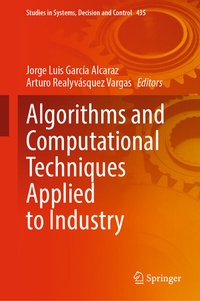
Algorithms and Computational Techniques Applied to Industry
Description

This book presents algorithms and computational applications integrated in software that are being applied in the industry. It shows how companies using these tools are more competitive and efficient in the use and resources management. The book is organized in three sections, depending on the supply chain stage: procurement, including contact with costumers and product design; Production process, including relationship with suppliers and among departments; and Distribution, including logistics and transportation.
More details
Other editions
Additional editions
Persons
Jorge Luis García-Alcaraz is a full-time researcher in the Department of Industrial Engineering at the Autonomous University of Ciudad Juarez (México). He received an M.Sc. in Industrial Engineering from the Colima Technology Institute (Mexico), a Ph.D. in Industrial Engineering from Ciudad Juarez Technology Institute (Mexico), a Ph.D. in Engineering, Product Design, and Industrial Process from University of La Rioja (Spain), a Ph.D. in Sciences and Industrial Technology from Public University of Navarre (Spain), and a PostDoc in Manufacturing Process from University of La Rioja (Spain). His main research areas are related to multicriteria decision-making applied to manufacturing, production process modelling, statistical inference, environmental engineering, and software application to industry. He is founding member of the Mexican Society of Operation Research and active member in the Mexican Academy of Industrial Engineering. Currently, Dr. García-Alcaraz is a nationalresearcher recognized by the National Council of Science & Technology of Mexico (CONACYT) as Level III, and he is working with research groups from Colombia, Spain, Dominican Republic, Germany, Netherland, Chile, Brazil, and Peru.
Arturo Realyvásquez Vargas is a full-time professor from the Department of Industrial Engineering at Tecnológico Nacional de Mexico/Instituto Tecnológico de Tijuana in Mexico. He received a master's degree in Industrial Engineering, a Ph.D. in Engineering Sciences from the Autonomous University of Ciudad Juarez in Mexico, and a Ph.D. in Innovation in Product Engineering and Industrial Process at the University of La Rioja (Spain). Specifically, his main research areas are related to optimization of industrial processes, lean manufacturing, and ergonomics. Also, he is an active member of the Society of Ergonomists of Mexico Civil Association (Sociedad de Ergonomistas de México, SEMAC) and the Network of Optimization of Industrial Processes (Red de Optimización de Procesos Industriales, ROPRIN). Currently, Dr. Realyvásquez is a national researcher recognized by the National Council of Science & Technology of Mexico (CONACYT) as Candidate.
