

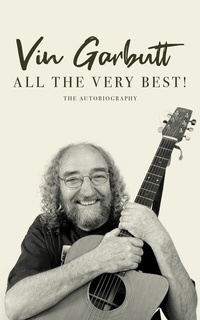
All The Very Best!
Description

Folk singer, guitarist, songwriter, storyteller and patter merchant, Vin Garbutt was the funniest and the most serious man on the folk scene for almost half a century.
Vin was adored by his fans - and, for a period, shunned by elements of the folk music industry. In this compelling autobiography, he reveals the man behind the hilarious stage patter and the songs that often moved his audience to tears.
The book takes us on an unforgettable journey from the streets of post-war South Bank in Middlesbrough to the steps of Sydney Opera House, and just about everywhere in between.
A globe-trotting trailblazer who sold out venues across the world, Vin was also a man of courage and conviction.
In All the Very Best! he explains why he refused to be silenced despite a backlash against views that were out of line with the mainstream - and the price he paid.
Written in the four years before his death in 2017, this is Vin's touching, funny and life-affirming story in his own words.
More details
Content
in your streets I did laugh and play
In Coral, Connaught, Pearl Street too;
Your walls protected me
from the wind and the rain.'
Vin Garbutt, Slaggy Island Farewell
I was born in a bucket. Like most Middlesbrough houses just after the war, our toilet in Coral Street, South Bank, was outside at the end of the yard. Mam popped out to the loo and went into labour while she was down there. Dad heard the screams and rushed out to fetch the midwife. That was his story, anyway - I've always had a sneaking feeling he was just getting out of the way. When I dropped with a thud into the white enamel pail, Mam thought that was the end of me.
'Me baby! I've killed me baby!' she wailed.
I was unscathed, to the best of my knowledge, although some people would say I've never been quite the full shilling. It was November 20th 1947. None of the neighbours heard the commotion at number eighteen because they were all glued to the radio, listening to Princess Elizabeth's wedding to Prince Philip at Westminster Abbey. While the rest of the nation followed the future Queen's progress up the aisle, there I was being dumped unceremoniously into a bucket.
Why Mam chose the name Vincent for me I'm not sure, but just before my baptism at St Peter's Roman Catholic Church in South Bank, my Nanna Kelly said it was only half a name.
'You can't have Vincent without Paul,' she said.
So I was named Vincent Paul Garbutt, after St Vincent de Paul, the French priest who went into the Church because he thought it would provide a cosy living and ended up dedicating his life to serving the poor. Whether Dad had any say in it I was never told, although being a Methodist he was fairly easy-going and probably just let the in-laws get on with it. Dad's siblings all had traditional English names like Alfred, Ena, Florence, Constance, Beatrice and William. But the names in Mam's family reflected their Irish Catholic ancestry - Michael, John, James, Bernard, who was known as Uncle Barney, and Mary.
When I was old enough I went to York Street Nursery School, which was in the shadow of the works and a fine place for delicate little lungs to be drawing their early breaths. Every afternoon we all had a nap on bunk beds - at least us kids did anyway, I've no idea what the staff got up to. One afternoon I lay in the bed needing a wee and didn't dare tell anyone. To this day I can remember the warm, wet feeling of relief running down my legs when I gave in and let go.
Despite my unpromising start in life I enjoyed a wonderful childhood. We had a loving family and although we weren't well off, we never wanted for anything. I was the third of four children - there's Michael, Mary, me, and then a nine-year gap to the youngest, our Ellen. Mam didn't go out to work, she had enough on her plate looking after us kids and the house. Dad was an electrician's mate at the sprawling Dorman Long steelworks that was partly responsible for the plumes of smoke that trailed across the South Bank sky, day and night. He was one of life's gentlemen. My earliest memory is of him waking up at the crack of dawn and traipsing sleepily down the stairs before his six-till-two shift, with me following after him. Then he'd give me a slice of what he called 'cakey'. It was just ordinary thick, white bread cut from a proper loaf and smeared with real butter, but it was delicious. The memory is so evocative that even now when I eat bread and butter it brings warm memories flooding back of standing on the doorstep with a slice of cakey in my hand, seeing Dad off to work.
As I was growing from a toddler into a little boy, King George VI was becoming older and more infirm. I don't recall hearing about his death in the winter of 1952, but I do remember Queen Elizabeth II's Coronation the following summer, when I was only four years old. Every street in South Bank held a party, with red, white and blue bunting draped between the houses and trestle tables in the middle of the roads. There was a festive atmosphere and we all wore fancy dress. I put on my little cowboy suit and felt like Roy Rogers, the King of the Cowboys. We all won first prize because it was such a special occasion and all the grown-ups were feeling generous.
I remember the day our Ellen was born. It was February 19th 1956 and there was thick snow on the ground. I was playing out on a sledge Dad had made for us, when my cousin Tessie Dales came walking towards me down the street.
'You've got a new baby sister,' she said.
I heard the words but didn't take in what they meant, so I stayed out playing in the snow until it was time for bed.
South Bank was dead friendly in those days. It was nicknamed Slaggy Island because of the slag tips all around, big piles of waste from the iron industry. The nickname gave me the title for one of my early songs. Nobody had cars, of course, and there was hardly any traffic of any kind. At least once a week a man came round with a horse and cart and we rode around the streets for the fare of a few small coins. My Uncle Ray owned a greengrocer's shop and I loved tagging along with him to the fruit and veg warehouse in his lorry and helping carry a few carrots and beetroots into the shop while he lugged the big sacks of spuds in.
Each street had its own bonfire on Guy Fawkes Night. Ours was on Middlesbrough Road, where a bombed-out house made the perfect site. Our gang went 'bommie raiding' to pinch the materials other gangs had gathered together ready for the big night. We weren't the best fighters, so we made up for it by being sneaky and making sure we weren't caught. We'd return triumphantly carrying a few stolen branches or sticks of old furniture, whistling Colonel Bogey's March together like a little ragtag army on their way to war.
We sometimes had family holidays in Scarborough or Blackpool but my warmest memories are the times we stayed at Dad's mate's wooden chalet at Stanghow, out on the Moor Road. Although it was only a few miles away it was the countryside to us South Bank kids and even now when I smell cows and rabbits, I'm back there again in my mind. I would never have believed that I would one day buy a house nearby and live in it for over thirty years. It must have been a tight squeeze inside that chalet because as well as the six of us, Uncle Ray and Aunty Mary came with their kids. I can still picture us climbing out of the windows in the evenings when we were supposed to be in bed. In the daytime we roamed free-range on the moors collecting frogs or bilberries, with no adults to tell us what we should and shouldn't do.
There was huge excitement every summer when Crows Fair came to the common at the end of our road. One year I fell in love with the girl on the hot dog stand. Life could have been so different if she'd accepted my advances and let me run away with her. I could have had my ear pierced and spun people round on the waltzers for the rest of my days. Instead I had to wait until I was nine years old to leave South Bank behind.
First we moved just a few hundred yards away to Spencer Road in Teesville East and then later to Ambrose Road, a mile away on the Normanby side of Eston. I'm not saying we're parochial on Teesside but there was a big stone road sign at Crossbeck Convent that marked the border between Normanby and Eston. The different distances marked on the front and back suggested it was half a mile from one side of the stone to the other!
Mike and Mary went to St Peter's Infants and Juniors, but just before I started school St James' Juniors opened on the corner of the Trunk Road and Normanby Road. I went there until I sat the eleven-plus - and failed it miserably. Nearly everyone else passed. The headteacher, Sister Mary Dennis, whacked them through it. She was a tiny nun who slid along the corridors in little shuffling steps but could move surprisingly quickly when she wanted to. In fact she was faster than a real penguin. She had a lovely smile, although you wouldn't know that if you went to my school. It was only years later when she came to our house visiting Mam that I saw it for the first time. We kids hated her because she whacked us and I still have a scar on my forefinger as a memento of one beating she gave me with a stick. But Mam loved her and said she had a heart of gold.
Even Sister Mary Dennis's whackings couldn't help me, though. I was always a little bit slow with my thought processes anyway, but any hope I had of passing disappeared on the exam day when the ink from my old-fashioned fountain pen leaked. I still remember one of the few questions I got right - 'What is the shaven patch on the top of a monk's head called?' I knew that one and enthusiastically scribbled down 'tonsure'. No sooner was the word on the paper than I was staring in horror at the blue ink flooding indiscriminately over that and all my other answers, right and wrong alike. I gave in and accepted my fate after that.
Failing the eleven-plus wasn't such a disaster. All my life I'd walked everywhere I needed to be - to school, church and the doctors -...
