

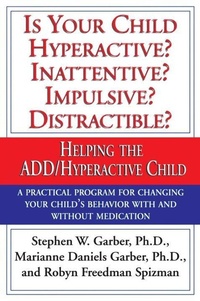
Is Your Child Hyperactive? Inattentive? Impulsive? Distractable?
Helping the ADD/Hyperactive Child
Published on 14. April 2010
256 pages
978-0-307-87443-6 (ISBN)
Description

Evan, five years old, hardly stands, much less sits, still for more than a few moments. Jessie is eight -- she's adorable...she never finishes anything on time...she's a dreamer. Cal is fifteen -- he is so impulsive that his parents worry he'll try drugs on a whim.
What do these kids have in common? Do they remind you of your own children?
The most talked-about childhood syndrome of the eighties and nineties is ADHD (attention deficit hyperactivity disorder). This developmental disorder disrupts a child's life and often results in low self-esteem, poor grades and even social and emotional problems. These problems usually are not outgrown -- without help. But does your child have ADHD?
ADHD is characterized by the following groups of behaviors:
Inattention
-- making careless mistakes
-- difficulty sustaining attention
-- problems with listening
-- failure to finish schoolwork or chores
-- difficulties organizing
-- trouble sustaining mental efforts
-- losing things
-- being easily distracted
-- forgetfulness
Hyperactivity/Impulsivity
-- fidgeting/squirming
-- trouble staying seated
-- inappropriate running/climbing
-- difficulty playing quietly
-- being on the go/driven
-- talking excessively
-- blurting out answers
-- difficulty awaiting turn
-- often interrupting
All children display many of these behaviors at some point. But-according to the Diagnostic and Statistical Manual of the American Psychiatric Association, Fourth Edition, for a child to be diagnosed with ADHD, six or more of these symptoms of inattention and/or hyperactivity/impulsivity must have persisted for at least six months.
Is Your Child Hyperactive? Inattentive? Impulsive? Distractible? offers an invaluable step-by-step program already used by thousands of parents to help you change these behaviors at home. Don't just watch it happen; help your child help himself.
What do these kids have in common? Do they remind you of your own children?
The most talked-about childhood syndrome of the eighties and nineties is ADHD (attention deficit hyperactivity disorder). This developmental disorder disrupts a child's life and often results in low self-esteem, poor grades and even social and emotional problems. These problems usually are not outgrown -- without help. But does your child have ADHD?
ADHD is characterized by the following groups of behaviors:
Inattention
-- making careless mistakes
-- difficulty sustaining attention
-- problems with listening
-- failure to finish schoolwork or chores
-- difficulties organizing
-- trouble sustaining mental efforts
-- losing things
-- being easily distracted
-- forgetfulness
Hyperactivity/Impulsivity
-- fidgeting/squirming
-- trouble staying seated
-- inappropriate running/climbing
-- difficulty playing quietly
-- being on the go/driven
-- talking excessively
-- blurting out answers
-- difficulty awaiting turn
-- often interrupting
All children display many of these behaviors at some point. But-according to the Diagnostic and Statistical Manual of the American Psychiatric Association, Fourth Edition, for a child to be diagnosed with ADHD, six or more of these symptoms of inattention and/or hyperactivity/impulsivity must have persisted for at least six months.
Is Your Child Hyperactive? Inattentive? Impulsive? Distractible? offers an invaluable step-by-step program already used by thousands of parents to help you change these behaviors at home. Don't just watch it happen; help your child help himself.
More details
Other editions
Additional editions
Stephen W. Garber | Marianne Daniels Garber | Robyn Freedman Spizman
Is Your Child Hyperactive? Inattentive? Impulsive? Distractable?
Helping the ADD/Hyperactive Child
Book
01/1995
Random House USA Inc
€17.50
Article exhausted; check different version
Content
- Intro
- Other Books by this Author
- Title Page
- Dedication
- Contents
- List of Figures
- Preface
- Chapter 1 - My Child Has What?
- Chapter 2 - How to Tell If Your Child Really Has ADHD
- Chapter 3 - Motivating Your Child
- Chapter 4 - How to Explain ADHD to Your Child
- Chapter 5 - Gaining Acceptance and Support from Siblings, Other Relatives, Friends, Teachers and Others
- Chapter 6 - If, When and How to Use Medication
- Chapter 7 - Controlling Activity Level
- Chapter 8 - Calmness Training
- Chapter 9 - Impulse Control Training
- Chapter 10 - Beating Distractions
- Chapter 11 - Stretching Attention Span
- Chapter 12 - Following Rules
- Chapter 13 - Controlling Aggression
- Chapter 14 - Building Self-Esteem
- Chapter 15 - The ADHD Child at Play
- Chapter 16 - The ADHD Child at School
- Chapter 17 - The ADHD Child Grown Up
- Appendix A
- Appendix B
- Suggested Readings
- References
- About the Authors
- Copyright
