

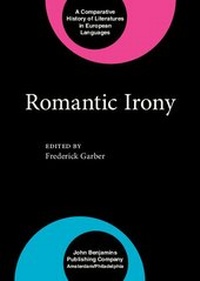
Romantic Irony
1st Edition
Published on 1. January 1988
395 pages
978-90-272-8616-1 (ISBN)
Description

This is the first collaborative international reading of irony as a major phenomenon in Romantic art and thought. The volume identifies key predecessor moments that excited Romantic authors and the emergence of a distinctly Romantic theory and practice of irony spreading to all literary genres. Not only the influential pioneer German, British, and French varieties, but also manifestations in northern, eastern, and southern parts of Europe as well as in North America, are considered. A set of concluding "syntheses" treat the shaping power of Romantic irony in narrative modes, music, the fine arts, and theater - innovations that will deeply influence Modernism. Thus the cross-cultural and interdisciplinary approach elaborated in the twenty chapters of Romantic Irony, as lead volume in the five-volume Romanticism series, establishes a significant new range for comparative literature studies in dealing with a complex literary movement.
SPECIAL OFFER: 30% discount for a complete set order (5 vols.).The Romanticism series in the Comparative History of Literatures in European Languages is the result of a remarkable international collaboration. The editorial team coordinated the efforts of over 100 experts from more than two dozen countries to produce five independently conceived, yet interrelated volumes that show not only how Romanticism developed and spread in its principal European homelands and throughout the New World, but also the ways in which the affected literatures in reaction to Romanticism have redefined themselves on into Modernism. A glance at the index of each volume quickly reveals the extraordinary richness of the series' total contents. Romantic Irony sets the broader experimental parameters of comparison by concentrating on the myriad expressions of "irony" as one of the major impulses in the Romantic philosophical and artistic revolution, and by combining cross-cultural and interdisciplinary studies with special attention also to literatures in less widely diffused language streams. Romantic Drama traces creative innovations that deeply altered the understanding of genre at large, fed popular imagination through vehicles like the opera, and laid the foundations for a modernist theater of the absurd. Romantic Poetry demonstrates deep patterns and a sharing of crucial themes of the revolutionary age which underlie the lyrical expression that flourished in so many languages and environments. Nonfictional Romantic Prose assists us in coping with the vast array of writings from the personal and intimate sphere to modes of public discourse, including Romanticism's own self-commentary in theoretical statements on the arts, society, life, the sciences, and more. Nor are the discursive dimensions of imaginative literature neglected in the closing volume, Romantic Prose Fiction, where the basic Romantic themes and story types (the romance, novel, novella, short story, and other narrative forms) are considered throughout Europe and the New World. This enormous realm is seen not just in terms of Romantic theorizing, but in the light of the impact of Romantic ideas and narration on later generations. As an aid to readers, the introduction to Romantic Prose Fiction explains the relationships among the volumes in the series and carries a listing of their tables of contents in an appendix. No other series exists comparable to these volumes which treat the entirety of Romanticism as a cultural happening across the whole breadth of the "Old" and "New" Worlds and thus render a complex picture of European spiritual strivings in the late eighteenth and the nineteenth centuries, a heritage still very close to our age.
SPECIAL OFFER: 30% discount for a complete set order (5 vols.).The Romanticism series in the Comparative History of Literatures in European Languages is the result of a remarkable international collaboration. The editorial team coordinated the efforts of over 100 experts from more than two dozen countries to produce five independently conceived, yet interrelated volumes that show not only how Romanticism developed and spread in its principal European homelands and throughout the New World, but also the ways in which the affected literatures in reaction to Romanticism have redefined themselves on into Modernism. A glance at the index of each volume quickly reveals the extraordinary richness of the series' total contents. Romantic Irony sets the broader experimental parameters of comparison by concentrating on the myriad expressions of "irony" as one of the major impulses in the Romantic philosophical and artistic revolution, and by combining cross-cultural and interdisciplinary studies with special attention also to literatures in less widely diffused language streams. Romantic Drama traces creative innovations that deeply altered the understanding of genre at large, fed popular imagination through vehicles like the opera, and laid the foundations for a modernist theater of the absurd. Romantic Poetry demonstrates deep patterns and a sharing of crucial themes of the revolutionary age which underlie the lyrical expression that flourished in so many languages and environments. Nonfictional Romantic Prose assists us in coping with the vast array of writings from the personal and intimate sphere to modes of public discourse, including Romanticism's own self-commentary in theoretical statements on the arts, society, life, the sciences, and more. Nor are the discursive dimensions of imaginative literature neglected in the closing volume, Romantic Prose Fiction, where the basic Romantic themes and story types (the romance, novel, novella, short story, and other narrative forms) are considered throughout Europe and the New World. This enormous realm is seen not just in terms of Romantic theorizing, but in the light of the impact of Romantic ideas and narration on later generations. As an aid to readers, the introduction to Romantic Prose Fiction explains the relationships among the volumes in the series and carries a listing of their tables of contents in an appendix. No other series exists comparable to these volumes which treat the entirety of Romanticism as a cultural happening across the whole breadth of the "Old" and "New" Worlds and thus render a complex picture of European spiritual strivings in the late eighteenth and the nineteenth centuries, a heritage still very close to our age.
More details
Other editions
Additional editions
Frederick Garber
Romantic Irony
Book
01/1988
Akademiai Kiado
€153.70
Available (delivery time upon request)
Content
- ROMANTIC IRONY
- Editorial page
- Title page
- Copyright page
- GENERALPREFACE TO ALL VOLUMES PUBLISHED AS PART OF THE "COMPARATIVE HISTORY
- EDITOR'S PREFACE
- Table of contents
- TRADITION AND BACKGROUND
- ROMANTIC IRONY AND CERVANTES
- BIBLIOGRAPHICAL NOTE
- STERNE: ARABESQUES AND FICTIONALITY
- NATIONAL MANIFESTATIONS
- THE THEORY OF IRONY IN GERMAN ROMANTICISM
- THE MODEL OF SOCRATES
- THE PLATONIC INSPIRATION
- THE FICHTEAN MODEL
- IRONY AND DIALECTICS
- HUMOR VERSUS IRONY
- THE IRONY OF SADNESS AND MELANCHOLIC IRONY
- TRAGIC IRONY
- IRONY OF ABSURDITY OR GENERAL IRONY OF THE WORLD
- THE PRACTICE OF IRONY IN EARLY GERMAN ROMANTICISM
- MODES OF ROMANTIC IRONY IN NINETEENTH-CENTURY FRANCE
- I. ORIGIN AND DEVELOPMENT
- 1. RHETORICAL IRONY
- 2. IRONY AND FEELING
- 3. INFLUENCE OF SHAKESPEARE
- 4. PHILARÈTE CHASLES
- 5. HOFFMANN
- II. THE PRINCIPAL TECHNIQUES OF ROMANTIC IRONY
- 1. FRAMING TECHNIQUES
- 2. INTERVENTIONS OF THE AUTHOR
- 3. STRUCTURAL IRONY
- III. THEMATIC IRONY
- 1. THE VIEW OF THE SELF
- 2. THE VIEW OF HISTORY
- 3. THE VIEW OF EVIL
- 4. THE CLOWN
- 5. THE COMEDIAN
- BIBLIOGRAPHY
- THE IRONIC RECIT IN PORTUGUESE ROMANTICISM
- IMAGINATION AND IRONY IN ENGLISH ROMANTIC POETRY
- THORBECKE AND THE RESISTANCE TO IRONY IN THE NETHERLANDS
- ROMANTIC IRONY IN SCANDINAVIAN LITERATURE
- IRONY AND WORLD-CREATION IN THE WORK OF MIHAI EMINESCU
- ROMANTIC IRONY IN NINETEENTH-CENTURY HUNGARIAN LITERATURE
- 1. FROM VERBAL TO ROMANTIC IRONY
- 2. KIERKEGAARDIAN IRONY IN THE WORK OF SZÉCHENYI
- 3. ROMANTIC IRONY IN THE POETRY OF THE POST-REVOLUTIONARY PERIOD
- 4. THE MOST SUSTAINED EXAMPLE OF ROMANTIC IRONY IN HUNGARIAN LITERATURE: PHANTOM VISIONS ON THE SOUL'S HORIZON
- 5. THE TRAGEDY OF MAN AND THE END OF THE CULT OF ROMANTIC IRONY
- ROMANTIC IRONY IN POLISH LITERATURE AND CRITICISM
- PUSHKIN, LERMONTOV, GOGOL: IRONIC MODES IN RUSSIAN ROMANTICISM
- ROMANTIC IRONY AND THE SOUTHERN SLAVS
- THE DEVELOPMENT OF ROMANTIC IRONY IN THE UNITED STATES
- SYNTHESES
- ROMANTIC IRONY AND NARRATIVE STANCE
- MUSICAL FORMS OF ROMANTIC IRONY
- ROMANTIC IRONY AND THE GROTESQUE
- ROMANTIC IRONY AND MODERN ANTI-THEATER
- CODA: IRONIES, DOMESTIC AND COSMOPOLITAN
- BIBLIOGRAPHY
- INDEX
- The series Comparative History of Literatures in European Languages
