

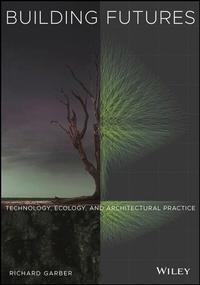
Building Futures
Description

An approach to Information Modeling engaging concepts of equality, sustainability, and labor as they relate to environment and architectural practice
Building Futures: Technology, Ecology, and Architectural Practice explores how architects, and the buildings and environments we create, can engage future realities, both abstract and readily understood. These range from climate change and public health to advanced ideas about manufacture and construction. The text demonstrates multiple and hybrid paths in which building information modeling (BIM) and outgrowth technological processes including environmental simulation and human-robot interaction can be utilized in today's contemporary context, expanding the architect's agency by focusing on a more conceptual, and ecological, basis for our work. Moving beyond a basic understanding of the role of computation in architecture and design, the work shows how to think critically and speculatively about technology's deeper and more lasting impacts on both architecture and society. Topics covered in Building Futures include:
* Technology: information modeling and the relationship between computational and real objects, new approaches to coding in architectural design, and direct-to-manufacture workflows
* Environment: understanding part-to-whole relationships at a variety of scales and the interconnectedness of things, post-subjective architectural approaches to ecology, and new ideas about sustainability
* Practice: revisiting architecture by remote control in the time of new global challenges, and novel ideas about creativity, authorship, and professionalism
Design professionals and practice leaders grappling with the relationship of technology to design pedagogy will use Building Futures to better theorize and execute their architectural vision. Students in upper-level courses studying technique and theory will also find value in the work, which prepares incoming professionals for the major changes that the Architecture, Engineering, and Construction (AEC) industry may undergo in the coming years and decades.
"The book prompts us to consider simulating events where architecture and architects could mitigate, redirect or develop contingencies, in relation to the environment, flows of material and capital, and other "things" that operate from the immediate, through to almost geological timescales."
From the Foreword by Robert Stuart-Smith, Director of the Autonomous Manufacturing Lab, University of Pennsylvania
More details
Other editions
Additional editions
Person
Richard Garber, AIA, is a founding partner at GRO Architects, whose recent projects include buildings, plans, and communities in a number of US cities. Richard teaches graduate Architecture at the Weitzman School of Design, University of Pennsylvania, and has written numerous books and essays including BIM Design: Realizing the Creative Potential of Building Information Modelling (John Wiley & Sons, 2014), and was guest editor of AD Closing the Gap: Information Models in Contemporary Design Practice (Wiley, 2009).
Content
xi Foreword
2 Introduction: Building Futures
5 Part 1
6 Chapter 1 On Technology I
24 Chapter 2 Morphosis's Immaterial Moments in the Making of Things
46 Chapter 3 on Technology II
58 Chapter 4 UNStudio's Future Lifecycles
81 Part 2
82 Chapter 5 On Ecology I
94 Chapter 6 Zaha Hadid's Circular Economy
118 Chapter 7 on Ecology II
132 Chapter 8 Winka Dubbeldam's Synthetic Natures
153 Part 3
154 Chapter 9 On Construction I
166 Chapter 10 Componibile, by Remote Control, GRO Architects
178 Chapter 11 on Construction II
198 Chapter 12 On Practice
206 Chapter 13 Assembly OSM's Modular Platforms and Digital Twins
224 Chapter 14 A Practical Synopsis
235 Index
