

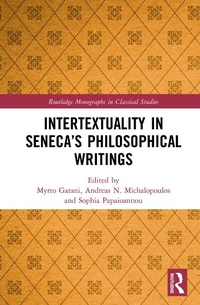
Intertextuality in Seneca's Philosophical Writings
1st Edition
Published on 19. March 2020
286 pages
978-1-000-03773-9 (ISBN)
Description

This volume is the first systematic study of Seneca's interaction with earlier literature of a variety of genres and traditions. It examines this interaction and engagement in his prose works, offering interpretative readings that are at once groundbreaking and stimulating to further study.
Focusing on the Dialogues, the Naturales quaestiones, and the Moral Epistles, the volume includes multi- perspectival studies of Seneca's interaction with all the great Latin epics (Lucretius, Vergil and Ovid), and discussions of how Seneca's philosophical thought is informed by Hellenistic doxography, forensic rhetoric and declamation, the Homeric tradition, Euripidean tragedy and Greco-Roman mythology. The studies analyzes the philosophy behind Seneca's incorporating exact quotations from earlier tradition (including his criteria of selectivity) and Seneca's interaction with ideas, trends and techniques from different sources, in order to elucidate his philosophical ideas and underscore his original contribution to the discussion of established philosophical traditions. They also provide a fresh interpretation of moral issues with particular application to the Roman worldview as fashioned by the mos maiorum. The volume, finally, features detailed discussion of the ways in which Seneca, the author of philosophical prose, puts forward his stance towards poetics and figures himself as a poet.
Intertextuality in Seneca's Philosophical Writings will be of interest not only to those working on Seneca's philosophical works, but also to anyone working on Latin literature and intertextuality in the ancient world.
Focusing on the Dialogues, the Naturales quaestiones, and the Moral Epistles, the volume includes multi- perspectival studies of Seneca's interaction with all the great Latin epics (Lucretius, Vergil and Ovid), and discussions of how Seneca's philosophical thought is informed by Hellenistic doxography, forensic rhetoric and declamation, the Homeric tradition, Euripidean tragedy and Greco-Roman mythology. The studies analyzes the philosophy behind Seneca's incorporating exact quotations from earlier tradition (including his criteria of selectivity) and Seneca's interaction with ideas, trends and techniques from different sources, in order to elucidate his philosophical ideas and underscore his original contribution to the discussion of established philosophical traditions. They also provide a fresh interpretation of moral issues with particular application to the Roman worldview as fashioned by the mos maiorum. The volume, finally, features detailed discussion of the ways in which Seneca, the author of philosophical prose, puts forward his stance towards poetics and figures himself as a poet.
Intertextuality in Seneca's Philosophical Writings will be of interest not only to those working on Seneca's philosophical works, but also to anyone working on Latin literature and intertextuality in the ancient world.
Reviews / Votes
"[T]his volume helps us to judge some of the advantages and limitations of intertextual hermeneutics. Each author sensitively argues for the need to move beyond surface readings of Seneca's philosophical prose to discover a deeper meaning that hinges on his profound engagement with the literary and philosophical tradition... This volume makes clear that Seneca truly is a man of many genres, whose works exploit rhetorical imitatio and aemulatio for a variety of reasons, but often to further elaborate and enhance his political, poetic and philosophical purpose." - The Classical JournalMore details
Series
Edition
1. Auflage
Language
English
Place of publication
London
United Kingdom
Publishing group
Taylor & Francis Ltd
Target group
College/higher education
Product notice
Reflowable
Illustrations
1 Tables, black and white
ISBN-13
978-1-000-03773-9 (9781000037739)
Copyright in bibliographic data and cover images is held by Nielsen Book Services Limited or by the publishers or by their respective licensors: all rights reserved.
Schweitzer Classification
Other editions
Additional editions
Myrto Garani | Andreas N. Michalopoulos | Sophia Papaioannou
Intertextuality in Seneca's Philosophical Writings
Book
01/2023
1st Edition
Routledge
€69.51
Shipment within 10-20 days
Myrto Garani | Andreas N. Michalopoulos | Sophia Papaioannou
Intertextuality in Seneca's Philosophical Writings
Book
04/2020
1st Edition
Routledge
€206.70
Shipment within 15-20 days
Book
02/2020
Routledge
Unfortunately, price unknown
Available (delivery time upon request)
Persons
Myrto Garani is Assistant Professor in Latin Literature at the National and Kapodistrian University of Athens, Greece. She is the author of Empedocles Redivivus: Poetry and Analogy in Lucretius (London and New York, 2007) and co-editor with David Konstan of The Philosophizing Muse. The Influence of Greek Philosophy on Roman Poetry, Pierides III (2014). She has also published a number of articles on Empedocles' reception in Latin literature, especially in Ovid's Fasti . Her other publications include articles on Lucretius, Propertius, Ovid and the Pseudo-Vergilian Aetna. She is currently working on a monograph on Seneca's Naturales quaestiones Book 3 and a commentary of Lucretius' De rerum natura 6.
Andreas N. Michalopoulos is Professor of Latin at the National and Kapodistrian University of Athens. He has published extensively on Latin literature of the 1st centuries BC and AD (especially epic, elegy, and drama), he has edited numerous volumes (more recently Dicite, Pierides. Classical Studies in Honour of Stratis Kyriakidis, 2017, with Sophia Papaioannou and Andrew Zissos) and is the author of Ancient Etymologies in Ovid's Metamorphoses: A Commented Lexicon (2001), Ovid, Heroides 16 and 17: Introduction, Text and Commentary (2006), and Ovid, Heroides 20 and 21: Introduction, Text and Commentary (2013). His research interests include Augustan poetry, ancient etymology, Roman drama, the Roman novel, and the modern reception of classical literature.
Sophia Papaioannou is Professor of Latin at the National and Kapodistrian University of Athens, Faculty of Philology. She is the author of numerous articles and chapters on Augustan literature (especially epic) and on Roman comedy, as well as two books on Ovid: Epic Succession and Dissension: Ovid, Metamorphoses 13.623- 14.582 , and the Reinvention of the Aeneid (2005); and Redesigning Achilles: The 'Recycling' of the Epic Cycle in Ovid, Metamorphoses 12.1- 13.620 (2007); and a collection of papers on Terence (Terence and Interpretation, 2014). She has published on the reception of Vergil and Ovid in the Late Antiquity across various genres and authors, and one of her current projects includes the tracing of Vergilian and Ovidian influence in the subtext of Nonnus' Dionysiaca .
Andreas N. Michalopoulos is Professor of Latin at the National and Kapodistrian University of Athens. He has published extensively on Latin literature of the 1st centuries BC and AD (especially epic, elegy, and drama), he has edited numerous volumes (more recently Dicite, Pierides. Classical Studies in Honour of Stratis Kyriakidis, 2017, with Sophia Papaioannou and Andrew Zissos) and is the author of Ancient Etymologies in Ovid's Metamorphoses: A Commented Lexicon (2001), Ovid, Heroides 16 and 17: Introduction, Text and Commentary (2006), and Ovid, Heroides 20 and 21: Introduction, Text and Commentary (2013). His research interests include Augustan poetry, ancient etymology, Roman drama, the Roman novel, and the modern reception of classical literature.
Sophia Papaioannou is Professor of Latin at the National and Kapodistrian University of Athens, Faculty of Philology. She is the author of numerous articles and chapters on Augustan literature (especially epic) and on Roman comedy, as well as two books on Ovid: Epic Succession and Dissension: Ovid, Metamorphoses 13.623- 14.582 , and the Reinvention of the Aeneid (2005); and Redesigning Achilles: The 'Recycling' of the Epic Cycle in Ovid, Metamorphoses 12.1- 13.620 (2007); and a collection of papers on Terence (Terence and Interpretation, 2014). She has published on the reception of Vergil and Ovid in the Late Antiquity across various genres and authors, and one of her current projects includes the tracing of Vergilian and Ovidian influence in the subtext of Nonnus' Dionysiaca .
Content
Introduction: Intertextuality in the Philosopher Seneca Part 1 1. Seneca on Augustus and Roman Fatherhood 2. Myth, Poetry and Homer in Seneca Philosophus 3. Seneca and the Doxography or Ethics Part 2 4. Reading Seneca Reading Vergil 5. Seneca Quoting Ovid in the Epistulae Morales 6. The Importance of Collecting Shells: Intertextuality in Seneca's Epistle 49 7. Sub auro servitus habitat: Seneca's Moralizing of Architecture and the Anti-Neronian Querelle 8. Seneca on the Mother Cow: Poetic Models and Natural Philosophy in the Consolation to Marcia 9. Seneca on Pythagoras' mirabilia aquarum (NQ 3.20-1, 25-6; Ovid Met. 15.270-336)
