

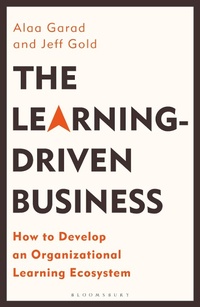
The Learning-Driven Business
How to Develop an Organizational Learning Ecosystem
1st Edition
Published on 13. May 2021
336 pages
978-1-4729-8665-8 (ISBN)
Description

A comprehensive guide to developing a culture of learning and education within your business.
In any kind of organization, learning has become a vital part of the growth and development process, but it only produces effective results if it is pursued strategically and embedded deeply into the culture of the workplace. In recent years, there has been a growing consensus that, for many organizations, learning is their only sustainable competitive advantage - ensuring a committed and engaged workforce that is positioned to identify and exploit business opportunities in an increasingly volatile and uncertain world. This makes it essential for leaders and senior managers to investigate the full range of learning processes and to understand exactly how individual, group, machine and organization-wide learning can produce long-lasting results for individuals as well as for the company itself.
Backed by new academic theory, yet designed to be completely accessible to a business readership, The Learning-Driven Business highlights the importance of Organizational Learning (OL) for organizations which wish to remain competitive and profitable, before clarifying the various pathways and frameworks that can lead to success.
With the onset of automation and artificial intelligence, as well as the proliferation of redundancies and the economic instability of modern times, organizations and their employees must prioritise effective OL in order to overcome these challenges and remain competitive and relevant in the 21st century. This book is a guide for all business leaders and academics looking to adapt to the changing world through OL, using Garand & Golds' unique and original academic model.
In any kind of organization, learning has become a vital part of the growth and development process, but it only produces effective results if it is pursued strategically and embedded deeply into the culture of the workplace. In recent years, there has been a growing consensus that, for many organizations, learning is their only sustainable competitive advantage - ensuring a committed and engaged workforce that is positioned to identify and exploit business opportunities in an increasingly volatile and uncertain world. This makes it essential for leaders and senior managers to investigate the full range of learning processes and to understand exactly how individual, group, machine and organization-wide learning can produce long-lasting results for individuals as well as for the company itself.
Backed by new academic theory, yet designed to be completely accessible to a business readership, The Learning-Driven Business highlights the importance of Organizational Learning (OL) for organizations which wish to remain competitive and profitable, before clarifying the various pathways and frameworks that can lead to success.
With the onset of automation and artificial intelligence, as well as the proliferation of redundancies and the economic instability of modern times, organizations and their employees must prioritise effective OL in order to overcome these challenges and remain competitive and relevant in the 21st century. This book is a guide for all business leaders and academics looking to adapt to the changing world through OL, using Garand & Golds' unique and original academic model.
More details
Edition
1. Auflage
Language
English
Place of publication
London
United Kingdom
Publishing group
Bloomsbury Publishing PLC
Target group
Professional and scholarly
ISBN-13
978-1-4729-8665-8 (9781472986658)
Copyright in bibliographic data and cover images is held by Nielsen Book Services Limited or by the publishers or by their respective licensors: all rights reserved.
Schweitzer Classification
Other editions
Additional editions
Alaa Garad | Jeff Gold
The Learning-Driven Business
How to Develop an Organizational Learning Ecosystem
Book
05/2021
Bloomsbury Business
€28.50
Article exhausted; check different version
Persons
Alaa Garad is a Senior Teaching Fellow at the University of Portsmouth and a Visiting Professor at the Arab Academy for Science and Technology. He is a trustee of the Institute of Commercial Management and a Fellow at The Learning and Performance Institute. Alongside his academic experience, Alaa is an award-winning executive with over 20 years of experience in designing, leading and managing projects in various sectors.
Jeff Gold is co-founder of the HRD and Leadership Research Unit at Leeds Business School and the Director of the DBA programme at Leeds Beckett University. He is also the Professor of Organisation Learning at York Business School. He has worked as a consultant with organizations such as the NHS, Hallmark Cards and the Police Service, and is the co-author of Human Resource Management, now in its 6th edition.
Jeff Gold is co-founder of the HRD and Leadership Research Unit at Leeds Business School and the Director of the DBA programme at Leeds Beckett University. He is also the Professor of Organisation Learning at York Business School. He has worked as a consultant with organizations such as the NHS, Hallmark Cards and the Police Service, and is the co-author of Human Resource Management, now in its 6th edition.
Content
- Intro
- Series
- Title
- Contents
- Introduction
- Part One: Leadership Learning and Individual Learning - Introduction
- 1 Leadership and Strategic Learning
- 2 Reflection
- 3 Mentoring and Coaching
- 4 Employees' Cross-Training
- Part Two: Why Team Learning?
- 5 After-action Reviews (AARs)
- 6 Problem-solving Teams (PSTs)
- 7 Action Learning Sets (ALSs)
- 8 Futures and Foresight Learning (FFL)
- Part Three: Introduction - Differences between OWL and OL
- 9 Machine Learning
- 10 Benchmarking
- 11 Feedback Loops
- 12 Organizational Self-assessment (OSA)
- 13 Quality Awards (QAWs)
- 14 Suggestion Systems (SS)
- 15 Dialogue in the Learning-Driven Business
- 16 Mystery Shopping and Auditing
- Part Four: Introduction - Learning Means Excellence
- 17 The Learning-Driven Organization Model
- 18 Conclusion: The Way Forward
- References
- Acknowledgements
- Index
- Copyright
