

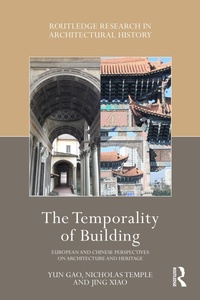
The Temporality of Building
European and Chinese Perspectives on Architecture and Heritage
1st Edition
Published on 31. March 2025
248 pages
978-1-317-20010-9 (ISBN)
Description

This book examines the role that time plays in the life of buildings, adopting a comparative study of this influence between European and Chinese traditions. Whilst issues of time in architecture have attracted increasing interest by academics in the West, challenging the dominant modernist precepts of space, there is little understanding of the subject in China and how these compare to historical and contemporary perspectives in Europe. A guiding premise of the investigation is that notions of building time require insight into how cultural habits commingle with natural rhythms, or what David Leatherbarrow calls "concurrency".
Rather than examining specific buildings, the first three chapters apply three key themes (language, ritual and heritage) as cultural lenses to reveal differences and similarities between the two traditions. Through these lenses, buildings, interiors and their exterior spaces (churches/cathedrals, temples, palaces, gardens and courtyard houses) are explored to demonstrate how building time involves particular situations/settings and their correlating relationships to past traditions. In the final chapter we consider notions of time in the context of contemporary buildings in Europe and China, drawing on the earlier historical investigations and addressing globalising influences.
This book would be of interest to architects, architectural theorists, historians, philosophers, sociologists and anthropologists.
Rather than examining specific buildings, the first three chapters apply three key themes (language, ritual and heritage) as cultural lenses to reveal differences and similarities between the two traditions. Through these lenses, buildings, interiors and their exterior spaces (churches/cathedrals, temples, palaces, gardens and courtyard houses) are explored to demonstrate how building time involves particular situations/settings and their correlating relationships to past traditions. In the final chapter we consider notions of time in the context of contemporary buildings in Europe and China, drawing on the earlier historical investigations and addressing globalising influences.
This book would be of interest to architects, architectural theorists, historians, philosophers, sociologists and anthropologists.
Reviews / Votes
This is an unusual study that provides a cross-cultural examination on the cultures of building in Europe and China, with a focus on time and temporality in the practice of constructing and reconstructing where language, ritual and historical memory may have constituted three crucial aspects for understanding the problem; the act of building in time. It is an ambitious and admirable exercise, as it delves deep into historical cases in the two very different spheres of civilization. It reveals, among others, a non-material and non-linear sense of time and memory in the eastern culture, and a Judeo-Christian conception of linear time and objectified memory. Contemporary cases are also examined where different cultures collided with contradictions and in acceleration, with interesting questions raised for us. It is a thought-provoking study, an excellent read for all who are interested in thinking with different cultures in a post-Enlightenment world we are in today.Jianfei Zhu, Chair of East Asian Architecture, Newcastle University, United Kingdom.
Insightful and profound, The Temporality of Building offers a much-needed, comparative exploration of time, architecture, and heritage across the distinct cultural landscapes of Europe and China. Through three innovative lenses -language, ritual, and heritage - the authors delve into previously uncharted areas, revealing captivating stories of how these societies have uniquely shaped, preserved, and redefined their approaches to building and time. With concise prose and nuanced scholarship, this book deepens our understanding of cultural perspectives on continuity and authenticity, while prompting us to question our own assumptions about heritage and the future. For anyone interested in the rich interplay of tradition, time, and preservation in a world facing environmental change, this is a must-read.
Yue Zhuang, University of Exeter, United Kingdom.
More details
Series
Edition
1. Auflage
Language
English
Place of publication
London
United Kingdom
Publishing group
Taylor & Francis Ltd
Target group
College/higher education
Illustrations
18 Line drawings, black and white; 74 Halftones, black and white; 92 Illustrations, black and white
File size
64,28 MB
ISBN-13
978-1-317-20010-9 (9781317200109)
Copyright in bibliographic data and cover images is held by Nielsen Book Services Limited or by the publishers or by their respective licensors: all rights reserved.
Schweitzer Classification
Other editions
Additional editions

Book
05/2025
Routledge
Unfortunately, price unknown
Available (delivery time upon request)
Yun Gao | Nicholas Temple | Jing Xiao
The Temporality of Building
European and Chinese Perspectives on Architecture and Heritage
Book
03/2025
1st Edition
Routledge
€193.50
Shipment within 10-20 days
Persons
Yun Gao is Reader in Architecture at the University of Huddersfield and a Chartered Architect of the Royal Institute of British Architects. She received a PhD from the University of Edinburgh on the architectural heritage in SW China. She is author of numerous refereed journal papers and edited book chapters, and a number of books including Architecture of Dai Nationality in Yunnan, China and Creative Villages in SW China, and has been a recipient of research grant awards such as a British Academy/Leverhulme Small Research Grant and AHRC grants. She is the International Corresponding Editor for the Journal of Architecture (UK).
Nicholas Temple is Senior Professor of Architectural History at London Metropolitan University and formerly Director of the Centre for Urban and Built Ecologies (CUBE). A graduate of Cambridge University (Magdalene College), he has served as head of the School of Architecture at the University of Lincoln and as an assistant professor of architecture at the University of Pennsylvania. He has researched and published widely on the history and theory of architecture and the city, and was shortlisted for the International CICA Bruno Zevi Book Award in 2014 for his book Renovatio Urbis: Architecture, Urbanism and Ceremony in the Rome of Julius II (Routledge, 2011).
Jing Xiao is Associate Professor in Architecture at the School of Architecture and Urban Planning, Shenzhen University in China. He received a PhD from the University of Nottingham on the subject of the transformation of architectural knowledge via pictorial media in pre-modern China. He has written and published on pre-modern Chinese architectural history and modern urban and technical history of the metropolis. A chartered architect of the Royal Institute of British Architects and assistant Editor-in-chief for the World Architecture Review (China), Dr Xiao has received research grants from funding bodies such as the National Science Foundation of China and Harvard University/Getty Foundation.
Nicholas Temple is Senior Professor of Architectural History at London Metropolitan University and formerly Director of the Centre for Urban and Built Ecologies (CUBE). A graduate of Cambridge University (Magdalene College), he has served as head of the School of Architecture at the University of Lincoln and as an assistant professor of architecture at the University of Pennsylvania. He has researched and published widely on the history and theory of architecture and the city, and was shortlisted for the International CICA Bruno Zevi Book Award in 2014 for his book Renovatio Urbis: Architecture, Urbanism and Ceremony in the Rome of Julius II (Routledge, 2011).
Jing Xiao is Associate Professor in Architecture at the School of Architecture and Urban Planning, Shenzhen University in China. He received a PhD from the University of Nottingham on the subject of the transformation of architectural knowledge via pictorial media in pre-modern China. He has written and published on pre-modern Chinese architectural history and modern urban and technical history of the metropolis. A chartered architect of the Royal Institute of British Architects and assistant Editor-in-chief for the World Architecture Review (China), Dr Xiao has received research grants from funding bodies such as the National Science Foundation of China and Harvard University/Getty Foundation.
Content
List of Figures
Image Credits
Acknowledgements
Introduction: Building in (and out of) Time
Chapter 1: Oral, Written and Printing Traditions in Building
Chapter 2: Ritual Time, Transcendence and Immanence
Chapter 3: Building Restoration and Heritage
Chapter 4: Contemporary Building Case-Studies in Europe and China
Conclusion
Select Bibliography
Index
Image Credits
Acknowledgements
Introduction: Building in (and out of) Time
Chapter 1: Oral, Written and Printing Traditions in Building
Chapter 2: Ritual Time, Transcendence and Immanence
Chapter 3: Building Restoration and Heritage
Chapter 4: Contemporary Building Case-Studies in Europe and China
Conclusion
Select Bibliography
Index
