

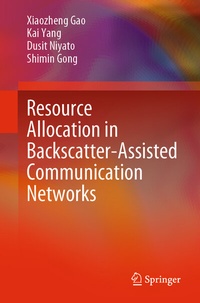
Resource Allocation in Backscatter-Assisted Communication Networks
Description

This book investigates the resource allocation in backscatter-assisted communication networks. With the development of backscatter communications, integrating backscatter communication technology into traditional communication networks can improve the network performance significantly. To fully improve the performance of backscatter-assisted communication networks, resource allocation is of special importance. It is worth to mention that the resource allocation in backscatter-assisted communication networks is more challenging than that in traditional communication networks, and the tradeoff of the performance between backscatter communications and traditional communications needs to be carefully considered.
In this book, considering that game theory is an attractive tool for developing and analyzing distributed, flexible, and autonomous networks, we develop the auction-based time scheduling schemes, contract-based time assignment scheme, and evolutionary game-based access point and service selection scheme for the backscatter-assisted radio-frequency-powered cognitive networks, where some important properties such as individual rationality are considered. We also employ the optimization approach and develop a relay mode selection and resource sharing scheme for backscatter-assisted hybrid relay networks to improve the throughput. We believe that the developed resource allocation schemes in this book can provide useful guidance for the design of backscatter-assisted communication networks and future Internet of Things. Graduate students, researchers, and engineers in the field of communication networks can benefit from the book.
More details
Other editions
Additional editions
Persons
Kai Yang received the Ph.D. degree from Beijing Institute of Technology, China, in 2010. From January 2010 to July 2010, he was with the Department of Electronic and Information Engineering, Hong Kong Polytechnic University. From 2010 to 2013, he was with Alcatel-Lucent Shanghai Bell, Shanghai, China. In 2013, he joined the Laboratoire de Recherche en Informatique, University Paris Sud 11, Orsay, France. Now, he is Professor in the School of Information and Electronics, Beijing Institute of Technology, Beijing, China. His current research interests include resource allocation, convex optimization, massive MIMO, mmWave systems, and interference mitigation.
Dusit Niyato is currently Professor at the School of Computer Science and Engineering, Nanyang Technological University, Singapore. He received B.Eng. from King Mongkuts Institute of Technology Ladkrabang (KMITL), Thailand, in 1999 and Ph.D. in Electrical and Computer Engineering from the University of Manitoba, Canada, in 2008. His research interests are in the areas of Internet of Things (IoT), machine learning, and incentive mechanism design. He is IEEE Fellow. He has published 8 books, more than 350 journal papers, and more than 250 conference papers and received more than 37000 citations according to Google Scholar. He is very active in the editorship of IEEE journals.
Shimin Gong received the B.E. and M.E. degrees in Electronics and Information Engineering from Huazhong University of Science and Technology, Wuhan, China, in 2008 and 2012, respectively, and the Ph.D. degree in Computer Engineering from Nanyang Technological University, Singapore, in 2014. He was Associate Researcher with the Shenzhen Institutes of Advanced Technology, Chinese Academy of Sciences, Shenzhen, China. He is currently Associate Professor with the School of Intelligent Systems Engineering, Sun Yat-sen University, Guangzhou, China. His research interests include wireless powered communications, Internet of Things (IoT), low-power backscatter communications, and machine learning in wireless communications. He was Recipient of the Best Paper Award on MAC and Cross-layer Design in IEEE WCNC 2019. He has been Lead Guest Editor of the IEEE TRANSACTIONS ON COGNITIVE COMMUNICATIONS AND NETWORKING, a special issue on Deep Reinforcement Learning on Future Wireless CommunicationNetworks.
