

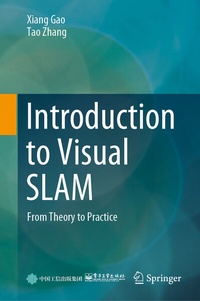
Introduction to Visual SLAM
Description

This book offers a systematic and comprehensive introduction to the visual simultaneous localization and mapping (vSLAM) technology, which is a fundamental and essential component for many applications in robotics, wearable devices, and autonomous driving vehicles. The book starts from very basic mathematic background knowledge such as 3D rigid body geometry, the pinhole camera projection model, and nonlinear optimization techniques, before introducing readers to traditional computer vision topics like feature matching, optical flow, and bundle adjustment.
The book employs a light writing style, instead of the rigorous yet dry approach that is common in academic literature. In addition, it includes a wealth of executable source code with increasing difficulty to help readers understand and use the practical techniques. The book can be used as a textbook for senior undergraduate or graduate students, or as reference material for researchers and engineers in related areas.
More details
Other editions
Additional editions
Persons
Dr. Xiang Gao received his Ph.D. in control science and engineering from Tsinghua University, Beijing, China, in 2017. In 2018, he worked as Postdoctoral Researcher at the Technical University of Munich for one year. He is currently serving as Senior Engineer at idriverplus.com, with a focus on localization and HD map reconstruction for autonomous driving vehicles. He published the book "14 Lectures on Visual SLAM: from Theory to Practice" (1st edition in 2017 and 2nd edition in 2019, in Chinese), which has since sold over 50,000 copies.
Professor Tao Zhang is currently Associate Professor, Head of the Department of Automation, and Vice Director of the School of Information Science and Technology at Tsinghua University. His research interests include pattern recognition, nonlinear system control, robotics, control engineering, and artificial intelligence. He has authored 6 books and translated 2 others on robotics, SLAM, multimedia, VR, etc. He serves on the editorial boards of several prestigious journals, such as IEEE/ASME Transactions on Mechatronics.
