

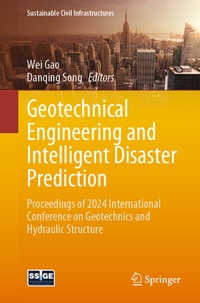
Geotechnical Engineering and Intelligent Disaster Prediction
Description

This book features selected proceedings from the "2024 International Conference on Geotechnics and Hydraulic Structure," focusing on Geotechnical Engineering and Intelligent Disaster Prediction. It addresses the vital role of geotechnical engineering in underground structure safety and infrastructure stability. With the advancement of AI and interdisciplinary collaboration, the field has transitioned to electronic surveying and big data prediction for stress analysis and safety monitoring. The conference highlights stress analysis in geotechnical and underground engineering, and the application of AI in geotechnical predictions. The book includes case studies and research on soil mechanics, tunnel construction, and geotechnical failures, as well as AI's role in disaster prediction and monitoring. It aims to be a comprehensive resource for engineers and scholars, offering insights and innovative solutions in geotechnical engineering.
More details
Other editions
Additional editions
Persons
Wei Gao , male, born in 1971, PhD, post-doctoral, professor, doctoral supervisor. It is mainly engaged in the stability analysis of geotechnical engineering in complex environment and the research and teaching of big data artificial intelligence technology in geotechnical engineering. At present, more than 100 academic papers have been published ( including more than 40 SCI retrievals ), 5 monographs and 2 textbooks have been published. As a host or main participant, he has completed more than 40 scientific research projects, including key projects of the National Natural Science Foundation of China, 973 projects, and general projects of the National Natural Science Foundation of China. The research results have won one second prize of national science and technology progress and one first prize of Hubei province science and technology progress.
Prof. Danqing Song has long been engaged in the scientific research of rock body engineering geomechanics related to side slopes, tunnels, underground caverns, etc. He mainly carries out related research on the structural dynamics effect of rock bodies, rock body dynamics catastrophe, geologic disaster monitoring, early warning, prevention and control, and intelligent construction of underground engineering, and has participated in the major projects of Sichuan-Tibet Railway, the Three Gorges, the JiuDian Gorge of the upper reaches of the Yellow River, HeiFangTai, and the middle reaches of the Jinsha Jiang River, such as the XiangLi Highway, and the evaluation of deformation stability and prevention and control. He has been involved in the evaluation of deformation stability and prevention and control of landslides, high slopes, and deeply buried tunnels in many major projects.
Content
Section One: Geotechnical Mechanics and Mechanical Theory.- a. Geotechnical Mechanics and Computational Optimization Methods.- b. Theoretical Mechanics and Geotechnical Load Theory.- Section Two: Research and Case Studies in Geotechnical Engineering.- a. Geotechnical Slope and Soil Mechanics Analysis.- b. Tunnel and Underground Engineering Construction.- c. Geotechnical Failure and Theory in Complex Environments.- d. Safety Management and Technological Applications in Geotechnical Engineering Construction.- e. Quality Control and Monitoring Techniques in Geotechnical Engineering Construction.- Section Three: Intelligent Disaster Prediction.- a. Application of Artificial Intelligence and Big Data Technologies in Geotechnical Engineering Prediction.- b. Monitoring and Early Warning of Geotechnical and Geological Disasters.- c. Visualization Display and Emergency Response Plan Optimization of Intelligent Geotechnical Disaster Prediction System.- d. Model Optimization and Algorithm Improvement in Geotechnical Disaster Prediction Using Artificial Intelligence.
