

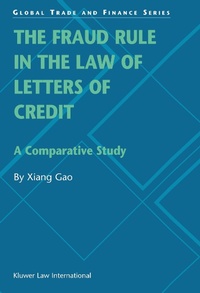
The Fraud Rule in the Law of Letters of Credit: A Comparative Study
A Comparative Study
Published on 1. January 2003
222 pages
978-90-411-7318-8 (ISBN)
Description

Although the letter of credit is essentially an international instrument with an age-old pedigree, a troubling number of serious disputes still founder on national provisions with respect to the fraud rule (or fraud exception). The rule is embodied in several major international agreements, but its adjudication takes place under national statutes in which - in the opinion of Judge Xiang Gao of the Supreme People's Court of the People's Republic of China (PRC) - a significant degree of further refinement and harmonization is called for.
Dr. Gao finds the best provisions and practices in respect of the fraud rule in the United States, the United Kingdom, Canada, and Australia, and applies these standards to the reformulation of the fraud rule in the PRC. In the process he surveys the entire field of the fraud rule in the law of letters of credit in its substantive aspects, thus going deeper than mere banking law analyses and revealing, for the benefit of jurists everywhere, the fundamental legal issues that must underlie all sound judicial reasoning in the area. In more practical terms, this approach also allows judges to meet their essential responsibility - that of giving an answer when a case is put before them - with the widest and best possible degree of discernment.
Among the many factors contributing to the law and practice pertaining to letters of credit, Dr. Gao finds the following elements, particularly relevant to his subject:
- the ICC Rules;
- the UNCITRAL Convention;
- Article 5 of the UCC;
- Sztejn v. J. Henry Schroder Banking Corp.;
- US.-Iranian cases; and
- the United City Merchants case.
Drawing on all of these elements - as well as on the drafting process of the Supreme People's Court that led to a new fraud rule provision in 2001 - Dr. Gao gives us the deepest and most wide-ranging judicial analysis of this subject available. His unique study will be of great value not only to jurists and academics, but to all lawyers concerned with the legal underpinnings of international trade.
Dr. Gao finds the best provisions and practices in respect of the fraud rule in the United States, the United Kingdom, Canada, and Australia, and applies these standards to the reformulation of the fraud rule in the PRC. In the process he surveys the entire field of the fraud rule in the law of letters of credit in its substantive aspects, thus going deeper than mere banking law analyses and revealing, for the benefit of jurists everywhere, the fundamental legal issues that must underlie all sound judicial reasoning in the area. In more practical terms, this approach also allows judges to meet their essential responsibility - that of giving an answer when a case is put before them - with the widest and best possible degree of discernment.
Among the many factors contributing to the law and practice pertaining to letters of credit, Dr. Gao finds the following elements, particularly relevant to his subject:
- the ICC Rules;
- the UNCITRAL Convention;
- Article 5 of the UCC;
- Sztejn v. J. Henry Schroder Banking Corp.;
- US.-Iranian cases; and
- the United City Merchants case.
Drawing on all of these elements - as well as on the drafting process of the Supreme People's Court that led to a new fraud rule provision in 2001 - Dr. Gao gives us the deepest and most wide-ranging judicial analysis of this subject available. His unique study will be of great value not only to jurists and academics, but to all lawyers concerned with the legal underpinnings of international trade.
More details
Other editions
Additional editions
Book
01/2003
1st Edition
Kluwer Law International
€101.65
Shipment within 10-20 days
Content
- Cover
- Half Title Page
- Title Page
- Copyright Page
- Table of Contents
- Preface
- 1.The Letter of Credit and its Legal Framework
- THE NATURE OF LETTERS OF CREDIT
- Definition
- Operation and Classification
- Commercial Letters of Credit
- Standby Letters of Credit
- Distinction between Commercial and Standby Credits
- Letters of Credit and Guarantees
- Historical Development
- Early Forms
- Buyers' Credits
- Modern Letters of Credit
- Letters of Credit, Negotiable Instruments and Contracts
- Letters of Credit and Negotiable Instruments
- Letters of Credit and Contracts
- Summary
- THE LEGAL FRAMEWORK OF LETTERS OF CREDIT
- Source of Law
- ICC Rules
- UCP
- eUCP
- URCG
- URDG
- ISP98
- UNCITRAL Convention
- Article 5 of the UCC
- Two Fundamental Principles
- Principle of Independence
- Principle of Strict Compliance
- SUMMARY
- 2.The Fraud Rule: An Overview
- MEANING AND RATIONALE
- Meaning
- Rationale
- Closing a Loophole
- Public Policy for the Control of Fraud
- Maintaining the Utility of Letters of Credit
- HISTORICAL DEVELOPMENT
- The Breeding Season
- One Early Case Study
- Fraud Cases in the Early 20th Century
- Commentary
- The Catalyst - The Sztejn Case
- The Facts
- The Judgment
- Commentary
- THE FRAUD RULE IN THE UNITED STATES
- Prior UCC Article 5
- Revised UCC Article 5
- THE FRAUD RULE IN OTHER JURISDICTIONS
- United Kingdom
- Canada
- Australia
- THE FRAUD RULE IN ICC RULES
- UCP
- URCG
- URDG
- ISP98
- THE FRAUD RULE UNDER THE UNCITRAL CONVENTION
- SUMMARY
- 3.The Standard of Fraud
- THE POSITION IN THE UNITED STATES
- Pre-UCC Position
- Pre-Sztejn Cases
- The Test of Sztejn
- Prior UCC Article 5 Position
- Egregious Fraud
- Intentional Fraud
- Letter of Credit Fraud
- Flexible Standard
- Constructive Fraud
- Summary
- Iranian Cases
- Revised UCC Article 5 Position
- Observations and Recommendations of the Task Force
- The Position in the Statute
- Case Studies
- THE POSITION IN THE UNITED KINGDOM
- THE POSITION IN CANADA
- THE POSITION IN AUSTRALIA
- Intentional Fraud
- Gross Equitable Fraud
- THE POSITION UNDER THE UNCITRAL CONVENTION
- SUMMARY
- 4.The Locus of Fraud
- THE CONTROVERSY
- Nature of Letters of Credit
- Language of Section 5-114(2)
- Drafting History of Section 5-114(2)
- Rationale of Sztejn
- CASE STUDIES
- A Typical Case
- More Cases for the Broad View
- More Cases for the Narrow View
- THE SOLUTION
- COMMENTARY
- 5.The Identity of the Fraudulent Party
- STATUTORY PROVISIONS
- Article 5 of the UCC
- Prior UCC Article 5
- Revised UCC Article 5
- UNCITRAL Convention
- APPLICANT FRAUD
- THIRD PARTY FRAUD: THE CASE OF UNITED CITY MERCHANTS
- The Facts
- The Judgments
- The Trial Court
- The Court of Appeal
- The House of Lords
- A Critical View
- Centrality of Documents
- Risk Allocation between Innocent Parties
- The Principle of Strict Compliance
- SUMMARY
- 6.Presenters Immune from the Fraud Rule
- PRELIMINARY OBSERVATIONS
- Negotiation
- The Distinction between Straight Credits and Negotiation Credits
- Straight Letters of Credit
- Negotiation Letters of Credit
- The Case of Creditanstalt
- LIKELY PRESENTERS
- Confirmers
- Nominated Persons
- Assignees of Proceeds
- Forfeiters or Assignees of Deferred Payment Obligations
- Holders in Due Course
- Holder in Due Course in the Context of Letters of Credit
- Expanded Use of the Doctrine
- Limitation of the Doctrine
- Holders of Accepted Drafts
- Transferees
- SUMMARY
- 7.The Fraud Rule in the People's Republic of China
- THE LEGAL SYSTEM OF THE PRC
- Roman Law Tradition
- Sources of Law
- Legislation
- Judicial Interpretation
- International Treaties and Practices
- THE FRAUD RULE IN THE PRC
- 1989 Summary
- Advent of the 1989 Summary
- The Fraud Rule in the 1989 Summary
- Post-Summary Cases
- Commentary and Analysis
- 1998 Draft
- Continuing Efforts of the SPC
- Content and Commentary
- 2001 Provision
- Drafting Process
- The Fraud Rule under the 2001 Provision
- Commentary
- A Final Note
- Selected Bibliography
- Index
- Back Cover
