

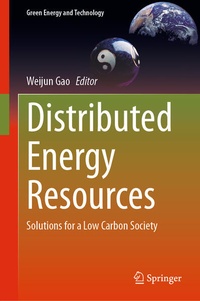
Distributed Energy Resources
Description

The future of the distributed energy generation market is promising, with opportunities in the residential, commercial, and industrial sectors driven by increasing awareness of clean energy, greenhouse gas (GHG) emission reduction targets, and rising global demand for energy. This book focuses on UN Sustainable Development Goal 7, which aims to "ensure access to affordable, reliable, sustainable, and modern energy for all." It provides research results, applications, and case studies on the potential of distributed energy resources as a solution to building a low-carbon society. Coverage includes modeling and evaluation of distributed power systems, system maintenance and reliability, economic potential and implications of hydrogen energy systems, grid stabilization and carbon emission reduction, smart design, and the impact of energy penetration on public power grids. Case studies include the effects of renewable energy policies on solar photovoltaic energy in China, Germany, Japan, and the United States of America and a feasibility assessment of distributed energy systems in Shanghai.
Distributed Energy Resources: Solutions for a Low Carbon Society will be a valuable resource for postgraduate students and researchers in energy systems, urban energy management, and renewable energy technologies and a reference guide for practicing engineers, urban energy planners, and energy system managers.
More details
Other editions
Additional editions
Person
Weijun Gao, Ph.D., is a tenured professor at the University of Kitakyushu, Japan, and an Academia Professor with Qingdao University of Technology, China. He has also been a visiting professor at Xi'an Jiaotong University, Zhejiang University, and Lawrence Berkeley National Laboratory. He received his Master's degree in Engineering from Zhejiang University and his Ph.D. in Engineering from Waseda University. Professor Gao's research interests include the science, engineering, management, and dissemination of city environment planning, distributed energy systems, building material recycling, health and environmental impacts of energy generation and use, geographic information systems, climate change (especially in urban areas), and energy forecasting.
