

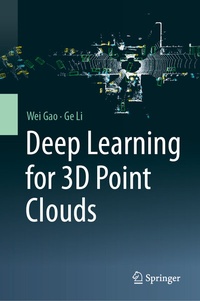
Deep Learning for 3D Point Clouds
Description

As an efficient 3D vision solution, point clouds have been widely applied into diverse engineering scenarios, including immersive media communication, autonomous driving, reverse engineering, robots, topography mapping, digital twin city, medical analysis, digital museum, etc. Thanks to the great developments of deep learning theories and methods, 3D point cloud technologies have undergone fast growth during the past few years, including diverse processing and understanding tasks. Human and machine perception can be benefited from the success of using deep learning approaches, which can significantly improve 3D perception modeling and optimization, as well as 3D pre-trained and large models. This book delves into these research frontiers of deep learning-based point cloud technologies.
The subject of this book focuses on diverse intelligent processing technologies for the fast-growing 3D point cloud applications, especially using deep learning-based approaches. The deep learning-based enhancement and analysis methods are elaborated in detail, as well as the pre-trained and large models with 3D point clouds. This book carefully presents and discusses the newest progresses in the field of deep learning-based point cloud technologies, including basic concepts, fundamental background knowledge, enhancement, analysis, 3D pre-trained and large models, multi-modal learning, open source projects, engineering applications, and future prospects.
Readers can systematically learn the knowledge and the latest developments in the field of deep learning-based point cloud technologies. This book provides vivid illustrations and examples, and the intelligent processing methods for 3D point clouds. Readers can be equipped with an in-depth understanding of the latest advancements of this rapidly developing research field.
More details
Other editions
Additional editions
Persons
Dr. Wei Gao is an assistant professor at the School of Electronic and Computer Engineering, Peking University, Shenzhen, China. His research interests include 3D point cloud compression and processing, image/video coding and processing, deep learning, and artificial intelligence. He actively participates in standardization activities for multimedia compression and leads the development of the open source project for point cloud technologies, namely OpenPointCloud. He is a senior member of IEEE. He has authored the book "Point Cloud Compression - Technologies and Standardization" published by Springer Nature.
Dr. Ge Li is a professor at the School of Electronic and Computer Engineering, Peking University, Shenzhen, China. He chairs the standardization of 3D point cloud compression in the Audio Video Coding Standard (AVS) working group in China. His research interests include 3D point cloud compression and processing, image/video processing and analysis, machine learning, and signal processing. He has authored the book "Point Cloud Compression - Technologies and Standardization" published by Springer Nature.
Content
Chapter 1. Introduction to 3D Point Clouds: Datasets and Perception.- Chapter 2. Learning Basics for 3D Point Clouds.- Chapter 3. Deep Learning-based Point Cloud Enhancement I.- Chapter 4. Deep Learning-based Point Cloud Enhancement II.- Chapter 5. Deep Learning-based Point Cloud Analysis I.- Chapter 6. Deep Learning-based Point Cloud Analysis II.- Chapter 7. Point Cloud Pre-trained Models and Large Models.- Chapter 8. Point Cloud-Language Multi-modal Learning.- Chapter 9. Open Source Projects for 3D Point Clouds.- Chapter 10. Typical Engineering Applications of 3D Point Clouds.- Chapter 11. FutureWork on Deep Learning-based Point Cloud Technologies.
