

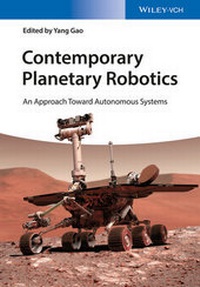
Contemporary Planetary Robotics
Description

in both theoretical principles and practical use cases.
The book recognizes the importance of system design hence discusses practices and tools that help take mission concepts to baseline design solutions, making it a practical piece of scientifi c reference suited to a variety of practitioners in planetary robotics.
More details
Other editions
Additional editions
Person
Content
Part 2: Key Planetary Robotic Systems
* Rovers
* Manipulators
* Drillers & samplers
Part 3: Key Enabling Technologies
*Vision and Image Processing
*Locomotion Design and Control
*Planetary Navigation
*Operation and Autonomy
Chapter 1
Introduction
Yang Gao, Elie Allouis, Peter Iles, Gerhard Paar and José de Gea Fernández
Planetary robotics is an emerging multidisciplinary field that builds on knowledge of astronautics, terrestrial robotics, computer science, and engineering. This book offers a comprehensive introduction to major research and development efforts for planetary robotics, with a particular focus on autonomous space systems, which will enable cost-effective, high-performing, planetary missions. Topics covered in this book include techniques and technologies enabling planetary robotic vision processing, surface navigation, manipulation, mission operations, and autonomy. Each topic or technological area is explained in a dedicated chapter using a typical space system design approach whereby design considerations and requirements are first discussed and followed by descriptions of relevant techniques and principles. Most chapters contain design examples or use cases that help demonstrate how techniques or theoretical principles can be implemented in real missions. Since any space engineering design or development is a system engineering process, this book also dedicates one chapter to planetary robotic system design - from mission concepts to baseline designs. As a result, this book can be used as a text or reference book for relevant engineering or science courses at the undergraduate and postgraduate level, or a handbook for industrial professionals in the space sector.
This chapter introduces the book by offering a chronicle on how planetary exploration and robotics have evolved to date, a systematic overview of planetary robotics, as well as an explanation on the organization and scope of the book.
1.1 Evolution of Extraterrestrial Exploration and Robotics
The need for humans to explore beyond the realm of Earth is driven by our inherent curiosity. Throughout our history, new worlds have been discovered by daring explorers who set out to discover new lands, find riches, or better understand these little-known territories. These journeys were fueled by the technological advances of the times such as the compass, maritime maps, or plane, and in return contributed tremendously to the scientific knowledge of humankind. For all the good provided by these exploratory endeavors, history also reveals that exploration is difficult, perilous, and can be fraught with unforeseeable consequences. For examples, within early maritime exploration, only a fraction of all the ships that aimed for the new worlds eventually achieved their goals. There have also been countless instances where the discovery of the new lands was detrimental to the indigenous populations. The past and lessons learned serve as a stark reminder to all new exploration endeavors.
Outer space has provided real, new exploration frontiers for mankind since the 1950s. With the capability and the irresistible attraction to go beyond our planet Earth, minimizing the impact of mankind on other extraterrestrial bodies (be it a planet, a moon, a comet, or an asteroid) is paramount. Strong with the hindsight and knowledge provided by humans' own history, we are continuously learning about these new space frontiers and taking precautions to avoid repeating mistakes learned from the past exploration activities.
The onset of space exploration in the late 1950s to early 1960s focused on sending humans into space and the Moon, a key priority for the two main adversaries of the Cold War. However, it was true then as it is now, in parallel to the expensive development of manned space programs, the use of cheaper robotic proxies was deemed important for understanding the space environment where the astronauts will be operating. The USSR had the first set of robotics missions, successfully launching a series of Luna probes starting from 1959. Within a year, the Luna 1 managed a flyby of the Moon, Luna 2 crash landed on the Moon, and Luna 3 took pictures of the Moon's far side. It took another 7 years before both the USSR and the United States, within a few months from each other, performed soft landing on the Moon with their respective probes, Luna 9 and Surveyor 1. These missions paved the way for the first human landing on the Moon in 1969 by the United States. Building on these earlier successes, robotic exploration missions have extended their reach to Mercury, Venus, Mars (known as the inner solar system), and subsequently the outer solar system where tantalizing glimpses of the volcanic Io, the frozen Europa, or the methane rains of Titan have beenobtained.
Planetary missions can use various ways to explore an extraterrestrial body, often starting with reconnaissance or remote sensing using orbiting satellites. More advanced approaches (such as landing, surface operation, and sample return) enabled by sophisticated robotic systems represent a giant leap in terms of mission complexity and risk, but more importantly scientific return. Not surprisingly, advanced extraterrestrial exploration is littered with unsuccessful missions bearing witness to serious technical challenges of such endeavors. Table 1.1 presents statistics of successful surface missions aimed for the solar system (excluding manned missions). The relatively low success rate is a clear reflection on the technical difficulties involved in designing, building, and operating the required robotic spacecraft. It is worth noting that space engineers and scientists have created the landscape of what we know today. With sheer determination, they continue to address countless challenges, failing often, but regrouping until they succeed.
Table 1.1 Statistics on planetary unmanned landing missions as of 2015
Venus Moon Mars Titan Asteroids/comets Total landing missions launched 19 35 16 1 6 Successful surface operation 9 13 9 1 1 Successful sample return 0 3 0 0 1Within the existing successful unmanned missions, various types of robotic systems have played significant roles, including robotic platforms (such as the surface rovers) or robotic payloads (such as the manipulators or robotic arms, subsurface samplers, and drills). Table 1.2 summarizes those successfully flown robots found on the Moon, Mars, and small bodies. The first genuine robotic payload successfully operated on an extraterrestrial body was a scoop (i.e., a manipulation cum sampling device) onboard the Surveyor 3 lander launched in 1967 to the Moon (as shown in Figure 1.1a). Following that, Luna 16 succeeded with the first planetary robotic arm-mounted drill in 1970 (as shown in Figure 1.1b), and Luna 17 succeeded with the first planetary rover called Lunokhod 1 in 1970 (as shown in Figure 1.1c).
Table 1.2 Successfully flown robots on Mars, the Moon, and small bodies as of 2015
Mission Country Target Rover Arm Sampler Drill Surveyor 3 United States Moon Luna 16/20/24 USSR Moon Luna 17/21 USSR Moon Viking United States Mars Mars Path Finder United States Mars Hayabusa (or Muses-C) Japan Asteroid Mars Exploration Rovers United States Mars Phoenix United States Mars Mars Science Laboratory United States Mars Chang'E 3 China Moon Rosetta Europe CometFigure 1.1 First successfully flown planetary robotic systems. (a) Surveyor 3 scoop, (b) Luna 16 arm-mounted drill, (c) Luna 17 rover (Lunokhod 1). (Credits NASA, Lavochkin Association).
There is no denying that these "firsts" led to incredible mission successes and science discoveries as a result of unabated and relentless launch attempts during the space race between the superpowers. Building on these foundations, the new generation of planetary exploration has since the 1990s not only traveled further into the solar system but also studied deeper fundamental scientific questions. The desire to go and explore is as strong as ever. Past space powers have been gradually joined by a flurry of new nations eager to test and demonstrate their technologies and contribute to an increasing body of knowledge. Commercial endeavors also have eyes on space and actively promote the Moon and Mars as possible destinations for long-term human presence or habitation. Shall the future exploration missions...
