

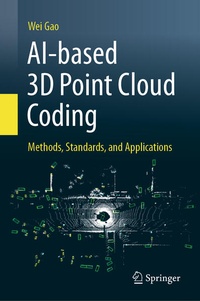
AI-based 3D Point Cloud Coding
Description

As 3D vision reshapes industries from augmented reality to autonomous systems, a critical challenge emerges: How can we efficiently process massive point cloud data without sacrificing quality? This book delivers the answer by unveiling the first unified framework that integrates AI-based coding algorithms, international standards (MPEG/JPEG/AVS), and real-world implementations-a breakthrough absent in existing literature. This book is a must-read for researchers, practitioners, and students who are interested in the interdisciplinary fields of artificial intelligence, data compression, immersive media, and 3D vision applications.
Featuring detailed discussions on both static and dynamic point cloud coding, the book systematically unpacks innovative methods, international standards, and open-source solutions. It addresses quality assessment, perception modeling, and artifact removal techniques-areas that pose significant challenges yet hold transformative potential for 3D data processing. By presenting comparative analyses of prominent standards, such as the deep learning-based point cloud coding standards from MPEG, JPEG, and AVS, alongside emerging AI-enhanced coding frameworks, the book equips professionals with the insights necessary to navigate and shape the future of multimedia communication and 3D vision technologies.
With its clear, segmented structure and targeted content, this book not only addresses current academic debates but also paves the way for future research and industrial applications. Readers are guided through a rich array of topics-from deep neural network fundamentals to lightweight implementations and rendering systems-ensuring they gain a robust, practical understanding of AI-based point cloud coding. Whether you are looking to advance your research, enhance your technical skills, or simply explore the forefront of 3D vision innovation, this book offers the critical tools and perspectives needed to excel.
More details
Other editions
Additional editions
Person
Wei Gao is an associate professor with tenure at the School of Electronic and Computer Engineering, Peking University, Shenzhen, China. He earned his Ph.D. in Computer Science from City University of Hong Kong in February 2017. Dr. Gao's research focuses on multimedia coding and processing, 3D vision and multimodal learning-areas directly relevant to the topics explored in this book. With over 200 high-quality technical papers published, he has made significant contributions to multimedia coding standardization by more than 30 adopted technical proposals. He is also the author or coauthor of three influential books, namely AI-based Image and Video Coding: Methods, Standards, and Applications; Point Cloud Compression: Technologies and Standardization and Deep Learning for 3D Point Clouds, published with Springer Nature.
Beyond his robust academic credentials, Dr. Gao actively serves on the editorial board of IEEE Transactions on Image Processing (TIP), IEEE Transactions on Circuits and Systems for Video Technology (TCSVT), IEEE Transactions on Multimedia (TMM), and holds elected memberships in both the IEEE Multimedia Systems and Applications Technical Committee (MSA-TC) and IEEE Visual Signal Processing and Communications Technical Committee (VSPC-TC). He leads several open-source projects, including OpenAICoding, OpenPointCloud, OpenDatasets, and OpenAIDring, which have become valuable resources for the research community. As a senior member of IEEE, he is also a frequent speaker at international conferences, where he shares his expertise on multimedia computing and artificial intelligence technologies.
Content
Chapter 1. Introduction to 3D Point Cloud Coding: Datasets and AI-based Trends.- Chapter 2. Fundamentals for Deep Learning-based 3D Point Cloud Coding.- Chapter 3. Quality Assessment and Perception Models for 3D Point Cloud.- Chapter 4. Deep Learning-based Static 3D Point Cloud Geometry Coding.- Chapter 5. Deep Learning-based Static 3D Point Cloud Attribute Coding.- Chapter 6. Deep Learning-based Dynamic 3D Point Cloud Coding.- Chapter 7. Human and Machine Perception Oriented 3D Point Cloud Coding.- Chapter 8. Compression Artifacts Removal for 3D Point Cloud Coding.- Chapter 9. Standards for AI-based 3D Point Cloud Coding.- Chapter 10. Implementations, Streaming, and Rendering for 3D Point Cloud Coding.- Chapter 11. Open Source Projects for 3D Point Cloud Coding.- Chapter 12. Future Works for AI-based 3D Point Cloud Coding.
