

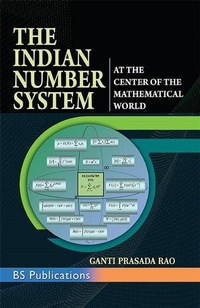
The Indian Number System
At the Center of the Mathematical World
Published on 11. July 2023
978-93-95038-46-1 (ISBN)
Description

This book presents well-established modern methods of representation and quantitative evaluation for a variety of entities, constants, functions, vectors, random quantities, fuzzy sets, and abstract entities such as relationships, cooperation, dependence, etc. and reveals striking similarities between these modern concepts and the Hindu-Arabic Decimal Number System. We regularly work with them without realizing these similarities perhaps because the centuries old Indian Number System became so commonplace today that these connections are not evidenced either by citations in the literature. It is hoped that this book will serve to throw some new light on the INS which is held in high esteem by great minds. The size of this book, its presentation in simple terms devoid of mystifying jargon, and its capture of the basic elements of the vast subject of mathematical concepts, especially in the field of systems and signals, are expected to be attractive to both teachers and students.
Review
"Considering Ganti Prasada Rao's book "Indian Number System (INS)- At the Center of the Mathematical world" I remember his visit in Berlin in 2003. He was guest of our Research Institute for Computer Architecture and Software Technology (FIRST) of the Fraunhofer Society /German National Research Center for Computer Science and gave a lecture with his historical view on number systems in mathematics and natural sciences up to their use in computer technology. Now I read his comprehensive book on this topic. It describes all the ideas and findings in the history of numbers and his experience as expert in systems theory of linear systems and self-organized systems. The book is a comprehensive description of the different number systems with special focus on the Indian number system and ended with mentioning functions and transformation. The book reflects Ganti Prasada Rao's wide field of interests and knowledge in the basics of mathematics and engineering and his novel insight into their connections with the Indian Number System. I recommend this worthwhile book to all scientists and students with interest in the basics of mathematics."
- Achim Sydow,
"This book is a masterpiece and a treasure house, data mining of number systems world over, unraveling the knowledge inherent in the ancient Hindu number system, the Vedic scriptures, and associating it to the multitude of present day mathematical concepts. We all know elementary mathematics and the Indian Number System (INS), but very few of us realize the original structure, its difference from the number systems of the rest of the world, and the hidden power in it. In this book the author has explained vividly the origin of the ancient Hindu number system, the origin of 1,2,3,.. and the radix 10. He also brought out the advantages of the INS over the other number systems. INS was originally known as the Hindu-Arabic system, since the Arabs were responsible mainly in spreading it to the western World, where the developments have taken place mostly. The author has also brought out clearly and amazingly, how many modern mathematical concepts such as scalars, vectors, functions f(t), representations as power series, orthogonal series, correlation, convolution, Integral Transforms, etc., up to the mathematics of Linear Dynamical Systems, ALL with examples, can be brought into the fold of the INS. He called the special feature of the INS as "Array Pair Structure" which is shown to be common between the INS and many mathematical modern mathematical concepts of representation and evaluation. Thus, the field of Mathematics is highly influenced by the INS. I consider this as the real contribution of this book and we adore the intellect and novelty of the author's presentation.
- B.L. Deekshatulu,
Review
"Considering Ganti Prasada Rao's book "Indian Number System (INS)- At the Center of the Mathematical world" I remember his visit in Berlin in 2003. He was guest of our Research Institute for Computer Architecture and Software Technology (FIRST) of the Fraunhofer Society /German National Research Center for Computer Science and gave a lecture with his historical view on number systems in mathematics and natural sciences up to their use in computer technology. Now I read his comprehensive book on this topic. It describes all the ideas and findings in the history of numbers and his experience as expert in systems theory of linear systems and self-organized systems. The book is a comprehensive description of the different number systems with special focus on the Indian number system and ended with mentioning functions and transformation. The book reflects Ganti Prasada Rao's wide field of interests and knowledge in the basics of mathematics and engineering and his novel insight into their connections with the Indian Number System. I recommend this worthwhile book to all scientists and students with interest in the basics of mathematics."
- Achim Sydow,
"This book is a masterpiece and a treasure house, data mining of number systems world over, unraveling the knowledge inherent in the ancient Hindu number system, the Vedic scriptures, and associating it to the multitude of present day mathematical concepts. We all know elementary mathematics and the Indian Number System (INS), but very few of us realize the original structure, its difference from the number systems of the rest of the world, and the hidden power in it. In this book the author has explained vividly the origin of the ancient Hindu number system, the origin of 1,2,3,.. and the radix 10. He also brought out the advantages of the INS over the other number systems. INS was originally known as the Hindu-Arabic system, since the Arabs were responsible mainly in spreading it to the western World, where the developments have taken place mostly. The author has also brought out clearly and amazingly, how many modern mathematical concepts such as scalars, vectors, functions f(t), representations as power series, orthogonal series, correlation, convolution, Integral Transforms, etc., up to the mathematics of Linear Dynamical Systems, ALL with examples, can be brought into the fold of the INS. He called the special feature of the INS as "Array Pair Structure" which is shown to be common between the INS and many mathematical modern mathematical concepts of representation and evaluation. Thus, the field of Mathematics is highly influenced by the INS. I consider this as the real contribution of this book and we adore the intellect and novelty of the author's presentation.
- B.L. Deekshatulu,
More details
Other editions
Additional editions
Ganti Prasada Rao
The Indian Number System - At the Center of the Mathematical World
Book
02/2023
Unknown
€36.50
Available (delivery time upon request)
