

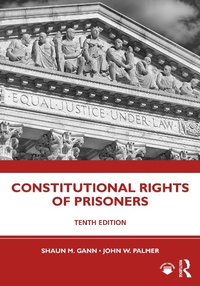
Constitutional Rights of Prisoners
10th Edition
Published on 19. July 2021
574 pages
978-1-000-40527-9 (ISBN)
Description

This updated tenth edition covers all aspects of prisoners' rights, including an overview of the judicial system and constitutional law and explanation of specific constitutional issues regarding correctional populations. It also discusses the federal statutes that affect correctional administration and inmates' rights to bring litigation. Accessible and reader-friendly, it provides a practical understanding of how constitutional law affects the day-to-day issues of prisons, jails, and community corrections programs.
The tenth edition includes a thorough update of relevant case law, and new chapters are included that deliver the latest developments on Search, Seizure, and Privacy, Juveniles and Youthful Offenders, and the Death Penalty. Part II contains the Supreme Court syllabi for the significant Court cases relating to the concepts covered.
This updated edition is appropriate as a primary text for undergraduate or graduate-level correctional law and prisoner rights courses within Criminal Justice, Criminology, and Sociology departments. It is also an invaluable reference tool for law students and correctional agencies.
The tenth edition includes a thorough update of relevant case law, and new chapters are included that deliver the latest developments on Search, Seizure, and Privacy, Juveniles and Youthful Offenders, and the Death Penalty. Part II contains the Supreme Court syllabi for the significant Court cases relating to the concepts covered.
This updated edition is appropriate as a primary text for undergraduate or graduate-level correctional law and prisoner rights courses within Criminal Justice, Criminology, and Sociology departments. It is also an invaluable reference tool for law students and correctional agencies.
More details
Edition
10th edition
Language
English
Place of publication
London
United Kingdom
Publishing group
Taylor & Francis Ltd
Target group
College/higher education
Illustrations
1 Tables, black and white; 1 Line drawings, black and white; 1 Illustrations, black and white
ISBN-13
978-1-000-40527-9 (9781000405279)
Copyright in bibliographic data and cover images is held by Nielsen Book Services Limited or by the publishers or by their respective licensors: all rights reserved.
Schweitzer Classification
Other editions
Additional editions
Shaun M. Gann | John W. Palmer
Constitutional Rights of Prisoners
Book
07/2021
10th Edition
Routledge
€170.20
Shipment within 15-20 days
Shaun M. Gann | John W. Palmer
Constitutional Rights of Prisoners
Book
07/2021
10th Edition
Routledge
€402.90
Shipment within 15-20 days
Persons
Shaun M. Gann is an assistant professor in the Department of Criminal Justice at Boise State University. He earned his PhD in Criminal Justice from the University of Cincinnati. He has also worked as a Parole Officer for the Arkansas Department of Community Corrections, where he gained extensive experience in the day-to-day operations of the correctional system. He regularly teaches both undergraduate and graduate-level courses in corrections, including Contemporary Issues in Corrections, Correctional Law, and Correctional Counseling. His research interests include correctional programming and policy; juvenile court decision-making; race and delinquency; and the effects of court decisions on criminal justice policy. He is the coauthor of Correctional Assessment, Casework, and Counseling. He has published research in leading peer-reviewed journals such as Youth Violence & Juvenile Justice, Journal of Developmental and Life Course Criminology, Journal of Crime and Justice, Journal of Juvenile Justice, and Journal of Criminal Justice Education.
John W. Palmer served as a Professor of Law at Capital University Law School for close to 30 years. He earned his JD from University of Michigan Law School in 1962 and continued his education in legal advocacy and languages across his career. In addition to practicing law, Palmer held teaching positions at Concordia International University in Estonia, University of Warsaw, Central European University, International University of Germany, American University in Armenia, and Ohio Dominican University. He was a three-time Fulbright Scholar, at the University of Stockholm, Sweden, 1962-1963; the University of Warsaw, Poland, 2003-2004; and Estonia, 2004. He has been a frequent speaker on Criminal Justice, International Law, and Labor Law in South America and Europe. Throughout his illustrious career, he has amassed a variety of distinguished honors, including the Ohio Association of Chiefs of Police Award, 1972; Fellow, American Bar Foundation, 1977-Present; Special Commendation from FBI Director William Webster, 1978; Special Recognition Award, National Association for Dispute Resolution, 1979 (shared award with President Jimmy Carter); Ritter Award, Night Prosecutor's Program, Ohio Bar Foundation, 1983; Team Member of Conference with Russian Leadership, Kremlin, 1987; and Special Award, Association International de Droit Penal, Siracusa, Italy, 1991.
John W. Palmer served as a Professor of Law at Capital University Law School for close to 30 years. He earned his JD from University of Michigan Law School in 1962 and continued his education in legal advocacy and languages across his career. In addition to practicing law, Palmer held teaching positions at Concordia International University in Estonia, University of Warsaw, Central European University, International University of Germany, American University in Armenia, and Ohio Dominican University. He was a three-time Fulbright Scholar, at the University of Stockholm, Sweden, 1962-1963; the University of Warsaw, Poland, 2003-2004; and Estonia, 2004. He has been a frequent speaker on Criminal Justice, International Law, and Labor Law in South America and Europe. Throughout his illustrious career, he has amassed a variety of distinguished honors, including the Ohio Association of Chiefs of Police Award, 1972; Fellow, American Bar Foundation, 1977-Present; Special Commendation from FBI Director William Webster, 1978; Special Recognition Award, National Association for Dispute Resolution, 1979 (shared award with President Jimmy Carter); Ritter Award, Night Prosecutor's Program, Ohio Bar Foundation, 1983; Team Member of Conference with Russian Leadership, Kremlin, 1987; and Special Award, Association International de Droit Penal, Siracusa, Italy, 1991.
Content
Part I: Correctional Law
1. An Overview of the Judicial System and Correctional Law
2. Religion in Prison
3. Searches, Seizures, and Privacy
4. Rights to Visitation and Association
5. Rights to Use of Mail, Internet, and Telephone
6. Rights to Medical Care and Rehabilitation Programs
7. Prisoner Legal Services
8. Additional Constitutional Issues
9. Isolated Confinement - "The Hole" and Administrative Segregation
10. Prisoner Disciplinary Proceedings
11. Use of Force
12. The Death Penalty
13. Parole and Probation
14. Juvenile and Youthful Offenders
15. Legal Remedies Available to Prisoners
16. Selected Federal Statutes Affecting Prisoners
Index of Cases for Part I
Part II: Supreme Court Decisions Relating to Part I
Appendix I: Constitutional Amendments
Appendix II: Selected Federal Statutes
1. An Overview of the Judicial System and Correctional Law
2. Religion in Prison
3. Searches, Seizures, and Privacy
4. Rights to Visitation and Association
5. Rights to Use of Mail, Internet, and Telephone
6. Rights to Medical Care and Rehabilitation Programs
7. Prisoner Legal Services
8. Additional Constitutional Issues
9. Isolated Confinement - "The Hole" and Administrative Segregation
10. Prisoner Disciplinary Proceedings
11. Use of Force
12. The Death Penalty
13. Parole and Probation
14. Juvenile and Youthful Offenders
15. Legal Remedies Available to Prisoners
16. Selected Federal Statutes Affecting Prisoners
Index of Cases for Part I
Part II: Supreme Court Decisions Relating to Part I
Appendix I: Constitutional Amendments
Appendix II: Selected Federal Statutes
