

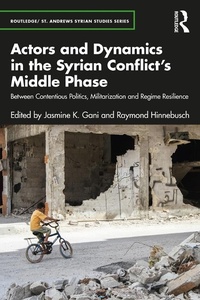
Actors and Dynamics in the Syrian Conflict's Middle Phase
Between Contentious Politics, Militarization and Regime Resilience
1st Edition
Published on 17. March 2022
452 pages
978-1-000-54593-7 (ISBN)
Description

This volume covers the "middle" time period of the Syrian uprising, roughly from 2012 when Syria's peaceful protest began to mutate into a violent insurgency and civil war until roughly 2018 when the conflict took on features of a "frozen conflict".
The middle period was important as one of key junctures or turning points when the struggle could have reached rather different outcomes. Non-violent protest failed to drive democratization and turned into violent insurrection but revolution from below also failed as did regime counter-insurgency, leaving protracted civil war the default outcome. Second, the consequences of civil war became evident with six themes: failing statehood coexisted with regime resilience; rebel governance emerged as a viable challenge to the regime; social forces were sharply polarized; external actors exacerbated internal divisions; a predatory war economy emerged; and intense violence led to massive displacement of the population.
Taking an innovative and interdisciplinary approach that seeks to capture the full complexity of the phenomenon, this book contributes significantly to our understanding of the Syrian conflict, therefore it will be of interest to academics, students, journalists and policy-makers interested in the Syrian civil war.
The middle period was important as one of key junctures or turning points when the struggle could have reached rather different outcomes. Non-violent protest failed to drive democratization and turned into violent insurrection but revolution from below also failed as did regime counter-insurgency, leaving protracted civil war the default outcome. Second, the consequences of civil war became evident with six themes: failing statehood coexisted with regime resilience; rebel governance emerged as a viable challenge to the regime; social forces were sharply polarized; external actors exacerbated internal divisions; a predatory war economy emerged; and intense violence led to massive displacement of the population.
Taking an innovative and interdisciplinary approach that seeks to capture the full complexity of the phenomenon, this book contributes significantly to our understanding of the Syrian conflict, therefore it will be of interest to academics, students, journalists and policy-makers interested in the Syrian civil war.
More details
Series
Edition
1. Auflage
Language
English
Place of publication
London
United Kingdom
Publishing group
Taylor & Francis Ltd
Target group
College/higher education
Product notice
Reflowable
Illustrations
9 Tables, black and white; 10 Line drawings, black and white; 3 Halftones, black and white; 13 Illustrations, black and white
ISBN-13
978-1-000-54593-7 (9781000545937)
Copyright in bibliographic data and cover images is held by Nielsen Book Services Limited or by the publishers or by their respective licensors: all rights reserved.
Schweitzer Classification
Other editions
Additional editions
Jasmine K. Gani | Raymond Hinnebusch
Actors and Dynamics in the Syrian Conflict's Middle Phase
Between Contentious Politics, Militarization and Regime Resilience
Book
03/2022
1st Edition
Routledge
€62.70
Shipment within 10-20 days
Jasmine K. Gani | Raymond Hinnebusch
Actors and Dynamics in the Syrian Conflict's Middle Phase
Between Contentious Politics, Militarization and Regime Resilience
Book
03/2022
1st Edition
Routledge
€207.90
Shipment within 10-20 days
Persons
Jasmine K. Gani is Senior Lecturer in the School of International Relations and Co-Director of the Centre for Syrian Studies at the University of St Andrews. Her research, supervision, and teaching focus on three main areas: the history of European and US empires in the Middle East and Asia, with particular focus on US-Syrian relations; ideologies and social movements in the Middle East; and postcolonial thought and history. She is the author of The Role of Ideology in Syrian-US Relations: Conflict and Cooperation, and co-editor of the Routledge Handbook on the Middle East and North Africa State and States System (with Raymond Hinnebusch).
Raymond Hinnebusch is professor of international relations and Middle East politics and founder and Co-Director of the Centre for Syrian Studies at the University of St. Andrews. His works include Authoritarian Power and State Formation in Ba'thist Syria (1990) and Syria: Revolution from Above (Routledge: 2001); he co-edited Syria: From Reform to Revolt, (Syracuse, 2014); The Syrian Uprising: Domestic Factors and Early Trajectory (Routledge 2018) and The War for Syria: Regional and International Factors in the Syrian Conflict (Routledge 2019), and edited After the Arab Uprisings: Between Democratization, Counter-revolution and State Failure (Routledge 2016).
Raymond Hinnebusch is professor of international relations and Middle East politics and founder and Co-Director of the Centre for Syrian Studies at the University of St. Andrews. His works include Authoritarian Power and State Formation in Ba'thist Syria (1990) and Syria: Revolution from Above (Routledge: 2001); he co-edited Syria: From Reform to Revolt, (Syracuse, 2014); The Syrian Uprising: Domestic Factors and Early Trajectory (Routledge 2018) and The War for Syria: Regional and International Factors in the Syrian Conflict (Routledge 2019), and edited After the Arab Uprisings: Between Democratization, Counter-revolution and State Failure (Routledge 2016).
Content
1. Introduction, The Syrian Uprising: Between Peaceful Protest and State Failure Part I. Critical Junctures 2. Governance amidst Civil War: from Failing Statehood to Competitive regime Re-formation 3. Three Faces of the Syrian Contentious Movement: 'Externalisation' of Contention in the Middle Phase of the Syrian Conflict 4. The Syrian Civil War's 2015 Impasse: How Russia's Intervention Turned the Tide 5. International Conflict Mediation in Syria: From 'Transformation' to 'Containment' Part II. Local Contentious Politics 6. The Struggle for Territory: Territorial fragmentation and Competitive Governance in Syria through three case studies 7. The Syrian Interim Government: Potential thwarted by domestic 'irrelevance' and foreign neglect 8. Who owns the law? Logics of Insurgent Courts in the Syrian War (2012 - 2017) 9. The Battle for Deir ez-Zor (2011-2017) Part III. Militarisation, Division, and Regime Resilience 10. Alawite Opposition and the Rise of ISIS 11. Tribes at War 12. Tracing Kurdish Politics in Syria and its Prospects 13. How did Muhajiroun become Jihadists? Foreign Fighters and the Geopolitics of the Conflict in Syria Part IV. The War Economy 14. Capital, Business Elites and the Syrian Uprising 15. Syria's Banking Sector: from crony capitalism to a survivalist strategy amidst the Syrian conflict 16. Division and Cooperation among Syrian Businessmen in Turkey: an Investigation of the Political and Economic Behaviour of Syrian Business Migrants Part V. Transnationalism in the Syrian Conflict: Intellectuals to Refugees 17. Syrians and the Quest for their voice 18. Syrian Intellectuals and the Media: competing narratives and discursive wars 19. The Syrian Humanitarian Disaster: Understanding Perceptions and Aspirations in Jordan, Lebanon and Turkey 20. Trans-local Activism and the Syrian struggle in global politics - Civil society, agency, and 'new' political spaces
