

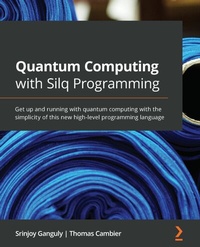
Quantum Computing with Silq Programming
Get up and running with quantum computing with the simplicity of this new high-level programming language
Published on 23. September 2024
310 pages
978-1-80056-121-2 (ISBN)
Description

Learn the mathematics behind quantum computing and explore the high-level quantum language Silq to take your quantum programming skills to the next level
Key Features
Harness the potential of quantum computers more effectively using Silq
Learn how to solve core problems that you may face while writing quantum programs
Explore useful quantum applications such as cryptography and quantum machine learning
Book DescriptionQuantum computing is a growing field, with many research projects focusing on programming quantum computers in the most efficient way possible. One of the biggest challenges faced with existing languages is that they work on low-level circuit model details and are not able to represent quantum programs accurately. Developed by researchers at ETH Zurich after analyzing languages including Q# and Qiskit, Silq is a high-level programming language that can be viewed as the C++ of quantum computers! Quantum Computing with Silq Programming helps you explore Silq and its intuitive and simple syntax to enable you to describe complex tasks with less code. This book will help you get to grips with the constructs of the Silq and show you how to write quantum programs with it. You'll learn how to use Silq to program quantum algorithms to solve existing and complex tasks. Using quantum algorithms, you'll also gain practical experience in useful applications such as quantum error correction, cryptography, and quantum machine learning. Finally, you'll discover how to optimize the programming of quantum computers with the simple Silq. By the end of this Silq book, you'll have mastered the features of Silq and be able to build efficient quantum applications independently.What you will learn
Identify the challenges that researchers face in quantum programming
Understand quantum computing concepts and learn how to make quantum circuits
Explore Silq programming constructs and use them to create quantum programs
Use Silq to code quantum algorithms such as Grover s and Simon's
Discover the practicalities of quantum error correction with Silq
Explore useful applications such as quantum machine learning in a practical way
Who this book is forThis Silq quantum computing book is for students, researchers, and scientists looking to learn quantum computing techniques and software development. Quantum computing enthusiasts who want to explore this futuristic technology will also find this book useful. Beginner-level knowledge of any programming language as well as mathematical topics such as linear algebra, probability, complex numbers, and statistics is required.
Key Features
Harness the potential of quantum computers more effectively using Silq
Learn how to solve core problems that you may face while writing quantum programs
Explore useful quantum applications such as cryptography and quantum machine learning
Book DescriptionQuantum computing is a growing field, with many research projects focusing on programming quantum computers in the most efficient way possible. One of the biggest challenges faced with existing languages is that they work on low-level circuit model details and are not able to represent quantum programs accurately. Developed by researchers at ETH Zurich after analyzing languages including Q# and Qiskit, Silq is a high-level programming language that can be viewed as the C++ of quantum computers! Quantum Computing with Silq Programming helps you explore Silq and its intuitive and simple syntax to enable you to describe complex tasks with less code. This book will help you get to grips with the constructs of the Silq and show you how to write quantum programs with it. You'll learn how to use Silq to program quantum algorithms to solve existing and complex tasks. Using quantum algorithms, you'll also gain practical experience in useful applications such as quantum error correction, cryptography, and quantum machine learning. Finally, you'll discover how to optimize the programming of quantum computers with the simple Silq. By the end of this Silq book, you'll have mastered the features of Silq and be able to build efficient quantum applications independently.What you will learn
Identify the challenges that researchers face in quantum programming
Understand quantum computing concepts and learn how to make quantum circuits
Explore Silq programming constructs and use them to create quantum programs
Use Silq to code quantum algorithms such as Grover s and Simon's
Discover the practicalities of quantum error correction with Silq
Explore useful applications such as quantum machine learning in a practical way
Who this book is forThis Silq quantum computing book is for students, researchers, and scientists looking to learn quantum computing techniques and software development. Quantum computing enthusiasts who want to explore this futuristic technology will also find this book useful. Beginner-level knowledge of any programming language as well as mathematical topics such as linear algebra, probability, complex numbers, and statistics is required.
All prices
More details
Edition
Digital original
Language
English
Place of publication
Birmingham
United Kingdom
Target group
Professional and scholarly
US School Grade: College Graduate Student
Edition type
Digital original
Product notice
Reflowable
File size
8,66 MB
ISBN-13
978-1-80056-121-2 (9781800561212)
Copyright in bibliographic data and cover images is held by Nielsen Book Services Limited or by the publishers or by their respective licensors: all rights reserved.
Schweitzer Classification
Other editions
Additional editions
Srinjoy Ganguly | Thomas Cambier
Quantum Computing with Silq Programming
Get up and running with quantum computing with the simplicity of this new high-level programming language
Book
04/2021
Packt Publishing
€51.20
Shipment within 3-4 weeks
Persons
Ganguly Srinjoy :
Srinjoy Ganguly works as a quantum AI research scientist at Fractal Analytics. He has 4+ years of experience in quantum computing, and is an IBM Qiskit advocate and educator. He also teaches quantum computing at Woxsen University as a visiting professor. His research interests include QNLP, category theory with compositionality, variational quantum algorithms and their applications, and machine learning.Cambier Thomas :
Thomas Cambier is a French programmer and software developer. After studying top-level mathematics, physics, and computer science at Ecole Polytechnique, France's leading engineering school, he obtained a Master's degree in computer science at ETH Zuerich on a broad range of subjects going from algorithmics and cryptography to object-oriented programming. Deeply interested in the promising possibilities resulting from quantum computing, he wrote his Master's thesis on the design of quantum algorithms with Silq, a brand-new high-level quantum language created by a research group at ETH Zuerich.
Srinjoy Ganguly works as a quantum AI research scientist at Fractal Analytics. He has 4+ years of experience in quantum computing, and is an IBM Qiskit advocate and educator. He also teaches quantum computing at Woxsen University as a visiting professor. His research interests include QNLP, category theory with compositionality, variational quantum algorithms and their applications, and machine learning.Cambier Thomas :
Thomas Cambier is a French programmer and software developer. After studying top-level mathematics, physics, and computer science at Ecole Polytechnique, France's leading engineering school, he obtained a Master's degree in computer science at ETH Zuerich on a broad range of subjects going from algorithmics and cryptography to object-oriented programming. Deeply interested in the promising possibilities resulting from quantum computing, he wrote his Master's thesis on the design of quantum algorithms with Silq, a brand-new high-level quantum language created by a research group at ETH Zuerich.
Content
Table of Contents
Essential Mathematics and Algorithmic Thinking
Quantum Bits, the Quantum Measurements, and Quantum Logic Gates
Multiple Quantum Bits, Entanglement, and Quantum Circuits
Physical Realization of a Quantum Computer
Challenges in Quantum Computer Programming
Silq Programming Basics and Features
Programming Multiple Qubit Quantum Circuits with Silq
Quantum Algorithms I - Deutsch-Jozsa and Bernstein-Vazirani
Quantum Algorithms II - Grover
Quantum Algorithms III: Quantum Fourier Transform and Phase Estimation
Quantum Error Correction
Quantum Cryptography: Quantum Key Distribution (QKD)
Quantum Machine Learning
Essential Mathematics and Algorithmic Thinking
Quantum Bits, the Quantum Measurements, and Quantum Logic Gates
Multiple Quantum Bits, Entanglement, and Quantum Circuits
Physical Realization of a Quantum Computer
Challenges in Quantum Computer Programming
Silq Programming Basics and Features
Programming Multiple Qubit Quantum Circuits with Silq
Quantum Algorithms I - Deutsch-Jozsa and Bernstein-Vazirani
Quantum Algorithms II - Grover
Quantum Algorithms III: Quantum Fourier Transform and Phase Estimation
Quantum Error Correction
Quantum Cryptography: Quantum Key Distribution (QKD)
Quantum Machine Learning
