

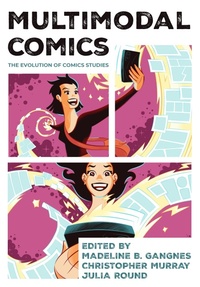
Multimodal Comics
The Evolution of Comics Studies
Published on 13. March 2024
300 pages
978-1-78938-948-7 (ISBN)
Description

Comics have always embraced a diversity of formats, existing in complex relationships to other media, and been dynamic in their response to new technologies and means of distribution. This collection explores interactions between comics, other media and technologies, employing a wide range of theoretical and critical perspectives.
By focusing on key critical concepts within multimodality (transmediality, adaptation, intertextuality) and addressing multiple platforms and media (digital, analogue, music, prose, linguistics, graphics), it expands and develops existing comics theory and also addresses multiple other media and disciplines.
Over the last decade Studies in Comics has been at the forefront of international research in comics. This volume showcases some of the best research to appear in the journal. In so doing it demonstrates the evolution of Comics Studies over the last decade and shows how this research field has engaged with various media and technologies in a continuously evolving artistic and production environment. The theme of multimodality is particularly apt since media and technologies have changed significantly during this period. The collection will thus give a view of the ways in which comics scholars have engaged with multimodality during a time when "modes" were continually changing.
By focusing on key critical concepts within multimodality (transmediality, adaptation, intertextuality) and addressing multiple platforms and media (digital, analogue, music, prose, linguistics, graphics), it expands and develops existing comics theory and also addresses multiple other media and disciplines.
Over the last decade Studies in Comics has been at the forefront of international research in comics. This volume showcases some of the best research to appear in the journal. In so doing it demonstrates the evolution of Comics Studies over the last decade and shows how this research field has engaged with various media and technologies in a continuously evolving artistic and production environment. The theme of multimodality is particularly apt since media and technologies have changed significantly during this period. The collection will thus give a view of the ways in which comics scholars have engaged with multimodality during a time when "modes" were continually changing.
More details
Language
English
Place of publication
Bristol
United Kingdom
Publishing group
Intellect
Target group
College/higher education
Illustrations
53 Halftones, black and white; 6 Halftones, color
ISBN-13
978-1-78938-948-7 (9781789389487)
Copyright in bibliographic data and cover images is held by Nielsen Book Services Limited or by the publishers or by their respective licensors: all rights reserved.
Schweitzer Classification
Other editions
Additional editions
Madeline B. Gangnes | Christopher Murray | Julia Round
Multimodal Comics
The Evolution of Comics Studies
Book
05/2024
Intellect Books
€148.49
Shipment within 3-4 weeks
Persons
Madeline Gangnes is an assistant professor of English at the University of Scranton in Pennsylvania, USA. She is a co-editor of Studies in Comics and the advisory editor of Sequentials. Her work appears in Studies in Comics, the
Journal of Graphic Novels and Comics, the Victorian Periodicals Review, and Key Terms in Comics Studies, among other publications.
Professor Christopher Murray is professor of Comics Studies and English Literature in the School of Humanities, Social Sciences and Law at the University of Dundee, Scotland. He leads the Masters in Comics and Graphic Novels and is director of the Scottish Centre for Comics Studies and Dundee Comics Creative Space. He is a founding co-editor of Studies in Comics.
Julia Round's books include Gothic in Comics and Graphic Novels (2014) and the award-winning Gothic for Girls (2019). She is associate professor of English and Comics Studies at Bournemouth University, UK, and one of the founders and co-editors of Studies in Comics journal and the Encapsulations book series.
Journal of Graphic Novels and Comics, the Victorian Periodicals Review, and Key Terms in Comics Studies, among other publications.
Professor Christopher Murray is professor of Comics Studies and English Literature in the School of Humanities, Social Sciences and Law at the University of Dundee, Scotland. He leads the Masters in Comics and Graphic Novels and is director of the Scottish Centre for Comics Studies and Dundee Comics Creative Space. He is a founding co-editor of Studies in Comics.
Julia Round's books include Gothic in Comics and Graphic Novels (2014) and the award-winning Gothic for Girls (2019). She is associate professor of English and Comics Studies at Bournemouth University, UK, and one of the founders and co-editors of Studies in Comics journal and the Encapsulations book series.
Content
List of Figures
Foreword
Roger Sabin
Introduction
Madeline B. Gangnes, Christopher Murray, and Julia Round
SECTION ONE: MULTIPLICITY AND (INTER)TEXTUALITY
The Shape of Comic Book Reading
A. David Lewis
Re-inventing the Origins of the Boy Who Wouldn't Grow Up: Regis Loisel's Peter Pan
Armelle Blin-Rolland
The Myth of Eco: Cultural Populism and Comics Studies
Marc Singer
Intertwining Verbal and Visual Elements in Printed Narratives for Adults
Pascal Lefevre
SECTION TWO: METACOMICS AND THE DIGITAL
Spiegelman's Magic Box: MetaMaus and the Archive of Representation
Elisabeth R. Friedman
Meaning from Movement: Blurring the Temporal Border between Animation and Comics
Joshua Gowdy
SECTION THREE: LINGUISTICS AND LANGUAGE
Narrative, Language, and Comics-as-Literature
Hannah Miodrag
The Cognitive Grammar of 'I': Viewing Arrangements in Graphic Autobiographies
Christian W. Schneider
SECTION FOUR: SOUND AND VISION
Sound Affects: Visualizing Music, Musicians, and (Sub)Cultural Identity in BECK and Scott Pilgrim
Camilo Diaz Pino
The Musicalization of Graphic Narratives and P. Craig Russell's Graphic Novel Operas, 'The Magic Flute' and 'Salome'
Victoria Addis
SECTION FIVE: FROM MATERIAL TO TRANSTEXTUAL AND BEYOND
'Animating' the Narrative in Abstract Comics
Paul Fisher Davies
Multimodal Duck-Rabbitry: Multistable Perception and the Narrative Potential of Fold-Ins
Thomas Hamlyn-Harris and Ross Watkins
Resisting Narrative Immersion
Greice Schneider
Square Eyes: Augmenting Bodies, Boredom, and Things
Merlyn Seller
Afterword
Madeline B. Gangnes, Christopher Murray, and Julia Round
Notes on Contributors
Index
Foreword
Roger Sabin
Introduction
Madeline B. Gangnes, Christopher Murray, and Julia Round
SECTION ONE: MULTIPLICITY AND (INTER)TEXTUALITY
The Shape of Comic Book Reading
A. David Lewis
Re-inventing the Origins of the Boy Who Wouldn't Grow Up: Regis Loisel's Peter Pan
Armelle Blin-Rolland
The Myth of Eco: Cultural Populism and Comics Studies
Marc Singer
Intertwining Verbal and Visual Elements in Printed Narratives for Adults
Pascal Lefevre
SECTION TWO: METACOMICS AND THE DIGITAL
Spiegelman's Magic Box: MetaMaus and the Archive of Representation
Elisabeth R. Friedman
Meaning from Movement: Blurring the Temporal Border between Animation and Comics
Joshua Gowdy
SECTION THREE: LINGUISTICS AND LANGUAGE
Narrative, Language, and Comics-as-Literature
Hannah Miodrag
The Cognitive Grammar of 'I': Viewing Arrangements in Graphic Autobiographies
Christian W. Schneider
SECTION FOUR: SOUND AND VISION
Sound Affects: Visualizing Music, Musicians, and (Sub)Cultural Identity in BECK and Scott Pilgrim
Camilo Diaz Pino
The Musicalization of Graphic Narratives and P. Craig Russell's Graphic Novel Operas, 'The Magic Flute' and 'Salome'
Victoria Addis
SECTION FIVE: FROM MATERIAL TO TRANSTEXTUAL AND BEYOND
'Animating' the Narrative in Abstract Comics
Paul Fisher Davies
Multimodal Duck-Rabbitry: Multistable Perception and the Narrative Potential of Fold-Ins
Thomas Hamlyn-Harris and Ross Watkins
Resisting Narrative Immersion
Greice Schneider
Square Eyes: Augmenting Bodies, Boredom, and Things
Merlyn Seller
Afterword
Madeline B. Gangnes, Christopher Murray, and Julia Round
Notes on Contributors
Index
