

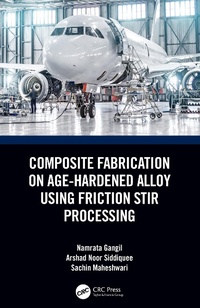
Composite Fabrication on Age-Hardened Alloy using Friction Stir Processing
1st Edition
Published on 13. December 2020
144 pages
978-1-000-29901-4 (ISBN)
Description

This up-to-date reference text discusses the fabrication technique for strengthening of high specific strength alloys including age-hardened aluminum alloys for several industrial applications.
The text presents an exhaustive overview of the materials used in the aircraft construction in general and age-hardened aluminum alloys in particular. The text discusses important concepts including surface composite fabrication using friction stir processing (FSP), FSP tools, effect of reinforcement particles, and conditions that affect strengthening during surface composite fabrication on age-hardened aluminum alloys. The text will facilitate the readers to control parameters and avoid conditions that lead to a net negative impact on the resulting composites and select the one that lead to a net gain. It will enable the readers, researchers, and professionals to plan and practice composite fabrication via FSP with a benefit of net strengthening.
The understanding of specific strength of materials used in applications including aerial vehicles and manufacturing is important. The proposed text highlights importance of age-hardened alloy as one of the materials used for diverse applications. It discusses strengthening strategies of existing age-hardened aluminum alloys through composite fabrication via a solid-state FSP route. The text will help students and professionals working in the field of manufacturing, materials science, and aerospace engineering.
The text discusses an important aspect of strengthening age-hardened alloy using solid-state friction stir processing for diverse applications in industries including manufacturing and aviation. It will serve as an ideal reference for graduate students, academic researchers, and professionals in the field of mechanical engineering, aerospace engineering, and materials science. It will also be helpful to the professionals working in the aviation and manufacturing industries.
The text presents an exhaustive overview of the materials used in the aircraft construction in general and age-hardened aluminum alloys in particular. The text discusses important concepts including surface composite fabrication using friction stir processing (FSP), FSP tools, effect of reinforcement particles, and conditions that affect strengthening during surface composite fabrication on age-hardened aluminum alloys. The text will facilitate the readers to control parameters and avoid conditions that lead to a net negative impact on the resulting composites and select the one that lead to a net gain. It will enable the readers, researchers, and professionals to plan and practice composite fabrication via FSP with a benefit of net strengthening.
The understanding of specific strength of materials used in applications including aerial vehicles and manufacturing is important. The proposed text highlights importance of age-hardened alloy as one of the materials used for diverse applications. It discusses strengthening strategies of existing age-hardened aluminum alloys through composite fabrication via a solid-state FSP route. The text will help students and professionals working in the field of manufacturing, materials science, and aerospace engineering.
The text discusses an important aspect of strengthening age-hardened alloy using solid-state friction stir processing for diverse applications in industries including manufacturing and aviation. It will serve as an ideal reference for graduate students, academic researchers, and professionals in the field of mechanical engineering, aerospace engineering, and materials science. It will also be helpful to the professionals working in the aviation and manufacturing industries.
More details
Edition
1. Auflage
Language
English
Place of publication
London
United Kingdom
Publishing group
Taylor & Francis Ltd
Target group
College/higher education
Professional and scholarly
Illustrations
13 Tables, black and white; 41 Line drawings, black and white; 31 Halftones, black and white; 72 Illustrations, black and white
ISBN-13
978-1-000-29901-4 (9781000299014)
Copyright in bibliographic data and cover images is held by Nielsen Book Services Limited or by the publishers or by their respective licensors: all rights reserved.
Schweitzer Classification
Other editions
Additional editions
Namrata Gangil | Arshad Noor Siddiquee | Sachin Maheshwari
Composite Fabrication on Age-Hardened Alloy using Friction Stir Processing
Book
10/2024
1st Edition
CRC Press
€69.70
Shipment within 15-20 days
Namrata Gangil | Arshad Noor Siddiquee | Sachin Maheshwari
Composite Fabrication on Age-Hardened Alloy using Friction Stir Processing
Book
12/2020
1st Edition
CRC Press
€169.60
Shipment within 15-20 days
Persons
"Namrata Gangil is working as an assistant professor in the department of mechanical engineering, Ajay Kumar Garg Engineering College, Ghaziabad, India. She has over eight years of teaching and research experience at undergraduate and postgraduate levels. She has published several high impact SCI research articles in esteemed journals. Her research areas include welding, friction stir welding, friction stir processing, and material-structure-property correlation.
Arshad Noor Siddiquee is a professor in the department of mechanical engineering at Jamia Millia Islamia (A Central University), New Delhi, India. His major research interest includes frictions stir welding, friction stir processing, material technology, welding engineering, and machining. He has published more than 145 articles in reputed journals. He has also co-authored five books/monographs and has patents to his credit.
Sachin Maheshwari is a professor in the division of manufacturing processes and automation engineering at the Netaji Subhas University of Technology, New Delhi, India. His major research interest includes welding fluxes, frictions stir welding, friction stir processing, materials-structure-property correlation, and welding engineering. He has a number of research articles on promising areas in reputed journals and several patents many of which have been commercialized too. "
Arshad Noor Siddiquee is a professor in the department of mechanical engineering at Jamia Millia Islamia (A Central University), New Delhi, India. His major research interest includes frictions stir welding, friction stir processing, material technology, welding engineering, and machining. He has published more than 145 articles in reputed journals. He has also co-authored five books/monographs and has patents to his credit.
Sachin Maheshwari is a professor in the division of manufacturing processes and automation engineering at the Netaji Subhas University of Technology, New Delhi, India. His major research interest includes welding fluxes, frictions stir welding, friction stir processing, materials-structure-property correlation, and welding engineering. He has a number of research articles on promising areas in reputed journals and several patents many of which have been commercialized too. "
Content
1 Introduction 2 State of the Art 3 Aspects and Challenges of SC Fabrication on AA7050 Alloy 4 Case Study for SC Fabrication on AA7050 Alloy Through FSP 5 Future Directions
