

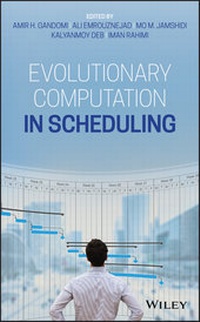
Evolutionary Computation in Scheduling
Description

This book provides insight into the use of evolutionary computations (EC) in real-world scheduling, showing readers how to choose a specific evolutionary computation and how to validate the results using metrics and statistics. It offers a spectrum of real-world optimization problems, including applications of EC in industry and service organizations such as healthcare scheduling, aircraft industry, school timetabling, manufacturing systems, and transportation scheduling in the supply chain. It also features problems with different degrees of complexity, practical requirements, user constraints, and MOEC solution approaches.
Evolutionary Computation in Scheduling starts with a chapter on scientometric analysis to analyze scientific literature in evolutionary computation in scheduling. It then examines the role and impacts of ant colony optimization (ACO) in job shop scheduling problems, before presenting the application of the ACO algorithm in healthcare scheduling. Other chapters explore task scheduling in heterogeneous computing systems and truck scheduling using swarm intelligence, application of sub-population scheduling algorithm in multi-population evolutionary dynamic optimization, task scheduling in cloud environments, scheduling of robotic disassembly in remanufacturing using the bees algorithm, and more. This book:
* Provides a representative sampling of real-world problems currently being tackled by practitioners
* Examines a variety of single-, multi-, and many-objective problems that have been solved using evolutionary computations, including evolutionary algorithms and swarm intelligence
* Consists of four main parts: Introduction to Scheduling Problems, Computational Issues in Scheduling Problems, Evolutionary Computation, and Evolutionary Computations for Scheduling Problems
Evolutionary Computation in Scheduling is ideal for engineers in industries, research scholars, advanced undergraduates and graduate students, and faculty teaching and conducting research in Operations Research and Industrial Engineering.
More details
Other editions
Additional editions

Persons
AMIR H. GANDOMI, PHD, is Professor of Data Science at University of Technology Sydney, Australia.
ALI EMROUZNEJAD, PHD, is Professor and Chair of Business Analytics at Aston University, UK.
MO M. JAMSHIDI, PHD, is Lutcher Brown Endowed Chair and Professor of Electrical and Computer Engineering at the University of Texas at San Antonio, USA.
KALYANMOY DEB, PHD, is Koenig Endowed Chair and Professor of Electrical and Computer Engineering at Michigan State University, USA.
IMAN RAHIMI, PHD, is a member of the Young Researchers and Elite Club, Isfahan (Khorasgan) Branch at Islamic Azad University, Iran.
Content
List of Contributors vii
Editors' Biographies xi
Preface xv
Acknowledgments xvii
1 Evolutionary Computation in Scheduling: A Scientometric Analysis 1
Amir H. Gandomi, Ali Emrouznejad, and Iman Rahimi
2 Role and Impacts of Ant Colony Optimization in Job Shop Scheduling Problems: A Detailed Analysis 11
P. Deepalakshmi and K. Shankar
3 Advanced Ant Colony Optimization in Healthcare Scheduling 37
Reza Behmanesh, Iman Rahimi, Mostafa Zandieh, and Amir H. Gandomi
4 Task Scheduling in Heterogeneous Computing Systems Using Swarm Intelligence 73
S. Sarathambekai and K. Umamaheswari
5 Computationally Efficient Scheduling Schemes for Multiple Antenna Systems Using Evolutionary Algorithms and Swarm Optimization 105
Prabina Pattanayak and Preetam Kumar
6 An Efficient Modified Red Deer Algorithm to Solve a Truck Scheduling Problem Considering Time Windows and Deadline for Trucks' Departure 137
Amir Mohammad Fathollahi-Fard, Abbas Ahmadi, and Mohsen S. Sajadieh
7 Application of Sub-Population Scheduling Algorithm in Multi-Population Evolutionary Dynamic Optimization 169
Javidan Kazemi Kordestani and Mohammad Reza Meybodi
8 Task Scheduling in Cloud Environments: A Survey of Population-Based Evolutionary Algorithms 213
Fahimeh Ramezani, Mohsen Naderpour, Javid Taheri, Jack Romanous, and Albert Y. Zomaya
9 Scheduling of Robotic Disassembly in Remanufacturing Using Bees Algorithms 257
Jiayi Liu, Wenjun Xu, Zude Zhou, and Duc Truong Pham
10 A Modified Fireworks Algorithm to Solve the Heat and Power Generation Scheduling Problem in Power System Studies 299
Mohammad Sadegh Javadi, Ali Esmaeel Nezhad, Seyed-Ehsan Razavi, Abdollah Ahmadi, and João P.S. Catalão
Index 327
