

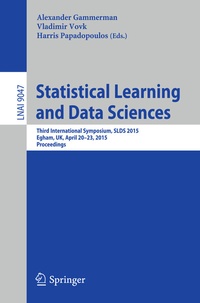
Statistical Learning and Data Sciences
Description

The 36 revised full papers presented together with 2 invited papers were carefully reviewed and selected from 59 submissions. The papers are organized in topical sections on statistical learning and its applications, conformal prediction and its applications, new frontiers in data analysis for nuclear fusion, and geometric data analysis.
More details
Other editions
Additional editions
Content
Learning with Intelligent Teacher: Similarity Control and Knowledge Transfer.- Statistical Inference Problems and Their Rigorous Solutions.- Feature Mapping Through Maximization of the Atomic Interclass Distances.- Adaptive Design of Experiments for Sobol Indices Estimation Based on Quadratic Metamodel.- GoldenEye++: A Closer Look into the Black Box.- Gaussian Process Regression for Structured Data Sets.- Adaptive Design of Experiments Based on Gaussian Processes.- Forests of Randomized Shapelet Trees.- Aggregation of Adaptive Forecasting Algorithms Under Asymmetric Loss Function.- Visualization and Analysis of Multiple Time Series by Beanplot PCA.- Recursive SVM Based on TEDA.- RDE with Forgetting: An Approximate Solution for Large Values of k with an Application to Fault Detection Problems.- Sit-to-Stand Movement Recognition Using Kinect.- Additive Regularization of Topic Models for Topic Selection and Sparse Factorization.- Social Web-Based Anxiety Index's Predictive Information on S&P 500 Revisited.- Exploring the Link Between Gene Expression and Protein Binding by Integrating mRNA Microarray and ChIP-Seq Data.- Evolving Smart URL Filter in a Zone-Based Policy Firewall for Detecting Algorithmically Generated Malicious Domains.- Lattice-Theoretic Approach to Version Spaces in Qualitative Decision Making.- A Comparison of Three Implementations of Multi-Label Conformal Prediction.- Modifications to p-Values of Conformal Predictors.- Cross-Conformal Prediction with Ridge Regression.- Handling Small Calibration Sets in Mondrian Inductive Conformal Regressors.- Conformal Anomaly Detection of Trajectories with a Multi-class Hierarchy.- Model Selection Using Efficiency of Conformal Predictors.- Confidence Sets forClassification.- Conformal Clustering and Its Application to Botnet Traffic.- Interpretation of Conformal Prediction Classification Models.- New Frontiers in Data Analysis for Nuclear Fusion Confinement Regime Identification Using Artificial Intelligence Methods.- How to Handle Error Bars in Symbolic Regression for Data Mining in Scientific Applications.- Applying Forecasting to Fusion Databases.- Computationally Efficient Five-Class Image Classifier Based on Venn Predictors.- SOM and Feature Weights Based Method for Dimensionality Reduction in Large Gauss Linear Models.- Geometric Data Analysis Assigning Objects to Classes of a Euclidean Ascending Hierarchical Clustering.- The Structure of Argument: Semantic Mapping of US Supreme Court Cases.- Supporting Data Analytics for Smart Cities: An Overview of Data Models and Topology.- Manifold Learning in Regression Tasks.- Random Projection Towards the Baire Metric for High Dimensional Clustering.- Optimal Coding for Discrete Random Vector.
