

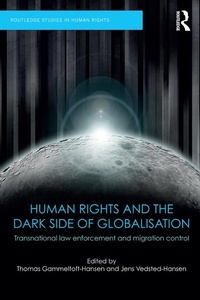
Human Rights and the Dark Side of Globalisation
Transnational law enforcement and migration control
Published on 8. December 2016
380 pages
978-1-315-40825-5 (ISBN)
Description

This edited volume examines the continued viability of international human rights law in the context of growing transnational law enforcement. With states increasingly making use of global governance modes, core exercises of public authority such as migration control, surveillance, detention and policing, are increasingly conducted extraterritorially, outsourced to foreign governments or delegated to non-state actors.
New forms of cooperation raise difficult questions about divided, shared and joint responsibility under international human rights law. At the same time, some governments engage in transnational law enforcement exactly to avoid such responsibilities, creatively seeking to navigate the complex, overlapping and sometimes unclear bodies of international law. As such, this volume argues that this area represents a particular dark side of globalisation, requiring both scholars and practitioners to revisit basic assumptions and legal strategies.
The volume will be of great interest to students, scholars and practitioners of international relations, human rights and public international law.
New forms of cooperation raise difficult questions about divided, shared and joint responsibility under international human rights law. At the same time, some governments engage in transnational law enforcement exactly to avoid such responsibilities, creatively seeking to navigate the complex, overlapping and sometimes unclear bodies of international law. As such, this volume argues that this area represents a particular dark side of globalisation, requiring both scholars and practitioners to revisit basic assumptions and legal strategies.
The volume will be of great interest to students, scholars and practitioners of international relations, human rights and public international law.
Reviews / Votes
'The topic of this book is as important and timely as its contributions are expert and original. As the phenomenon of mass migration has come to increased prominence on the agenda of global public policy, so too the efforts made by states to control their borders, restrict immigration and engage in cross-border law-enforcement and surveillance have raised important questions about the negative effects on human rights protection of cooperative activities by states at a regional and global level. This book offers an impressive and authoritative tour d'horizon of the key legal aspects, and as such is essential reading for policy makers, practitioners, academics and students working on the topic.' - Ralph Wilde, Faculty of Laws, University College London, UKMore details
Series
Language
English
Place of publication
London
United Kingdom
Publishing group
Taylor & Francis Ltd
Target group
College/higher education
Illustrations
1 Line drawings, black and white; 1 Illustrations, black and white
File size
3,47 MB
ISBN-13
978-1-315-40825-5 (9781315408255)
Copyright in bibliographic data and cover images is held by Nielsen Book Services Limited or by the publishers or by their respective licensors: all rights reserved.
Schweitzer Classification
Other editions
Additional editions
Thomas Gammeltoft-Hansen | Jens Vedsted-Hansen
Human Rights and the Dark Side of Globalisation
Transnational law enforcement and migration control
Book
12/2016
1st Edition
Routledge
€87.50
Shipment within 10-20 days
Thomas Gammeltoft-Hansen | Jens Vedsted-Hansen
Human Rights and the Dark Side of Globalisation
Transnational law enforcement and migration control
Book
12/2016
1st Edition
Routledge
€245.12
Shipment within 10-20 days
Persons
Thomas Gammeltoft-Hansen is Research Director at the Raoul Wallenberg Institute of Human Rights and Humanitarian Law, Sweden, and Honorary Professor of Law at Aarhus University, Denmark.
Jens Vedsted-Hansen is Professor at the School of Law, Aarhus University, Denmark.
Jens Vedsted-Hansen is Professor at the School of Law, Aarhus University, Denmark.
Content
Introduction
Human Rights in an Age of International Cooperation
[T. Gammeltoft-Hansen & Jens Vedsted-Hansen]
Part I. General issues pertaining to human rights and transnational law enforcement
Shared responsibility for human rights violations: A relational account
[Andre Nollkaemper]
Extraterritoriality and human rights: Prospects and challenges
[Marko Milanovic]
Part II. Law enforcement and security operations
Transnational operations carried out from a State's own territory - Armed drones and the extraterritorial effect of international human rights conventions
[Peter Vedel Kessing]
NSA surveillance and its meaning for international human rights law
[Mark Gibney]
Jurisdiction at sea: migrant interdiction and the transnational security state
[Douglas Guilfoyle]
Counter-piracy: Navigating the cloudy waters of international law, domestic law and human rights?
[Birgit Feldtmann]
Rescuing migrants at sea and the law of international responsibility
[Efthymios Papastavridis]
Part III. Migration control and access to asylum
Re-linking power and responsibility in extraterritorial immigration control. The case of immigration liaison officers
[Fabiane Baxewanos]
State responsibility and migration control: Australia's international deterrence model
[Nikolas Feith Tan]
Multi-stakeholder operations of border control coordinated at the EU level and the allocation of international responsibilities
[Maite Fernandez]
A 'blind spot' in the framework of international responsibility? Third party responsibility for human rights violations: The case of Frontex
[Melanie Fink]
The legality of Frontex Operation Hera-type migration control practices in light of the Hirsi judgment
[Niels Frenzen]
The Dark Side of Globalization: do EU border controls contribute to death in the Mediterranean?
[Elspeth Guild ]
'Outsourcing' protection and the transnational relevance of protection elsewhere: the case of UNHCR
[Julian M. Lehmann]
Human Rights in an Age of International Cooperation
[T. Gammeltoft-Hansen & Jens Vedsted-Hansen]
Part I. General issues pertaining to human rights and transnational law enforcement
Shared responsibility for human rights violations: A relational account
[Andre Nollkaemper]
Extraterritoriality and human rights: Prospects and challenges
[Marko Milanovic]
Part II. Law enforcement and security operations
Transnational operations carried out from a State's own territory - Armed drones and the extraterritorial effect of international human rights conventions
[Peter Vedel Kessing]
NSA surveillance and its meaning for international human rights law
[Mark Gibney]
Jurisdiction at sea: migrant interdiction and the transnational security state
[Douglas Guilfoyle]
Counter-piracy: Navigating the cloudy waters of international law, domestic law and human rights?
[Birgit Feldtmann]
Rescuing migrants at sea and the law of international responsibility
[Efthymios Papastavridis]
Part III. Migration control and access to asylum
Re-linking power and responsibility in extraterritorial immigration control. The case of immigration liaison officers
[Fabiane Baxewanos]
State responsibility and migration control: Australia's international deterrence model
[Nikolas Feith Tan]
Multi-stakeholder operations of border control coordinated at the EU level and the allocation of international responsibilities
[Maite Fernandez]
A 'blind spot' in the framework of international responsibility? Third party responsibility for human rights violations: The case of Frontex
[Melanie Fink]
The legality of Frontex Operation Hera-type migration control practices in light of the Hirsi judgment
[Niels Frenzen]
The Dark Side of Globalization: do EU border controls contribute to death in the Mediterranean?
[Elspeth Guild ]
'Outsourcing' protection and the transnational relevance of protection elsewhere: the case of UNHCR
[Julian M. Lehmann]
