

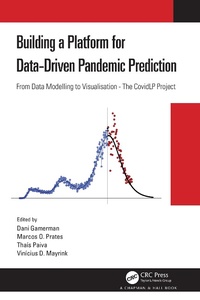
Building a Platform for Data-Driven Pandemic Prediction
From Data Modelling to Visualisation - The CovidLP Project
1st Edition
Published on 13. September 2021
382 pages
978-1-000-45722-3 (ISBN)
Description

This book is about building platforms for pandemic prediction. It provides an overview of probabilistic prediction for pandemic modeling based on a data-driven approach. It also provides guidance on building platforms with currently available technology using tools such as R, Shiny, and interactive plotting programs.
The focus is on the integration of statistics and computing tools rather than on an in-depth analysis of all possibilities on each side. Readers can follow different reading paths through the book, depending on their needs. The book is meant as a basis for further investigation of statistical modelling, implementation tools, monitoring aspects, and software functionalities.
Features:
A general but parsimonious class of models to perform statistical prediction for epidemics, using a Bayesian approach
Implementation of automated routines to obtain daily prediction results
How to interactively visualize the model results
Strategies for monitoring the performance of the predictions and identifying potential issues in the results
Discusses the many decisions required to develop and publish online platforms
Supplemented by an R package and its specific functionalities to model epidemic outbreaks
The book is geared towards practitioners with an interest in the development and presentation of results in an online platform of statistical analysis of epidemiological data. The primary audience includes applied statisticians, biostatisticians, computer scientists, epidemiologists, and professionals interested in learning more about epidemic modelling in general, including the COVID-19 pandemic, and platform building.
The authors are professors at the Statistics Department at Universidade Federal de Minas Gerais. Their research records exhibit contributions applied to a number of areas of Science, including Epidemiology. Their research activities include books published with Chapman and Hall/CRC and papers in high quality journals. They have also been involved with academic management of graduate programs in Statistics and one of them is currently the President of the Brazilian Statistical Association.
The focus is on the integration of statistics and computing tools rather than on an in-depth analysis of all possibilities on each side. Readers can follow different reading paths through the book, depending on their needs. The book is meant as a basis for further investigation of statistical modelling, implementation tools, monitoring aspects, and software functionalities.
Features:
A general but parsimonious class of models to perform statistical prediction for epidemics, using a Bayesian approach
Implementation of automated routines to obtain daily prediction results
How to interactively visualize the model results
Strategies for monitoring the performance of the predictions and identifying potential issues in the results
Discusses the many decisions required to develop and publish online platforms
Supplemented by an R package and its specific functionalities to model epidemic outbreaks
The book is geared towards practitioners with an interest in the development and presentation of results in an online platform of statistical analysis of epidemiological data. The primary audience includes applied statisticians, biostatisticians, computer scientists, epidemiologists, and professionals interested in learning more about epidemic modelling in general, including the COVID-19 pandemic, and platform building.
The authors are professors at the Statistics Department at Universidade Federal de Minas Gerais. Their research records exhibit contributions applied to a number of areas of Science, including Epidemiology. Their research activities include books published with Chapman and Hall/CRC and papers in high quality journals. They have also been involved with academic management of graduate programs in Statistics and one of them is currently the President of the Brazilian Statistical Association.
More details
Edition
1. Auflage
Language
English
Place of publication
London
United Kingdom
Publishing group
Taylor & Francis Ltd
Target group
College/higher education
Product notice
Reflowable
Illustrations
12 Tables, black and white; 101 Line drawings, black and white; 4 Halftones, black and white; 105 Illustrations, black and white
ISBN-13
978-1-000-45722-3 (9781000457223)
Copyright in bibliographic data and cover images is held by Nielsen Book Services Limited or by the publishers or by their respective licensors: all rights reserved.
Schweitzer Classification
Other editions
Additional editions
Dani Gamerman | Marcos O. Prates | Thais Paiva
Building a Platform for Data-Driven Pandemic Prediction
From Data Modelling to Visualisation - The CovidLP Project
Book
09/2021
1st Edition
Chapman & Hall/CRC
€232.70
Shipment within 15-20 days
Dani Gamerman | Marcos O. Prates | Thais Paiva
Building a Platform for Data-Driven Pandemic Prediction
From Data Modelling to Visualisation - The CovidLP Project
Book
09/2021
1st Edition
Chapman & Hall/CRC
€96.70
Shipment within 15-20 days
Persons
Dani Gamerman was Professor of Statistics at UFRJ from 1996 to 2019. He is currently Professor Emeritus at UFRJ since 2021 and Visiting Professor at UFMG since 2019. Director of the Graduate Program in Statistics at UFRJ (1999-2006 and 2015-2019). Published papers at JRSSB, Biometrika, Statistics and Computing, Bayesian Analysis, Journal of Multivariate Analysis, Applied Statistics and other journals. Author of books Monte Carlo Markov Chain: Stochastic Simulation for Bayesian Inference and Statistical Inference: an Integrated Approach, both with Chapman & Hall in their 2nd edition. Supervised 19 M.Sc. and 18 Ph.D. students. Visiting professor of a number of academic institution world-wide. Delivered seminars at many scientific meetings and universities world-wide, including plenary talks at a Valencia meeting and an ISBA world meeting. Editor of 5 statistical journals. Organized many statistical conferences in Brazil.
Marcos Prates obtained his bachelor's in 2006 in the Computational Mathematics program at the Universidade Federal de Minas Gerais (UFMG) and a master's in Statistics in 2008 from the same institution. In 2011 he received his Ph.D. in Statistics from the University of Connecticut and was a Visiting Professor in the same institution from 2019 to 2020. Currently, he is an Associate Professor at UFMG. His main research areas are Bayesian Statistics, Generalised Linear Mixed Models, Machine Learning, and Spatial Statistics. He was Director of the Graduate Program in Statistics in UFMG (2016-2018), was the Secretary for ISBRA, the Brazilian chapter of ISBA (2015-2016), and currently is the President of the Brazilian Statistical Association (2020-2022).
Thais Paiva obtained a bachelor degree in Actuarial Science from the Universidade Federal de Minas Gerais (UFMG) in 2008, and a Masters in Statistics from the same university in 2010. She earned a PhD degree in Statistics at Duke University in 2014. Since 2016, she has been an Assistant Professor in the Statistics Department at UFMG, working actively on the Actuarial Science undergraduate program and on the Statistics graduate program. Her main research interests are Bayesian Statistics, Imputation Methods for Missing Data, Data Confidentiality and Spatial Statistics.
Vinicius Mayrink is an Associate Professor in the Department of Statistics at the Universidade Federal de Minas Gerais (UFMG) in Brazil. He received: his Ph.D. degree in the Department of Statistical Science at Duke University (USA, 2011), B.Sc. degree in Statistics from UFMG (2004), M.Sc. degree in Statistics from the Universidade Federal do Rio de Janeiro (2006) and a second M.Sc. degree in Statistics at Duke University (2009). Vinicius is currently the sub-Director of the Graduate Program in Statistics of the UFMG (2021-2023). He was a member (treasurer, 2015-2016) of the administrative board of ISBRA (the Brazilian chapter of ISBA). His research interests include: Bayesian Inference, Multivariate Analysis, Spatial Statistics, Survival Analysis and Statistical Modeling in Bioinformatics.
Marcos Prates obtained his bachelor's in 2006 in the Computational Mathematics program at the Universidade Federal de Minas Gerais (UFMG) and a master's in Statistics in 2008 from the same institution. In 2011 he received his Ph.D. in Statistics from the University of Connecticut and was a Visiting Professor in the same institution from 2019 to 2020. Currently, he is an Associate Professor at UFMG. His main research areas are Bayesian Statistics, Generalised Linear Mixed Models, Machine Learning, and Spatial Statistics. He was Director of the Graduate Program in Statistics in UFMG (2016-2018), was the Secretary for ISBRA, the Brazilian chapter of ISBA (2015-2016), and currently is the President of the Brazilian Statistical Association (2020-2022).
Thais Paiva obtained a bachelor degree in Actuarial Science from the Universidade Federal de Minas Gerais (UFMG) in 2008, and a Masters in Statistics from the same university in 2010. She earned a PhD degree in Statistics at Duke University in 2014. Since 2016, she has been an Assistant Professor in the Statistics Department at UFMG, working actively on the Actuarial Science undergraduate program and on the Statistics graduate program. Her main research interests are Bayesian Statistics, Imputation Methods for Missing Data, Data Confidentiality and Spatial Statistics.
Vinicius Mayrink is an Associate Professor in the Department of Statistics at the Universidade Federal de Minas Gerais (UFMG) in Brazil. He received: his Ph.D. degree in the Department of Statistical Science at Duke University (USA, 2011), B.Sc. degree in Statistics from UFMG (2004), M.Sc. degree in Statistics from the Universidade Federal do Rio de Janeiro (2006) and a second M.Sc. degree in Statistics at Duke University (2009). Vinicius is currently the sub-Director of the Graduate Program in Statistics of the UFMG (2021-2023). He was a member (treasurer, 2015-2016) of the administrative board of ISBRA (the Brazilian chapter of ISBA). His research interests include: Bayesian Inference, Multivariate Analysis, Spatial Statistics, Survival Analysis and Statistical Modeling in Bioinformatics.
Content
I Introduction
1. Overview of the book
2. Pandemic Data
II Modelling
3. Basic Epidemiological Features
4. Data Distributions
5. Modelling Specific Data Features
6. Review of Bayesian Inference
III Further Modelling
7. Modelling Misreported Data
8. Hierarchical Modelling
IV Implementation
9. Data Extraction/ETL
10. Automating Modelling and Inference
11. Building an Interactive App with Shiny
V Monitoring
12. Daily Evaluation of the Updated Data
13. Investigating Inference Results
14. Comparing Predictions
VI Software
15. PandemicLP Package: Basic Functionalities
16. Advanced Settings: The Pandemic Model Funtion
VII Conclusion
17. Future Directions
1. Overview of the book
2. Pandemic Data
II Modelling
3. Basic Epidemiological Features
4. Data Distributions
5. Modelling Specific Data Features
6. Review of Bayesian Inference
III Further Modelling
7. Modelling Misreported Data
8. Hierarchical Modelling
IV Implementation
9. Data Extraction/ETL
10. Automating Modelling and Inference
11. Building an Interactive App with Shiny
V Monitoring
12. Daily Evaluation of the Updated Data
13. Investigating Inference Results
14. Comparing Predictions
VI Software
15. PandemicLP Package: Basic Functionalities
16. Advanced Settings: The Pandemic Model Funtion
VII Conclusion
17. Future Directions
