

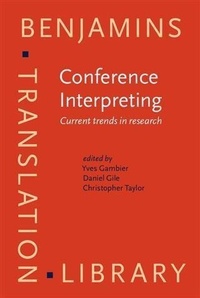
Conference Interpreting
Current trends in research. Proceedings of the International Conference on Interpreting: What do we know and how?
1st Edition
Published on 5. June 1997
IV, 246 pages
978-90-272-8560-7 (ISBN)
Description

'Conference Interpreting: What do we know and how?' is the title of a round-table conference (Turku 1994) organised to assess the state of the art in conference interpreting research. The result is collected in this volume with fully coordinated reports on the round tables. The book presents an exciting coverage of the field, touching on methodology, communication, discourse, culture, neurolinguistic and cognitive aspects, quality assessment, training and developing skills.
More details
Other editions
Additional editions
Yves Gambier | Daniel Gile | Christopher Taylor
Conference Interpreting
Current trends in research. Proceedings of the International Conference on Interpreting: What do we know and how?
Book
06/1997
John Benjamins Publishing Co
€111.30
Shipment within 10-15 days
Persons
Content
- CONFERENCE INTERPRETING: CURRENT TRENDS IN RESEARCH
- Editorial page
- Title page
- Copyright page
- Table of contents
- Foreword
- Neurolinguistic Research in Simultaneous Interpretation
- 1. How does a neurolinguist see the work of interpreting?
- 2. How can neurolinguistic research shed light on interpretation?
- 3. What does a neurolinguist expect interpreters and interpretation to bring to research?
- 4. The significance of neurolinguistic studies for interpretation
- 5. Future developments in interdisciplinary research
- Understanding for Interpreting, Interpreting for Understanding
- 1. Introduction
- 2. Interpretation as categorization
- 3. Research on interpreting: some remarks
- 4. Task analysis : one method, one model
- 5. Ergonomic analysis of the interpreting task
- 6. Conclusion
- Note
- Interpreting as Communication
- 1. Perspectives on language, communication and human action
- 2. A dialogical approach to interpreting
- 3. A concrete example
- 4. Interpreting: Products, processes and practices
- 5. A unified theory of interpreting?
- 6. Interpreting as decontextualizing practices
- 8. Conclusion
- NOTES
- Interpretation Research Policy
- 1. Introduction
- 2. Contributions by panelists
- 3. Concluding remarks
- The Interaction Between Research and Training
- 1. Introduction
- 2. Conference interpreting: the background to research and training
- 3. Research and training today: two separate worlds?
- 4. Training the interpreter: Note-taking strategies.
- 5. Training the interpreter: text selection for consecutive interpreting
- 6. The interaction between research and the profession: Training
- 7. Research and training: A conclusion?
- NOTES
- Methodology
- 1. Introduction
- 2. Individual presentations
- 3. Discussion
- 4. Conclusions
- Quality in Simultaneous Interpreting
- 1. Introduction
- 2. The Workshop
- 3. Conclusion
- Skill Components in Simultaneous Interpreting
- 1. Introduction
- 2. How research in bilingualism relates to issues in interpreting
- 3. Memory
- 4. Conclusions
- Editors'notes
- Intercultural Communication, Negotiation, and Interpreting
- 1. Introduction
- 2. What is Culture?
- 3. How Do Different Cultures Affect Communication?
- 4. Lexical Difficulties Faced by Broadcast Interpreters in Japan
- 5. Proto-typology of Intercultural Events with Interpreting
- 6. Intercultural Noise and Cultural Mediation
- 7. What Roles Should Interpreters Play in Intercultural Communication?
- 8. The Interpreter in the Business Environment
- 9. Should the Interpreter be a Cultural Mediator?
- 10. Intercultural Meetings as Real-Life Sessions
- 11. Conclusion - M. Kondo
- Linguistics, Discourse Analysis and Interpretation
- 1. Introduction
- 2. Reasoning in Interpreting - Maria Sidiropoulou, University of Athens
- 3. Discourse Analysis and Dialogue Interpreting - Helen Tebble, Deakin University, Melbourne
- 4. Cohesion in Political Speeches: Implications for Simultaneous Interpretation - Sandra Gallina, EU Interpreter, Brussels
- 5. Discourse Analysis and Interpreting - Anna-Riitta Vuorikoski, University of Tampere
- 6. Linguistics and interpreting - Christopher Taylor, University of Trieste
- 7. Theme as the interpreter's path indicator through the unfolding text -Carol Taylor Torsello, University of Trieste
- 8. Conclusion
- On Media and Court Interpreting
- 1. Introduction
- 2. Film interpreting: challenges and constraints of a semiotic practice
- 3. Broadcast interpreting in Japan. Some theoretical and practical aspects
- 4. Quality of media interpreting - a case study.
- 5. Court Interpreting. Interlingual, intercultural and intersocial communication. Plans for a project.
- 6. Interpreting between the Slovene and Italian languages in Italian Courts of Law.
- 7. The Right to Lie: On Interpreter-Mediated Police Interrogations.
- 8. Questions and Answers
- 9. Conclusion
- Postscript: After Turku
- REFERENCES
- Index of authors
- List of participants
- The series Benjamins Translation Library
