

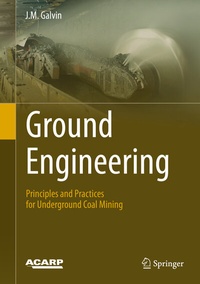
Ground Engineering - Principles and Practices for Underground Coal Mining
Description

More details
Other editions
Additional editions
Person
Emeritus Professor Jim Galvin has a relatively unique combination of industrial, research and academic experience in the mining industry that spans specialist research and applied knowledge in ground engineering, mine management and risk management. His career encompasses directing ground engineering research groups in South Africa and Australia; practical mining experience, including active participation in the mines rescue service and responsibility for the design, operation, and management of large underground coal mines and for the consequences of loss of ground control as a mine manager; appointments as Professor and Head of the School of Mining Engineering at the University of New South Wales; and safety advisor to a number of Boards of Directors of organisations associated with mining.
Content
1. Scope of ground engineering.- 2. Fundamental principles for ground engineering.- 3. Excavation mechanics.- 4. Pillar systems.- 5. Interaction between workings.- 6. Support and reinforcement.- Systems.- 7. Ground support design.- 8. Pillar extraction.- 9. Longwall mining.- 10. Overburden subsidence.- 11. Operational hazards.- 12. Managing risk in ground engineering.- Glossary of terms and symbols.- Appendices.
