

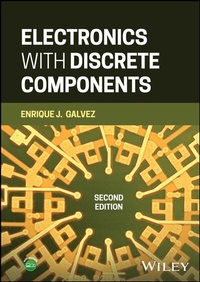
Electronics with Discrete Components
Description

Comprehensive textbook on electronics for physicists, now with more examples, exercises, hands-on electronics labs, troubleshooting tips, and practical exercises
Electronics with Discrete Components delivers a comprehensive overview of electronics from the perspective of a physicist. In the first part on digital components, after an introduction to digital electronics, the text covers fundamentals of combinational logic and its implementation in combinational logic devices, followed by sequential-logic devices such as flip-flops and memory components. The second part on analog components deals with the fundamentals of signal processing, filters, components such as diodes and transistors, and a lengthy coverage of operational amplifiers.
Each chapter ends with problem sets and "lab projects" that have been proven to work well for instruction. Questions on simple aspects of the lab that students should know are also included, such as regarding powering components and diagnosing signals with the oscilloscope and providing "troubleshooting tips" to help students find out why a particular circuit does not work.
The new edition of this textbook adds more worked examples, exercises with answers for the self-learner, and end-of-chapter problems. It adds new electronic components, covers the latest digital technologies plus adds a new section of Fourier transforms in electronics. In addition, it features labs with Arduino or Teensy boards which have become widespread in the community as inexpensive, easy-to-use electronics platforms.
Electronics with Discrete Components includes information on:
- Number systems, codes, signed numbers, binary functions, logic families, and IC wirings
- Filters and the frequency domain, covering RC, high- and low-pass, and cascading filters, FFTs, as well as important considerations for filter design
- Connecting digital to analog and to the world through TTL, CMOS, and LV gates and interfacing between the logic families
- Charge and potential, capacitors, electrical current, resistors, magnetic components, power, circuits, and abstractions and symbol jargon in the field
The Second Edition of Electronics with Discrete Components is an ideal textbook resource for a one-semester course on electronics for second-year physics students, as well as students from other disciplines or levels who understand elementary notions of circuits and complex numbers.
More details
Other editions
Additional editions
Person
Professor Enrique J. Galvez is an atomic and optical physics experimentalist. His studies have focused on optics and quantum optics, including fundamental studies of the geometric phase in optics, complex light beams, singular optics, photon entanglement, and the development of instructional quantum optics laboratories. He is the recipient of the 2010 Award to Faculty Member for Research at an Undergraduate Institution and the 2020 Jonathan F. Reichert and Barbara Wolff-Reichert Award for Excellence in Advanced Laboratory Instruction from the American Physical Society.
Content
Preface to the Second Edition xvii
Preface to the First Edition xix
About the Companion Website xxiii
1 The Basics 1
1.1 Foreword: Welcome to Electronics! 1
1.2 Charge and Potential 2
1.3 Capacitors 4
1.4 Electrical Current 8
1.5 Resistors 10
1.6 Magnetic Devices 17
1.7 Power 22
1.8 Circuits 24
1.9 Abstractions and Symbol Jargon 35
1.10 Answers to Exercises 36
1.11 Problems 37
1.12 Lab Projects 42
1.13 Practicum Test 44
Part I Digital 45
2 Introduction to Digital Electronics 47
2.1 Number Systems 48
2.2 Codes 51
2.3 Signed Numbers 52
2.4 Binary Functions 54
2.5 Logic Families 63
2.6 IC Wirings 71
2.7 Answers to Exercises 72
2.8 Problems 73
2.9 Lab Projects 78
2.10 Practicum Problems 87
3 Combinational Logic 89
3.1 Boolean Algebra 89
3.2 Theorems 90
3.3 NAND-gate Implementation 91
3.4 Representation of Boolean Functions 92
3.5 Simplification of Functions 93
3.6 Karnaugh Maps 95
3.7 More Than Four Variables 104
3.8 Wrap-up 104
3.9 Answers to Exercises 104
3.10 Problems 105
3.11 Lab Projects 111
3.12 Practicum Test 117
4 Advanced Combinational Devices 119
4.1 Pragmatic Designing 119
4.2 Adders 120
4.3 Decoders 122
4.4 Demultiplexers 127
4.5 Multiplex Expansion 128
4.6 Encoders 129
4.7 Multiplexers 130
4.8 Answers to Exercises 133
4.9 Problems 135
4.10 Lab Projects 139
5 Sequential Logic 143
5.1 Definitions 143
5.2 RS Flip-flops 146
5.3 d Flip-flop 148
5.4 Edge Trigger 150
5.5 JK Flip-flops 152
5.6 Applications of Flip-flops 153
5.7 Shift Registers 162
5.8 Multivibrators 163
5.9 Memory 164
5.10 Epilogue to Digital: Digital I/O 169
5.11 Answers to Exercises 173
5.12 Problems 176
5.13 Lab Projects 185
5.14 Practicum Test 192
Part II Analog 193
6 AC Signals 195
6.1 Connecting Analog with Digital: Analog-to-Digital Conversion 196
6.2 AC Circuits 200
6.3 Equivalent Circuits 215
6.4 Circuit Loading 217
6.5 Input and Output Impedance 220
6.6 Answers to Exercises 220
6.7 Problems 221
6.8 Lab Projects 225
6.9 Practicum Test 231
7 Filters and the Frequency Domain 233
7.1 RC Filters 234
7.2 High-pass Filters 235
7.3 Low-pass Filter 239
7.4 Cascading Filters 240
7.5 Recap: Important Considerations for Filter Design 243
7.6 Transformer 244
7.7 Resonant Circuits and Band-pass Filters 246
7.8 Fourier Analysis 249
7.9 Answers to Exercises 257
7.10 Problems 258
7.11 Lab Projects 262
7.12 Practicum Test 265
8 Diodes 267
8.1 Physics of Semiconductors 268
8.2 Diodes 273
8.3 Designing Diode Circuits 276
8.4 Diode Fauna 278
8.5 Diode Applications 284
8.6 Answers to Exercises 292
8.7 Problems 294
8.8 Lab Projects 299
8.9 Practicum Test 303
9 Transistors 305
9.1 The Bipolar-junction Transistor 306
9.2 Field-effect Transistors 320
9.3 Answers to Exercises 329
9.4 Problems 331
9.5 Lab Projects 337
9.6 Practicum Test 341
10 Operational Amplifiers 343
10.1 Negative Feedback 344
10.2 Closed-loop Circuits 346
10.3 Open-loop Circuits 362
10.4 Real Op-Amps 368
10.5 Interfacing the World 374
10.6 Answers to Exercises 375
10.7 Problems 377
10.8 Lab Projects 385
10.9 Practicum Test 391
Appendix A Logic Board 393
Appendix B If the Circuit Does Not Work 395
B. 1 Design 395
B. 2 The Obvious 395
B. 3 Placement 396
B. 4 Pins 396
B. 5 Breadboards 396
B.5. 1 Past the Obvious 396
B.5. 2 Digital Circuits 396
B.5. 3 Analog Circuits 397
B. 6 Abusive Power 397
B. 7 Stuck 397
B. 8 Done! 397
Appendix C Curve Tracer 399
C.1 I-V Curves for Diodes 399
C.2 I-V Curves for Transistors 400
Index 403
Preface to the First Edition
This text is designed for a one-semester course on electronics. Its primary audience is second-year physics students, but it can include students from other disciplines or levels who understand elementary notions of circuits and complex numbers. Most physics programs, especially those in liberal arts colleges, can afford only a one-semester course in electronics. Electronics is a vital part of a curriculum because it trains students in a basic skill of experimentation. With this knowledge, students can design circuits to manipulate electronic signals or drive mechanical devices. An electronics course also gives students a basic understanding of the inner workings of electronics instruments. Thus, an electronics course prepares students for advanced laboratories and, ultimately, experimental research.
Because of the nature of the topic, the course must have a huge hands-on component. Electronics is learned by experience. At Colgate University, we have been teaching a course that meets two days a week, with a one-hour lecture followed by a two- to three-hour lab. In the lab, students build circuits that closely follow the topic of the class. We have put special effort into making those labs instructive but at the same time interesting, empowering, and fun. We made a special effort to introduce transducers in the labs, highlighting applications. Today's students live around black boxes, mostly ignorant of the circuits that lie within them. Our recent experience tells us that students find the discovery of how those boxes work, or even the task of building them, extremely interesting, rewarding, and useful. Thus, we can use this "revelation" as a way to motivate students to learn electronics.
Instructors who adopt this text may have labs in place and may not have use for the labs in this book. However, the experiments listed may give instructors ideas to renew or modify the labs in place. In addition to the normal curricular plan, we devote two weeks in the middle of the semester and two weeks at the end of the semester to unscripted projects, in which students design the device of their choice. Here is where students learn tremendously and enjoy the experience. Their ambition to build the device of their choice pushes them to invest much energy and time, and along the way, they learn invaluable aspects of building devices, such as creating new designs and troubleshooting. In the first project, students do mostly digital work (more on this choice below), but they still use a little bit of analog, because they need switches or pushbuttons for digital inputs and light-emitting diodes (LED) for digital outputs. In the second project, students do mostly analog work, but they can combine analog and digital electronics. Whatever the case, students end up doing amazing projects. Some of the analog projects can be combined with real computers, but this is an aspect that we do not cover here. If lab PCs have interface cards, the projects will be more powerful. A word of caution from experience: make sure that the project does not become a computer project. Although knowing programming is not that bad of a goal these days, it is not the objective of this course.
The text is divided into two parts: digital and analog. In each part, we cover the essential components needed to understand and design circuits with discrete components. We cover the digital part first. This may seem like heresy to some instructors, but I urge them to reconsider the concept. Covering digital first makes sense because digital electronics focuses mostly on logic. The topic is not as intellectually demanding as analog. Besides a few rules of thumb for wiring, students have little need to know about the currents that flow through the gates or even the analog circuits that make up those gates. Later in the semester, after covering the analog part, the class revisits the details of gates. The digital part is demanding on wiring practices, but not on conceptual understanding. This way, students get early exposure to demanding circuits and are forced to embrace systematic wiring practices. By the time students reach analog, they no longer have trouble wiring and powering circuits. It makes sense to cover analog after digital because students end with the understanding of the complexity and importance of analog. Otherwise, students would get the wrong message: since analog is not needed to do digital, it is unnecessary altogether. An instructor who strongly disagrees with this strategy could swap the two parts without major logistic complications, but he or she would have to continue to emphasize analog concepts throughout the digital part.
The content of this text borrows ideas on the organization of topics from two classics in the field: Digital Design, by M. Morris Mano, and The Art of Electronics, by Paul Horowitz and Winfield Hill. The chapters are designed so that they take an integral number of days. Labs may also extend one day, and in digital, several labs build upon the circuit of the previous lab. The topics of the specific chapters go as follows. The first chapter, "The Basics," reviews the fundamentals of electricity and electrical components. It brings the student, especially the nonphysics major, up to speed with the physics and basics of electric circuits. The second chapter, "Introduction to Digital Electronics," covers digital signals and electronic gates. It is followed by two chapters on combinational logic, namely "Combinational Logic" and "Advanced Combinational Devices." They are followed by a chapter titled "Sequential Logic," which emphasizes counting circuits, and an important application in memory. Throughout this part, we include tables of integrated circuits that are useful for designing circuits. A rack of ICs of various types is vital in an electronics lab. The lab exercises use a "logic board," which is a homemade or commercial box with switches that generate input states, and LEDs to display output states. Appendix A gives the details of this device and its construction. Some versions of these boards are commercially available. If time permits, the instructor may consider other adventures, such as microcontrollers and interfacing using Labview, but such endeavors are specialized to particular equipment for which there is no uniform agreement. Instead of attempting a partial or incomplete description, we do not cover those at all.
The analog part starts with the chapter "AC Signals." It covers a more sophisticated analysis of circuits than the first chapter and centers on the use of complex numbers for defining signals and impedances. We find this advantageous and practical. To complement this, we include a short introduction to complex numbers. It ends with an important concept to students: Thevenin equivalent circuits. Throughout, this part reduces circuits to single-loop modules, building up the concepts of input and output impedance. We follow with the chapter "Filters and the Frequency Domain," where the role of frequency and frequency response comes to the surface. The use of multiple filter stages underscores the role of source and load impedance. At the end of this chapter, we insert a section on Fourier Series. This is important because electronics' processing of signals can be understood easily at the single frequency level. Therefore, knowing the decomposition of a complex signal into its frequency spectrum is vital in understanding the frequency response of a circuit. This part can be skipped if the curriculum already contains Fourier series. The chapter that follows, "Diodes," starts with a physical explanation of semiconductors that gives the student an intuitive and informed basic understanding of the physics of these materials. It emphasizes nonlinear responses and the use of the load line, and ends with an application on the design of power supplies, among other diode tricks. The chapter titled "Transistors," covers both bipolar-junction and field-effect transistors. Because operational amplifiers are much better suited for signal conditioning, we do not cover in detail some of the traditional circuits on biasing the transistor. Increasingly, modern devices use field-effect transistors instead of bipolar transistors, so we give both nearly equal coverage and focus on power drivers, followers, and current sources. These are applications that even operational amplifiers cannot deliver and in which transistors have rightful place. The final part of analog is the experimenters delight: "Operational Amplifiers." We give ample coverage to numerous circuits, plus we use them to smuggle in other interesting topics, such as comparators and feedback. We wrap up with a chapter that interfaces digital and analog signals and transducers, in "Connecting Digital to Analog and to the World."
At the end of most chapters is a section titled "Lab Projects" that contains many interesting circuits that have been proven to work well for instruction. Many of them have interesting twists that make the experience a fun one. I like to follow this motto: "Let the kids have fun." If they do, they will learn electronics. Our tests also have a practical component. When students work in groups there is a danger that they are passive and let their partner(s) do valuable laboratory know-how. To force them to be active participants, we test them individually on building simple circuits. The final section of each chapter is titled "Practicum Test." It gives questions that we have often asked on simple aspects of the lab that students should know. This includes...
