

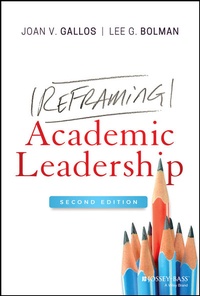
Reframing Academic Leadership
Description

Reframing Academic Leadership is the go-to guide for deepening leadership commitment, capacity, and impact. Gallos and Bolman tease out the unique opportunities and challenges in academic leadership and present powerful ideas and tools to guide and assist college and university administrators in:
* Creating campus environments that facilitate creativity and commitment
* Forging vital alliances and partnerships in service of the mission
* Building campus cultures and shared vision that unite and inspire
* Crafting institutional structures and strategies that foster innovation and excellence
In this updated edition, the authors integrate time-tested conceptual
frameworks with rich and compelling real-world cases and tackle contemporary, high-impact issues such as changes in the professoriate and in student populations, funding shortfalls, equity and social justice, the double-edged sword of technology, managing conflict and crisis, ethics and governance, and strengthening leadership agility and resolve. This readable, intellectually provocative, and pragmatic book is for all who care deeply about higher education, are committed to making it better, and understand its potential to transform lives, families, communities, organizations, and nations. Leadership matters more than ever, and Reframing Academic Leadership offers the seminal framework for understanding and leading in higher education today.
PRAISE FOR REFRAMING ACADEMIC LEADERSHIP | 1st ED
"Reframing Academic Leadership is the most comprehensive book on the topic and an excellent source of knowledge for faculty and managerial leaders in every college and university. An invaluable resource for students of higher education leadership!"
--MAUREEN SULLIVAN, Past President, American Library Association and Association of College and Research Libraries
"Reframing Academic Leadership provides a compassionate understanding of the stresses of leadership in higher education. It offers insights to those who do not fully appreciate why higher education is so hard to 'manage' and validation for those entirely familiar with this world. I recommend it enthusiastically."
--JUDITH BLOCK MCLAUGHLIN, Senior lecturer on education and faculty chair of the Harvard Seminar for New Presidents and the Harvard Seminar for Presidential Leadership, Harvard Graduate School of Education
"Bolman and Gallos provide a refreshing view of leadership essential for those assuming presidencies and other important leadership positions in higher education. This work is a bedside reference for aspiring and current leadership in higher education not only in the U.S. but also abroad."
--FERNANCO LEON GARCIA, President, Sistema CETYS Universidad, Baja California, Mexico
"Bolman and Gallos have written a practical, lucid text that brings together illustrative vignettes and robust frameworks for diagnosing and managing colleges and universities. I recommend it to new and experienced administrators who will routinely confront difficult people, structures, and cultures in their workplaces."
--CHRISTOPHER MORPHEW, Dean, School of Education, Johns Hopkins University
"Reframing Academic Leadership is filled with real-world examples from leaders. The book reads like a guide for leading a chamber music rehearsal where one's role constantly shifts from star to servant and where multiple answers may be 'right'."
--PETER WHITE, Dean and Professor of Conducting, Conservatory of Music, University of the Pacific
More details
Other editions
Additional editions
Persons
JOAN V. GALLOS is an award-winning educator, scholar, and academic leader, and Professor of Leadership Emerita at the former Wheelock College. Joan is a sought-after consultant and keynote speaker, especially in the academic STEM and library leadership worlds.
www.joangallos.com
LEE G. BOLMAN is Professor of Leadership and Marion Bloch Missouri Chair in Leadership Emeritus at the University of Missouri-Kansas City. Lee consults and lectures worldwide to corporations, public agencies, universities, and schools.
www.leebolman.com
Content
Preface vii
About the Authors xxi
Part I Leadership Epistemology: When You Understand, You Know What to Do 1
1. A Tale of Two Presidents: Opportunities and Challenges in Academic Leadership 3
2. Sensemaking and the Power of Reframing 19
3. Knowing What You're Doing: Learning, Authenticity, and Theories for Action 35
Part II Reframing Leadership Challenges 53
4. Building Clarity and Capacity: Leader as Analyst and Architect 55
5. Respecting and Managing Divergent Agendas: Leader as Compassionate Politician 77
6. Fostering a Caring and Productive Campus: Leader as Servant, Catalyst, and Coach 99
7. Keeping the Faith and Celebrating the Mission: Leader as Prophet and Artist 119
Part III Leadership Pragmatics: New Ideas for Old Challenges 139
8. Leading from the Middle 141
9. Managing Your Boss 161
10. Managing Conflict 173
11. Leading Difficult People 187
Part IV Leadership in a Changing World 207
12. Coping with a World in Motion: Students and Faculty 209
13. Coping with a World in Motion: Money and Technology 231
14. Leadership, Strategy, and Governance: Institutional Survival 243
Part V Sustaining Higher Education Leaders: Courage, Hope, and Values 263
15. Sustaining Integrity: Ethics and Leadership 265
16. Sustaining Health and Vitality 281
17. Feeding the Soul 295
18. Epilogue: The Sacred Nature of Academic Leadership 313
References 319
Index 369
Preface
With a sense of relief and completion, we submitted what we thought was the final manuscript for this second edition of Reframing Academic Leadership. Then Covid-19 hit with a vengeance. The world that everyone knew suddenly stopped in hope of slowing the viral spread - adding economic, political, societal, educational, and mental health challenges to the already devastating global health crisis of a fast-spreading virus with no vaccine or cure. As we worked to tease out the myriad implications for academic leaders, Americans and allies around the world took to the streets for equity and racial justice following the death of George Floyd under the knee of a Minneapolis police officer. We knew that we could not ignore the impact of both on higher education. We recalled our submission and went back to the drawing board. Much of what we had written about academic leadership still holds, but no institution and none of us will ever be quite the same. Both stories remain very much in motion - and will for some time - but two things are very clear. Every crisis contains opportunities for innovation and progress if we stay strong and search for them, and leadership feels more important now than ever.
The death of George Floyd was the latest in a long line of police shootings of Black citizens, and the broad protest movement under the banner of Black Lives Matter had been pushing for reform since early 2012. It took the actions of a courageous 17-year-old girl who recorded the dramatic and painful 8 minutes and 46 seconds-long video of Floyd's death on her cell phone that was played and replayed on television and across the internet to finally open the eyes of a nation and the world to systemic racism and to send outraged citizens into the streets of large and small cities during a pandemic demanding change - to move the country, in the words of scholar Ibram Kendi (2016, 2019, 2020), from denying a history of racial injustice that has haunted the United States since the 17th century to launching a proactive, "anti-racist revolution" (2020). To quote Margaret Mead, "Never doubt that a small group of thoughtful, committed, citizens can change the world. Indeed, it is the only thing that ever has."
The pandemic tells its own leadership story. It might have been stopped in its tracks in January 2020, but for an attempted coverup by local officials in Wuhan, China. The discovery of the "SARS coronavirus" in a group of Wuhan patients with an unusual and virulent pneumonia should have been entered into a high-tech national reporting system that China had created expressly for such situations after the 2002 SARS epidemic (Cook, 2020; Kuo, 2020; Myer, 2020; Shi, Rauhala, and Sun, 2020). The rules and procedures were clear. But they were not followed. The failure was catastrophic, the coverup deadly. But the causes were dismayingly ordinary. Regardless of country or sector, leaders routinely try to protect themselves and their organizations by hiding problems in hopes of fixing them before anyone notices. They prioritize their own comfort and interests over those of their constituents and communities. They act as if they must choose between competing needs without recognizing there are options that address both. Officials in Wuhan unleashed a global disaster while trying to avoid local embarrassment. They failed to anticipate that their decisions would be catastrophic for themselves, their constituents, the globe, and, as one piece of the collateral damage, institutions of higher education.
Here's the rub: the same dynamics that produced the coverup in Wuhan - and allowed so many to deny the meaning and implications of Black Lives Matter for so long - are also endemic in academic leadership. In a later chapter on ethics (Chapter 14), we catalog examples of leaders in colleges and universities following their own versions of the Wuhan playbook. Even as we write in late 2020, academic leaders are wrestling with how to balance the financial health and even the survival of their institutions against possible health risks to faculty, staff, students, families, and local communities. At least implicitly, circumstances are asking them to put a price on human life.
Nearly 400,000 Covid-19 infections and more than 90 college employee and student deaths were recorded across 1,800 institutions in 2020 (Ivory, Gebeloff, and Mervosh, 2020). Is this reason to celebrate the success of classroom safety measures? Are 90 deaths an acceptable sacrifice? Contact tracing and genetic analysis now confirm that community spread from students to their surrounding communities led to a higher death rate for older adults in college towns than elsewhere (Ivory, Gebeloff, and Mervosh, 2020). How far beyond campus borders do institutional responsibilities for health and welfare extend? How many constituent and community deaths should administrators risk in order to save their college and their stewardship of it? Sobering - and a strong incentive to clarify values and transcend either/or thinking.
These are indeed extraordinary times, and we have done our best to produce a volume that acknowledges the uncertainty and the possibilities in them. Returning from an unprecedented global calamity and seeking to build together a more just world, while overwhelming and disequilibrating, hold seeds for learning, innovation, and change. The world will go on and so will most - although probably not all - of our academic institutions. The wise and thoughtful will seize this transformational moment to recalibrate and to come back stronger and better. Louis Pasteur got it right: chance favors the prepared mind. Our goal for this new edition of Reframing Academic Leadership is the development of confident leaders who are prepared for the myriad opportunities and challenges they will face.
Threads of both continuity and change are woven throughout higher education's history. They continue as we enter the third decade of the 21st century, magnified by the extraordinary turning point of Covid-19. Both are central themes in this second edition of Reframing Academic Leadership. So is our belief in the vital role of academic leaders for bringing fresh thinking to perennial concerns like access, affordability, and quality.
Interviewed in the midst of the pandemic, E. Gordon Gee - who has held more university presidencies than any other American - noted that when he began his first presidency in 1981, surveys found that 95 percent of the population believed higher education was important. Now, said Gee, it's less than 50 percent, "even though higher education is the most important element in our culture and our economy right now" (Carlson & Friga, 2020). When Covid-19 threatened health and lives around the globe, political leaders turned to university-educated scientists, physicians, professors, and campus-based research centers and labs to help them understand and manage what was happening and what could be done about it. When they ignored or downplayed that expertise, they paid a price in lives and livelihoods lost. The pandemic is a particularly dramatic example of the extraordinary pace of change in our society and around the world that has put new pressures on colleges and universities to adapt and to deliver - and of the value when they do. History reminds us that innovation and change in response to radically shifting circumstances have always been key to the sector's survival and growth. Our goal in this revision is to support academic leaders as they find ways to do that again.
We are writing for an audience of readers who care deeply about colleges and universities, appreciate their strengths and imperfections, and are committed to making them better. We have worked to provide a research-based yet pragmatic approach to academic leadership. This new volume reflects changes in higher education, in the world, and in our own understandings. Additions, revisions, and occasional excisions all contribute to a book that aims to offer guidance for today and beyond. This second edition includes four new chapters - one each on ethics and on strategy and governance, and two on understanding the changing higher education landscape. Meanwhile, many ideas and some of the cases that we used in the first edition return because they are as relevant and instructive as ever. Throughout, the emphasis is on encouraging academic leaders to understand the unique context in which they work and to build their skills and confidence so as to lead well in response to it.
There are many roads to careers in academic administration. Some leaders in student affairs, advancement, business, operations, and other nonfaculty posts bring extensive training in their fields and in higher education administration. Other administrators are scholars and educators who hope for impact in a leadership role or who have chosen a different path in response to disappointment with the pace and focus of faculty life or to an honest assessment of their interests and strengths. Then there are the many accidental leaders for whom an administrative career just seems to happen. A nudge from somewhere combines with a willingness to serve - to fill an unanticipated administrative gap, to take one's turn as a division chair, to use one's talents to salvage a program or launch a needed project. Before long, service turns into more than a temporary assignment. Many an interim becomes permanent after a year or so on the job. This sets in motion a series of...
