

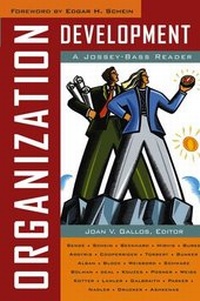
Organization Development
Description

More details
Other editions
Additional editions
Persons
Content
Foreword: Observations on the State of Organization Development xv
Edgar H. Schein
Introduction xxi
Joan V. Gallos
About the Editor xxix
Part One: The OD Field: Setting the Context, Understanding the Legacy 1
Editor's Interlude
Historical Roots
1 What Is Organization Development? 3
Richard Beckhard
2 Where Did OD Come From? 13
W. Warner Burke
Evolution of the Field
3 Revolutions in OD: The New and the New, New Things 39
Philip H. Mirvis
Theory Versus Practice
4 Theories and Practices of Organizational Development 89
John R. Austin and Jean M. Bartunek
Part Two: The OD Core: Understanding and Managing Planned Change 129
Editor's Interlude
Understanding Planned Change
5 Kurt Lewin and the Planned Approach to Change: A Reappraisal 133
Bernard Burnes
Intervention Theory
6 Effective Intervention Activity 158
Chris Argyris
Action Technologies
7 Action Research: Rethinking Lewin 185
Linda Dickens and Karen Watkins
8 Action Learning and Action Science: Are They Different? 202
Joseph A. Raelin
Appreciative Inquiry
9 Toward a Theory of Positive Organizational Change 223
David L. Cooperrider and Leslie E. Sekerka
Models of Change
10 Leading Change: Why Transformation Efforts Fail 239
John P. Kotter
11 The Congruence Model of Change 252
David A. Nadler
Part Three: The OD Process: Diagnosis, Intervention, and Levels of Engagement 263
Editor's Interlude
Individual
12 Teaching Smart People How to Learn 267
Chris Argyris
Small Group
13 Facilitative Process Interventions: Task Processes in Groups 286
Edgar H. Schein
Large Group
14 Large Group Interventions and Dynamics 309
Barbara Bunker and Billie Alban
Intergroup
15 Understanding the Power of Position: A Diagnostic Model 322
Michael J. Sales
Organization
16 Reframing Complexity: A Four-Dimensional Approach to Organizational Diagnosis, Development, and Change 344
Joan V. Gallos
Part Four: OD Consulting: Leading Change from the Outside 363
Editor's Interlude
Consulting Process
17 Masterful Consulting 365
Keith Merron
Consulting Phases and Tasks
18 Flawless Consulting 385
Peter Block
Contracting
19 The Organization Development Contract 397
Marvin Weisbord
Facilitation
20 The Facilitator and Other Facilitative Roles 409
Roger Schwarz
Coaching
21 The Right Coach 433
Howard Morgan, Phil Harkins, Marshall Goldsmith
Part Five: OD Leadership: Fostering Change from the Inside 445
Editor's Interlude
Understanding Options and Challenges
22 Reframing Change: Training, Realigning, Negotiating, Grieving, and Moving On 447
Lee G. Bolman and Terrence E. Deal
Leading as the Internal Consultant
23 What Constitutes an Effective Internal Consultant? 470
Alan Weiss
Leading as the Boss
24 Reversing the Lens: Dealing with Different Styles When You Are the Boss 485
Gene Boccialetti
Leading the Boss
25 Relations with Superiors: The Challenge of "Managing" a Boss 501
John Kotter
Building Support
26 Enlist Others 518
James Kouzes and Barry Posner
Part Six: OD Focus: Organizational Intervention Targets 541
Editor's Interlude
Strategy
27 Business Strategy: Creating the Winning Formula 545
Edward E. Lawler
Organizational Design
28 Matching Strategy and Structure 565
Jay Galbraith
Structure of Work
29 Designing Work: Structure and Process for Learning and Self-Control 583
Marvin Weisbord
Workspace Design
30 Making It Happen: Turning Workplace Vision into Reality 602
Franklin Becker and Fritz Steele
Culture
31 So How Can You Assess Your Corporate Culture? 614
Edgar H. Schein
Workforce Development
32 What Makes People Effective? 634
Edward E. Lawler
Team Development
33 What Makes a Team Effective or Ineffective? 656
Glenn M. Parker
Leadership Development
34 Developing the Individual Leader 681
Jay Conger and Beth Benjamin
Part Seven: OD Purpose and Possibilities: Seeing the Forest for the Trees 705
Editor's Interlude
Fostering Mission and Commitment
35 Creating a Community of Leaders 709
Phillip H. Mirvis and Louis "Tex" Gunning
Integrating Systems
36 Designing High-Performance Work Systems: Organizing People, Work, Technology, and Information 730
David A. Nadler and Marc S. Gerstein
Utilizing Diversity
37 Diversity as Strategy 748
David A. Thomas
Creating Learning Organizations
38 The Leader's New Work: Building Learning Organizations 765
Peter M. Senge
Creating Humane Organizations
39 Compassion in Organizational Life 793
Jason M. Kanov, Sally Maitlis, Monica C. Worline, Jane E. Dutton, Peter J. Frost, Jacoba M. Lilius
Fostering Growth and Development
40 Generating Simultaneous Personal, Team, and Organization Development 813
William R. Torbert
Part Eight: OD and the Future: Embracing Change and New Directions 829
Editor's Interlude
Changes in the Field
Practitioner Perspective
41 Emerging Directions: Is There a New OD? 833
Robert J. Marshak
Scholarly Perspective
42 The Future of OD? 842
David L. Bradford and W. Warner Burke
Changes in the External Environment
The Digital Revolution
43 From Cells to Communities: Deconstructing and Reconstructing the Organization 858
Rosabeth Moss Kanter
Globalization
44 Actions for Global Learners, Launchers, and Leaders 888
Ron Ashkenas, Dave Ulrich, Todd Jick, Steve Kerr
Knowledge Management
45 Knowledge-Worker Productivity: The Biggest Challenge 914
Peter F. Drucker
Sustainability and the Environment
46 Beyond Greening: Strategies for a Sustainable World 934
Stuart L. Hart
Organizational Values
47 The Healthy Organization 950
Richard Beckhard
References 953
Name Index 1021
Subject Index 1035
Foreword: Observations on the State of Organization Development
SOME HISTORICAL NOTES
Organization development as a practice evolved in the 1950s out of the work of the National Training Labs (NTL) on group dynamics and leadership. At the same time, a number of social psychology departments and business schools were discovering that traditional industrial psychology no longer met the varied needs of organizations. The concepts and tools available in the early days of the field were mostly diagnostic and individual oriented, and therefore did not fully respond to the problems that many organizations were facing. Of particular importance to OD's beginning was the discovery in the T-groups (T for training) of the power of "experiential" learning in groups and in the organizational arena. This combining of new forms of intervention and new concepts of group dynamics and leadership in effect created the field of OD.
OD had come a long way by the mid-1960s. This led Dick Beckhard, Warren Bennis, and me to start to design the Addison-Wesley series on organization development. We knew that we wanted a book series rather than a single book on OD because the field was, even at that time, too diverse to lend itself to a single volume. Some practitioners saw the future in terms of new ways of looking at interpersonal dynamics. Some saw it as a new set of values for how organizations should be managed. Some focused on group and intergroup problems. Still others tried to conceptualize how a total change program for an organization would look. Many different approaches were proposed on how best to deal with organizational issues and the management of change. No one model dominated the scene, and various "experimental interventions" within organizations were the order of the day.
The most radical of these experiments was to introduce the T-group into organizational units, even work groups, to leverage the impact of here-and-now experiential learning and feedback for individual and organizational growth. But as we now know, such experiments also revealed the limitations of face-to-face feedback across hierarchical lines. Telling the boss exactly what you think of him or her has not really worked out, though the current efforts to employ 360-degree feedback is clearly a contemporary version of those original experiments.
My own involvement in the field centered on efforts to understand the deeper dynamics of personal and organizational change. I had encountered deep change processes in my earlier studies on "brainwashing" of prisoners of war and civilians captured by the Chinese communists in the early 1950s-what I came to call coercive persuasion (Schein, Schneier, & Barker, 1961). When I took on my first job in the Sloan School in 1956, I observed similar coercive persuasion processes in the indoctrination of new hires by large corporations. But exposure to experiential learning through work with NTL led me to the conclusion that coercive persuasion works only when the target person is a captive. If people can walk away from unpleasant learning situations, they will do so. Learning, therefore, has to be based on a collaboration between consultant (coach) and client (learner), the understanding of which led me to define and describe "process consultation" as the group and organizational equivalent of Rogerian therapy for the individual (Schein, 1969, 1999). In that regard, I have always considered process consultation as an essential philosophy underlying organization development, not just a tool to be taken off the shelf when needed.
Probably the biggest impact on the evolution of OD as a field-I know this is true in my case-was the result of the actual experience that individuals had as consultants to managers in real organizations. Though research was always an important dimension of OD practice, there is no doubt in my mind that the essential learning about change and how to manage it came from our own experiential learning. For example, in my historical analysis of the rise and fall of the Digital Equipment Corporation, where I was a consultant for thirty years, I pointed out how Ken Olsen, the founder and my primary client, influenced my insights on how to conduct organizational surveys (Schein, 2003). He wanted me to do an engineering department survey, and when I asked him when he wanted to see the results, he said, "I don't want to see the results. If problems are uncovered, I want them fixed." His surprising response led me to the concept of upward cascading of survey results-that is, having each group analyze and categorize its own data before anything was shared with the next higher level. This approach empowered groups to fix their own problems and to feed upward only the things that higher levels of management alone could handle.
Working with clients also made highly visible the impact of deep cultural assumptions on how organizations design themselves, determine their strategy, and develop the basic processes that they use to get the work done. It became increasingly clear to me that culture is not just about the soft stuff of communication, rewards, and morale. It is deeply connected to the fundamental issues of organizational goals and means. The deep explanation of why Digital Equipment Corporation was successful-and why, in the end, it failed as a business-is all about the cultural DNA in that organization that made innovation an imperative and more central than concerns about business efficiency. Similarly, in my work with Ciba-Geigy in the late 1970s, I could see clearly how the company's acquisition strategy was far more dominated by self-image and cultural identity than by any pure economic or market criteria (Schein, 2004).
SOME CURRENT OBSERVATIONS
What has happened to the field of organization development in the last forty years? The answer is evident in this volume. OD has evolved, yet it has maintained a conceptual core and its diversity. If one scans the table of contents, it is evident that the core has a number of elements: a concern with process, a focus on change, and an implicit as well as explicit concern for organizational effectiveness. At the same time, there is a healthy diversity of views on what processes to focus on, how to manage change, and which values should inform the concept of "organizational health."
There is as yet no consensus on what the basic goals of organization development should be. Some practitioners would argue that OD's role is to "reform" organizations: to introduce humanistic values and ensure that organizations become "better" places to work for their employees. Others would argue that OD should help client systems be more effective at whatever it is the clients are trying to do within their cultural contexts. Client values should not be challenged unless they cross some broad ethical boundary. Still others would argue that the two positions converge, in that only organizations that operate by certain humanistic values can be effective in the long run anyway.
And finally, some would argue, as I would, that organizations are complex systems and that "health" therefore has to be defined in systemic terms: does the organization have a clear identity, the requisite variety, the capacity to learn, and sufficient internal alignment among its subsystems to function. Obviously, if the system has evil goals, OD practitioners would not work with it, but systems operate in all kinds of cultural contexts and have many different kinds of value sets. In this view of the field, the role of OD is more to help the system work its internal processes of alignment and integration than to challenge or to try to change those values.
The question has been raised about whether OD is a viable and growing concern or if the field has lost its momentum. To answer that question, one must first recognize how many elements of OD have evolved into organizational routines that are nowadays taken for granted: better communications, team building, management of intergroup competition, and change management, to name just a few. At the same time, as this volume suggests, the field is continuing to grow in defining concepts and tools to tackle the even tougher problems of change and organizational dynamics in an increasingly global and diverse world. Two current issues for the field to address strike me as paramount:
- The difficulty of creating a viable organization (system) that is geographically dispersed and consists of subsystems that are genuinely different national and occupational cultures. The positive aspects of diversity are highly touted, but the problems of alignment and integration of diverse cultural elements remain a major challenge.
- The ongoing difficulty of getting upward informational flow in hierarchies, as illustrated by all the recent disasters in NASA and in the slow response to the New Orleans flooding from Hurricane Katrina. Even the best of managers find themselves isolated and therefore ignorant of what is really going on below them. I see little evidence that OD practice has found a cure for that fundamental organizational pathology.
Organization development will continue to flourish as a field, however, because its practitioners are unique in their concern with human processes. OD practitioners have learned as a core part of their training that process is as important as content-and sometimes more important-and often is a strong reflection of content. Process at the individual, group, or intergroup levels is what OD practitioners...
