

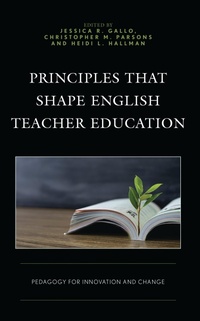
Principles that Shape English Teacher Education
Pedagogy for Innovation and Change
1st Edition
Published on 2. March 2024
220 pages
978-1-4758-6899-9 (ISBN)
Description

This book is an opportunity to both explore the concepts and theories that shape our current work as English educators and look ahead to new directions for the future of the field. It examines practices that illustrate the principles that guide English educators' teaching of the English Language Arts Methods course. New directions for the future of the field are also explored. The book's chapters include both practical enactments and theoretical examinations of teaching ELA methods courses. By including both theory and practice in the chapters, this book attends to current realities and potential futures of the field.
More details
Edition
1. Auflage
Language
English
Place of publication
New York
United States
Publishing group
Bloomsbury Publishing Plc
Target group
Professional and scholarly
Illustrations
7 BW Illustrations, 3 Tables, 4 Textboxes
ISBN-13
978-1-4758-6899-9 (9781475868999)
Copyright in bibliographic data and cover images is held by Nielsen Book Services Limited or by the publishers or by their respective licensors: all rights reserved.
Schweitzer Classification
Other editions
Additional editions
Jessica R. Gallo | Christopher Parsons | Heidi L. Hallman
Principles that Shape English Teacher Education
Pedagogy for Innovation and Change
Book
02/2024
Rowman & Littlefield Publishers
€34.50
Shipment within 10-20 days
Jessica R. Gallo | Christopher Parsons | Heidi L. Hallman
Principles that Shape English Teacher Education
Pedagogy for Innovation and Change
Book
02/2024
Rowman & Littlefield Publishers
€93.90
Shipment within 10-20 days
Persons
Jessica R. Gallo is associate professor of English Education at the University of Nevada, Reno. Her research focuses on English teacher preparation, middle and secondary writing pedagogy, and rural education. Her recent work has been published in the journals Voices from the Middle (2021), The Rural Educator (2020), and Teaching/Writing: The Journal of Writing Teacher Education (2020).
Christopher M. Parsons is associate professor of English Education and the coordinator of Secondary English Education at Keene State College (NH). Parsons's recent work, which has been published in the journals English Education (2021) and in the edited collection, Methods into Practice: New Visions in Teaching the English Language Arts Methods Course (2019), has focused on clinical field experiences for English teacher candidates.
Heidi L. Hallman is professor and Chair in the Department of Curriculum and Teaching at the University of Kansas. Her research interests include studying how prospective teachers are prepared to teach in diverse school contexts. Hallman's published work includes (Bloomsbury, 2017), Secondary English teacher education in the United States: Responding to a changing context (Bloomsbury, 2017), a national study of how English teachers are prepared and winner of the Richard Meade award for research in English education. Hallman's work has been published in English Education, Teaching Education,Teacher Education Quarterly, Equity & Excellence in Education, among others.
Christopher M. Parsons is associate professor of English Education and the coordinator of Secondary English Education at Keene State College (NH). Parsons's recent work, which has been published in the journals English Education (2021) and in the edited collection, Methods into Practice: New Visions in Teaching the English Language Arts Methods Course (2019), has focused on clinical field experiences for English teacher candidates.
Heidi L. Hallman is professor and Chair in the Department of Curriculum and Teaching at the University of Kansas. Her research interests include studying how prospective teachers are prepared to teach in diverse school contexts. Hallman's published work includes (Bloomsbury, 2017), Secondary English teacher education in the United States: Responding to a changing context (Bloomsbury, 2017), a national study of how English teachers are prepared and winner of the Richard Meade award for research in English education. Hallman's work has been published in English Education, Teaching Education,Teacher Education Quarterly, Equity & Excellence in Education, among others.
Content
Introduction: Theorizing the Genre of the Beliefs Statement: Within and Beyond Belief
Christopher Parsons and Jessica Gallo
Chapter 1: Revisiting Reflection with Dialogic Partners in Methods Courses
Amber Jensen
Chapter 2: Designed for Dissonance: Embracing Teacher Candidate Field Experiences as Dissonant Spaces
Christopher Parsons
Chapter 3: Uniting Preservice Teachers and Pedagogical Thinking
Melanie Shoffner
Chapter 4: An Argument about Argument Writing: Taking a Stance on the Five-Paragraph Essay
Mike Metz
Chapter 5: The English Classroom as a Contested Space: Fostering Critical Dialogue and Anti-Racist English Language Arts Practices
Hilary Lochte and Kristen Pastore-Capuana
Chapter 6: Planning Units to Work Within and Subvert the System by Critically Viewing Canonical Texts Through Literature Circles
Julie Bell
Chapter 7: Using Text Sets and Mini Lessons to Develop Sense of Authority as Teachers of Reading
Allison Wynhoff Olsen and William Fassbender
Chapter 8: English Pedagogy Through Critical Lenses: Empowering English Teachers as Agents of Change
Katharine Covino
Chapter 9: Figuring Out the Path Forward Together: The Power of Collaborative Reflection and Problem-Posing in Field-Based English Language Arts Teacher Education
Michelle Fowler-Amato
Chapter 10: Using the NCTE SPA Program Review as a Catalyst for Change: Moving Beyond the Methods Course
Lara Searcy
Chapter 11: The Impact of Policies That Promote the Science of Reading on English Teacher Preparation
William Kerns
Chapter 12: NCTE/ELATE Beliefs Meet Economic Realities: The Struggle to Prepare Students Facing Financial Challenges
Jeremy Glazer and Emily Wender
Chapter 13: Pre- and Co-requisite Content Knowledge and Pedagogy Development: Preparing Antiracist Future English Teachers
Christian Z. Goering and Holly Sheppard Riesco
Chapter 14: Beyond the Book: Critical Connective Literacies between Students and Authors on Social Media
Nora Peterman and Connor Warner
Chapter 15: Debating the Discourse of Professionalism with Pre-service English teachers
Heidi L. Hallman
About the Authors
Christopher Parsons and Jessica Gallo
Chapter 1: Revisiting Reflection with Dialogic Partners in Methods Courses
Amber Jensen
Chapter 2: Designed for Dissonance: Embracing Teacher Candidate Field Experiences as Dissonant Spaces
Christopher Parsons
Chapter 3: Uniting Preservice Teachers and Pedagogical Thinking
Melanie Shoffner
Chapter 4: An Argument about Argument Writing: Taking a Stance on the Five-Paragraph Essay
Mike Metz
Chapter 5: The English Classroom as a Contested Space: Fostering Critical Dialogue and Anti-Racist English Language Arts Practices
Hilary Lochte and Kristen Pastore-Capuana
Chapter 6: Planning Units to Work Within and Subvert the System by Critically Viewing Canonical Texts Through Literature Circles
Julie Bell
Chapter 7: Using Text Sets and Mini Lessons to Develop Sense of Authority as Teachers of Reading
Allison Wynhoff Olsen and William Fassbender
Chapter 8: English Pedagogy Through Critical Lenses: Empowering English Teachers as Agents of Change
Katharine Covino
Chapter 9: Figuring Out the Path Forward Together: The Power of Collaborative Reflection and Problem-Posing in Field-Based English Language Arts Teacher Education
Michelle Fowler-Amato
Chapter 10: Using the NCTE SPA Program Review as a Catalyst for Change: Moving Beyond the Methods Course
Lara Searcy
Chapter 11: The Impact of Policies That Promote the Science of Reading on English Teacher Preparation
William Kerns
Chapter 12: NCTE/ELATE Beliefs Meet Economic Realities: The Struggle to Prepare Students Facing Financial Challenges
Jeremy Glazer and Emily Wender
Chapter 13: Pre- and Co-requisite Content Knowledge and Pedagogy Development: Preparing Antiracist Future English Teachers
Christian Z. Goering and Holly Sheppard Riesco
Chapter 14: Beyond the Book: Critical Connective Literacies between Students and Authors on Social Media
Nora Peterman and Connor Warner
Chapter 15: Debating the Discourse of Professionalism with Pre-service English teachers
Heidi L. Hallman
About the Authors
