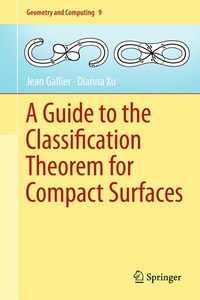
A Guide to the Classification Theorem for Compact Surfaces
Description

Ideal for students whose mastery of algebraic topology may be a work-in-progress, the text introduces key notions such as fundamental groups, homology groups, and the Euler-Poincaré characteristic. These prerequisites are the subject of detailed appendices that enable focused, discrete learning where it is required, without interrupting the carefully planned structure of the core exposition. Gently guiding readers through the principles, theory, and applications of the classification theorem, the authors aim to foster genuine confidence in its use and in so doing encourage readers to move on to a deeper exploration of the versatile and valuable techniques available in algebraic topology.
Reviews / Votes
From the reviews:
"Undoubtedly, one of the most beautiful pieces of the mathematical achievements is the classification of compact surfaces.... Each chapter provides a good list of references connnecting its topic to the literature. At the end, some appendices complete the work, the history of the classification problem being specially interesting." (Marco Castrillon Lopez, European Mathematical Society, euro-math-soc.eu, January, 2018)
"The book would make an excellent graduate or advanced undergraduate project. . audience would be instructors or researchers looking to reconnect to some topology fundamentals. Practitioners in topology-adjacent fields might find it valuable as a concise reference. . a textbook or supplemental reference for a second topology course with some careful planning . . Academic libraries should strongly consider this book as it offers a broad look at material common to a standard undergraduate mathematics curriculum." (Bill Wood, MAA Reviews, March, 2014)
"This book aims to give students . access to a true classic in algebraic topology: the classification of compact surfaces (up to homeomorphism). . The book includes many historical comments throughout and contains lots of pictures--both of the mathematicians involved in the classification theorem and of examples illustrating the mathematical content. Many examples are given that help one understand the basic tools . ." (Clara L?h, Mathematical Reviews, December, 2013)
"This highly focused book by Gallier (Univ. of Pennsylvania) and Xu (Bryn Mawr College) does both, delivering rigor to undergraduates by developing minimal doses of homotopy and homology theory, and without even presuming familiarity with group theory. . The present careful treatment of a major result that draws from several branches of mathematics makes the book an excellent resource for a capstone course. Summing Up: Highly recommended. Upper-division undergraduates and above." (D. V. Feldman, Choice, Vol. 51 (1), September, 2013)
"The book is geared toward an audience including first-year graduate students but also strongly motivated upper-level undergraduates . . the book under review offers a beautiful introduction to one of the oldest and most fascinating theorems in algebraic topology . . the historical remarks concerning the classification theorem for compact surfaces are highly enlightening to anyone interested in topology, and the many related biographies and photographs are just as entertaining. . No doubt, this is an introductory text of remarkable didactic value." (Werner Kleinert, zbMATH, Vol. 1270, 2013)
More details
Other editions
Additional editions