

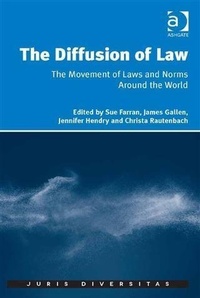
The Diffusion of Law
The Movement of Laws and Norms Around the World
Published on 28. August 2015
256 pages
978-1-4724-6041-7 (ISBN)
Description

In considering diffusion from a global perspective, this book provides timely new insights into its application in a variety of fields and at many levels of both legal and non-legal orderings. This collection contributes to the wider theoretical debate concerning the movement of law and legal norms by engaging with concrete examples of legal diffusion, in jurisdictions as diverse as Albania, the Czech Republic, Poland and Kuwait. These examples, taken together, provide a comprehensive illustration of the theoretical debates concerning the diffusion of laws and norms in terms of both process and form.
This international, multi-disciplinary and multi-methodological volume brings together scholars from law and social science with experience in mixed and hybrid jurisdictions, and advances the conversation about legal and normative diffusion across the academy. It represents a robust challenge to many preconceived ideas about legal movement and, as such, will be of interest to academics and students working in the fields of Law, Sociology, Anthropology, Political Science, Legal Education and comparative method.
This international, multi-disciplinary and multi-methodological volume brings together scholars from law and social science with experience in mixed and hybrid jurisdictions, and advances the conversation about legal and normative diffusion across the academy. It represents a robust challenge to many preconceived ideas about legal movement and, as such, will be of interest to academics and students working in the fields of Law, Sociology, Anthropology, Political Science, Legal Education and comparative method.
Reviews / Votes
`This volume truly demonstrates the ubiquity of the need for comparison, especially in law, resulting from globalization. The authors effectively demolish any doubts over the merits of comparative scholarship. The range of jurisdictional and disciplinary perspectives is extraordinarily wide, but it promotes insight into the world-wide circulation of legal notions.'Francois Venter, North-West University, South Africa
`This volume is full of engaging and superbly researched contributions on the diffusion of law. A must for anyone interested in comparative law, the book covers a wide range of important topics from a truly comparative perspective. It is a pleasure to read.'
Heikki Pihlajamaeki, University of Helsinki, Finland
`This book is an important contribution to both legal theory and comparative law. It is full of original insights on the ways legal norms, ideas and concepts travel across the globe. In addition to its valuable theoretical input, it presents a fascinating panorama of world-wide examples for legal migration and transplants.'
Nir Kedar, Sapir Academic College, Israel
More details
Series
Edition
New edition
Language
English
Place of publication
Farnham
United Kingdom
Publishing group
Taylor & Francis Ltd
Target group
Professional and scholarly
Edition type
New edition
Illustrations
Includes 3 b&w illustrations
File size
1,48 MB
ISBN-13
978-1-4724-6041-7 (9781472460417)
Copyright in bibliographic data and cover images is held by Nielsen Book Services Limited or by the publishers or by their respective licensors: all rights reserved.
Schweitzer Classification
Other editions
Additional editions
Sue Farran | James Gallen | Christa Rautenbach
The Diffusion of Law
The Movement of Laws and Norms Around the World
Book
07/2015
1st Edition
Routledge
€215.41
Shipment within 10-20 days
Persons
Sue Farran is a Professor of Laws at Northumbria University, UK, and an Adjunct Professor at the University of the South Pacific. She has a long-standing interest in comparative law and legal pluralism, and much of her published research uses case studies from the island countries of the South Pacific region to focus on issues of human rights, legal pluralism, the challenges of development and sustainability, globalisation and legal colonialism. In particular she is interested in the interface between legal systems and normative frameworks within states and between states, and the relationship between national, regional and international players in shaping and developing legal responses to contemporary issues. Sue has contributed to two other collections in this series: `Scotland: Is the tartan fading?' in A Study of Mixed Legal Systems: Endangered, Entrenched or Blended (2014 Ashgate) for which she was also lead editor, and `Pacific punch: tropical flavours of mixedness in the Island Republic of Vanuatu' in Palmer, Mattar and Koppel (eds) Mixed Legal Systems East and West (2015 Ashgate).
James Gallen is a graduate and Scholar of Trinity College Dublin and a graduate of New York University School of Law. He is a former Transitional Justice Scholar at New York University and has served as an Intern and Fellow at the International Center for Transitional Justice in New York and Kathmandu. He is a lecturer in the School of Law and Government at DCU. James defended his Ph.D. thesis in the School of Law at Trinity College Dublin in May 2012. His doctoral thesis examines the relationship between transitional justice, peace-building and economic development in international law. His research interests include human rights, international law and legal and political philosophy. His present research agenda concerns the implementation of policy coherence in international assistance to transitions and a transitional justice approach to child sex abuse in the Roman Catholic Church. James' recent selected publications include: (with Colin Smith, Trinity College Dublin), 'Cain Adomhnain and International Humanitarian Law', (2014) 16(1) Journal of the History of International Law 63-81 and 'Jus Post Bellum: An Interpretive Framework' in Carsten Stahn, Jens Iverson and Jennifer Easteryday (eds) Jus Post Bellum: Mapping the Normative Foundations (OUP 2014) 58-79.
Jennifer Hendry is a lecturer in Jurisprudence at the University of Leeds School of Law, prior to which she was a research fellow at the Tilburg Institute for Comparative & Transnational Law at Tilburg University. Jen has degrees from the University of Glasgow (LLB Hons 2002), the University of Edinburgh (LLM, 2003), and the European University Institute (PhD, 2009). She has been a visiting fellow at the University of Sydney (2011) and the University of Arizona (2013), and is a principal investigator on a World Universities Network-funded interdisciplinary international research network focusing on 'Spaces of Indigenous Justice'. Her research interests are in the areas of social and legal theory and comparative socio-legal studies, specifically legal pluralism, legal culture, spatial justice, and systems theory. Jen is a member of the senior editorial board of the German Law Journal and the executive of the UK Socio-Legal Studies Association (SLSA).
Recent selected publications include: `Legal Comparison and the Im/possibility of Legal Translation' in S. Glanert (ed.) Comparative Law: Engaging Translation (Routledge: July 2014) and `Legal Pluralism and Normative Transfer' in G. Frankenberg (ed.) Order Through Transfer: Studies in Comparative Constitutional Law (Edward Elgar: July 2013).
Christa Rautenbach is a Professor of Law, Faculty of Law, North-West University, Potchefstroom, South Africa. B Iuris (cum laude) LLB (cum laude) LLM LLD
Christa has more than 30 years of experience as a legal scientist. She worked for the Department of Justice for 14 years as a prosecutor before she became an academic scholar at the Faculty of Law, North-West University (Potchefstroom) where she currently holds an appointment as Full Professor. She remains involved in private practice as an advocate of the High Court of South Africa. Christa is the treasurer of the Society of Law Teachers of Southern Africa, Scientist Ambassador of the Alexander von Humboldt-Foundation and also the chairperson of the North-Eastern Chapter of the Alexander von Humboldt-Association of South Africa. In addition she is a member of the Executive Committee of Juris Diversitas. She has published extensively on subjects dealing with legal pluralism, customary law, mixed jurisdictions, cultural diversity, comparative law and law of succession and also presented numerous papers on these subjects globally. She is co-editor and co-author Introduction to Legal Pluralism in South Africa (2015( 4 ed) LexisNexis) and The Law of Succession in South Africa (2012 (2nd ed) Oxford University Press). Christa is also the editor of the internationally acclaimed electronic law journal, the Potchefstroom Electronic Law Journal and serves on the editorial boards of the Journal for Contemporary Roman-Dutch Law and the Journal of Comparative Law in Africa.
James Gallen is a graduate and Scholar of Trinity College Dublin and a graduate of New York University School of Law. He is a former Transitional Justice Scholar at New York University and has served as an Intern and Fellow at the International Center for Transitional Justice in New York and Kathmandu. He is a lecturer in the School of Law and Government at DCU. James defended his Ph.D. thesis in the School of Law at Trinity College Dublin in May 2012. His doctoral thesis examines the relationship between transitional justice, peace-building and economic development in international law. His research interests include human rights, international law and legal and political philosophy. His present research agenda concerns the implementation of policy coherence in international assistance to transitions and a transitional justice approach to child sex abuse in the Roman Catholic Church. James' recent selected publications include: (with Colin Smith, Trinity College Dublin), 'Cain Adomhnain and International Humanitarian Law', (2014) 16(1) Journal of the History of International Law 63-81 and 'Jus Post Bellum: An Interpretive Framework' in Carsten Stahn, Jens Iverson and Jennifer Easteryday (eds) Jus Post Bellum: Mapping the Normative Foundations (OUP 2014) 58-79.
Jennifer Hendry is a lecturer in Jurisprudence at the University of Leeds School of Law, prior to which she was a research fellow at the Tilburg Institute for Comparative & Transnational Law at Tilburg University. Jen has degrees from the University of Glasgow (LLB Hons 2002), the University of Edinburgh (LLM, 2003), and the European University Institute (PhD, 2009). She has been a visiting fellow at the University of Sydney (2011) and the University of Arizona (2013), and is a principal investigator on a World Universities Network-funded interdisciplinary international research network focusing on 'Spaces of Indigenous Justice'. Her research interests are in the areas of social and legal theory and comparative socio-legal studies, specifically legal pluralism, legal culture, spatial justice, and systems theory. Jen is a member of the senior editorial board of the German Law Journal and the executive of the UK Socio-Legal Studies Association (SLSA).
Recent selected publications include: `Legal Comparison and the Im/possibility of Legal Translation' in S. Glanert (ed.) Comparative Law: Engaging Translation (Routledge: July 2014) and `Legal Pluralism and Normative Transfer' in G. Frankenberg (ed.) Order Through Transfer: Studies in Comparative Constitutional Law (Edward Elgar: July 2013).
Christa Rautenbach is a Professor of Law, Faculty of Law, North-West University, Potchefstroom, South Africa. B Iuris (cum laude) LLB (cum laude) LLM LLD
Christa has more than 30 years of experience as a legal scientist. She worked for the Department of Justice for 14 years as a prosecutor before she became an academic scholar at the Faculty of Law, North-West University (Potchefstroom) where she currently holds an appointment as Full Professor. She remains involved in private practice as an advocate of the High Court of South Africa. Christa is the treasurer of the Society of Law Teachers of Southern Africa, Scientist Ambassador of the Alexander von Humboldt-Foundation and also the chairperson of the North-Eastern Chapter of the Alexander von Humboldt-Association of South Africa. In addition she is a member of the Executive Committee of Juris Diversitas. She has published extensively on subjects dealing with legal pluralism, customary law, mixed jurisdictions, cultural diversity, comparative law and law of succession and also presented numerous papers on these subjects globally. She is co-editor and co-author Introduction to Legal Pluralism in South Africa (2015( 4 ed) LexisNexis) and The Law of Succession in South Africa (2012 (2nd ed) Oxford University Press). Christa is also the editor of the internationally acclaimed electronic law journal, the Potchefstroom Electronic Law Journal and serves on the editorial boards of the Journal for Contemporary Roman-Dutch Law and the Journal of Comparative Law in Africa.
Content
Contents: Introduction, Sue Farran and Christa Rautenbach; Infusion of the diffused: four circles of diffusion infusing the legal system of Turkey, Esin OEruecue; The diffusion of Western legal concepts in Kuwait: reflections on the state, the legal system and legal education from comparative and historical perspectives, Myra Williamson; Diffusion of Islamic law in the UK: the case of the `special guardianship', Rita Duca; The Judicial Committee of the Privy Council: common law and its local variations in the Commonwealth, Pamela Martino; `Lease, locazioni and kera': merging legal concepts in postcolonial Malta, David Zammit and Kurt Xerri; Legal capital is out - EEIG is cool! How the evaporation of legal capital in EU private companies might provide a revival opportunity for EEIGs, Alessio Bartolacelli; The urban diffusion of local direct democracy between Switzerland and the United States, Thomas Favre-Bulle; The `margin of appreciation' in ECHR case-law as a boundary line to legal transplants, Alessandra Pera; The feature of droit commun in the Disposition Preliminaire of the Civil Code of Quebec: a clue to the bijurality of the legal system?, Biagio Ando; Law in changing circumstances: evolution of liability for succession debts in Poland, Elwira MacierzyA"ska-Franaszczyk; Albanian civil law and the influence of foreign laws, Juliana Latifi; `SvAE>A (TM)ensky fond' (trust fund): a daring new legal transplant in Czech law, KateA (TM)ina Ronovska; Diffusing bad ideas: what the migration of the separation of powers means for comparative law, Eoin Carolan; Index.
