

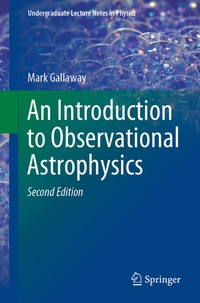
An Introduction to Observational Astrophysics
Description

This updated and fully corrected textbook provides a comprehensive overview of practical observing techniques for undergraduate astrophysics courses. The chapters introduce students to the basics of the field before delving into telescope types, the nature and operation of the astronomical camera, imaging techniques and reduction, photometry and spectrography, and solar and radio observations.
The second edition covers the latest research on calibrating the telescope-camera-observatory system. It contains revised information on all available astronomy equipment, including filters, webcams, sensors, and telescope designs. Also included is an entirely new chapter on exoplanet transit measurements. The textbook's practical approach will guide readers from basic first-year techniques to those required for a final-year project.
Reviews / Votes
"It is excellent, and its breadth of coverage is laudable. I would recommend it to undergraduate students and amateur astronomers . ." (John Southworth, The Observatory, Vol. 141 (1282), June, 2021)
More details
Other editions
Additional editions
Previous edition
Person
Dr. Mark Gallaway holds an undergraduate honors degree in Physical Science from the Open University and a PhD in Astrophysics from the University of Hertfordshire, UK (one of the largest astrophysics research groups in the UK). He has taught observational astrophysics at the University of Hertfordshire's Bayfordbury Observatory (the largest such observatory in the UK and one of the largest robotic observatories in Europe) for three years, continuing to do so after he became the Observatory Manager in 2011.
During his current tenure Dr. Gallaway has overseen both a large increase in student numbers and a refocusing of the observatory to one of the UK's leading small telescope research facilities. He is currently the PI of the Bayfordbury Supernova Search program, the Bayfordbury SuperWasp CV (Cataclysmic Variable) Follow-up program and the Bayfordbury NEO (Near Earth Object) Search. Dr. Gallaway is also a lead member of the M-Dwarf transit survey.
He regularly appears onthe BBC and other UK national broadcasters both as an expert. Furthermore, Dr. Gallaway has consulted on a number of general science programs in including the BBC documentary "How Satellites Rule Our Lives" and the series "How dangerous is..?"
