

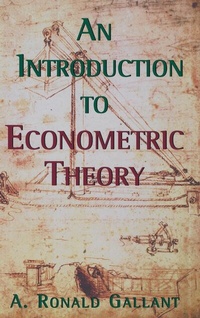
An Introduction to Econometric Theory
Measure-Theoretic Probability and Statistics with Applications to Economics
1st Edition
Published on 5. November 2018
208 pages
978-0-691-18623-8 (ISBN)
Description

Intended primarily to prepare first-year graduate students for their ongoing work in econometrics, economic theory, and finance, this innovative book presents the fundamental concepts of theoretical econometrics, from measure-theoretic probability to statistics. A. Ronald Gallant covers these topics at an introductory level and develops the ideas to the point where they can be applied. He thereby provides the reader not only with a basic grasp of the key empirical tools but with sound intuition as well.
In addition to covering the basic tools of empirical work in economics and finance, Gallant devotes particular attention to motivating ideas and presenting them as the solution to practical problems. For example, he presents correlation, regression, and conditional expectation as a means of obtaining the best approximation of one random variable by some function of another. He considers linear, polynomial, and unrestricted functions, and leads the reader to the notion of conditioning on a sigma-algebra as a means for finding the unrestricted solution. The reader thus gains an understanding of the relationships among linear, polynomial, and unrestricted solutions. Proofs of results are presented when the proof itself aids understanding or when the proof technique has practical value.
A major text-treatise by one of the leading scholars in this field, An Introduction to Econometric Theory will prove valuable not only to graduate students but also to all economists, statisticians, and finance professionals interested in the ideas and implications of theoretical econometrics.
In addition to covering the basic tools of empirical work in economics and finance, Gallant devotes particular attention to motivating ideas and presenting them as the solution to practical problems. For example, he presents correlation, regression, and conditional expectation as a means of obtaining the best approximation of one random variable by some function of another. He considers linear, polynomial, and unrestricted functions, and leads the reader to the notion of conditioning on a sigma-algebra as a means for finding the unrestricted solution. The reader thus gains an understanding of the relationships among linear, polynomial, and unrestricted solutions. Proofs of results are presented when the proof itself aids understanding or when the proof technique has practical value.
A major text-treatise by one of the leading scholars in this field, An Introduction to Econometric Theory will prove valuable not only to graduate students but also to all economists, statisticians, and finance professionals interested in the ideas and implications of theoretical econometrics.
More details
Other editions
Additional editions
A. Ronald Gallant
An Introduction to Econometric Theory
Measure-Theoretic Probability and Statistics with Applications to Economics
Book
07/1997
Princeton University Press
€117.20
Shipment within 10-20 days
Person
A. Ronald Gallant is Henry A. Latané Distinguished Professor of Economics at the University of North Carolina at Chapel Hill. He is a Fellow of the Econometric Society and the American Statistical Association, and a member of the Board of Directors of the National Bureau of Economic Research and the National Institute of Statistical Science. His books include Nonlinear Statistical Models. He is coeditor of the Journal of Econometrics.
Content
- Cover
- Title Page
- Copyright Page
- CONTENTS
- Preface
- Chapter 1 - Probability
- 1.1 Examples
- 1.2 Sample Space
- 1.3 Events
- 1.4 Probability Spaces
- 1.5 Properties of Probability Spaces
- 1.6 Combinatorial Results
- 1.7 Conditional Probability
- 1.8 Independence
- 1.9 Problems
- Chapter 2 - Random Variables and Expectation
- 2.1 Random Variables
- 2.2 Continuous Random Variables
- 2.3 Discrete Random Variables
- 2.4 Unconditional Expectation
- 2.5 Conditional Expectation
- 2.6 Problems
- Chapter 3 - Distributions, Transformations, and Moments
- 3.1 Distribution Functions
- 3.2 Independent Random Variables
- 3.3 Transformations
- 3.4 Moments and Moment Generating Functions
- 3.5 Covariance and Correlation
- 3.6 The Bivariate Normal Distribution
- 3.7 Matrix Notation for Moments
- 3.8 The Multivariate Normal Distribution
- 3.9 Problems
- Chapter 4 - Convergence Concepts
- 4.1 Random Samples
- 4.2 Almost Sure Convergence
- 4.3 Convergence in Probability
- 4.4 Convergence in Distribution
- 4.5 Lp Convergence
- 4.6 Problems
- Chapter 5 - Statistical Inference
- 5.1 Inference
- 5.2 Maximum Likelihood Estimation
- 5.3 Method of Moments Estimation
- 5.4 Bayesian Estimation
- 5.5 The Wald Test
- 5.6 The Lagrange Multiplier Test
- 5.7 The Likelihood Ratio Test
- 5.8 Bayesian Hypothesis Testing
- 5.9 Problems
- Appendix: Distributions
- References
- Index
