

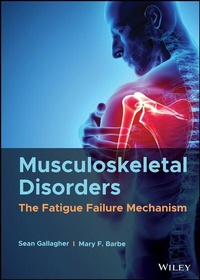
Musculoskeletal Disorders
Description

Hands-on guidance and tools for the prevention of musculoskeletal injuries in the workplace
In Musculoskeletal Disorders: The Fatigue Failure Mechanism, a team of accomplished occupational health experts delivers an essential and incisive discussion of how musculoskeletal disorders (MSDs) develop and progress, as well as how they can be prevented and controlled. Offering a novel, evidence-based approach to this costly problem, the book has broad implications for employers, insurers, and other stakeholders in workplace health and safety.
The authors identify new risk assessment approaches based on the cumulative effects of exposure to highly variable loading conditions. These new approaches can also be applied to evaluate the efficacy of job rotation scenarios and to quantify exoskeleton efficacy. The complexities associated with fatigue failure in biological environments are also explored in addition to suggested models for understanding how the body maintains musculoskeletal homeostasis.
Readers will also find:
* Thorough introductions to the material properties of musculoskeletal tissues and the fundamental principles of fatigue failure analysis
* In-depth explorations of the structure and function of the musculoskeletal system and up-to-date epidemiological research on MSDs
* Comprehensive discussions of validated fatigue failure risk assessment methods, including continuous exposure assessment to better quantify injury risk
* Insightful treatments of remodeling and healing processes as they apply to MSD risk, as well as factors that impair the healing process, like stress, obesity, and aging
Perfect for occupational and environmental health and safety (OEHS) professionals, Musculoskeletal Disorders: The Fatigue Failure Mechanism will also earn a place in the libraries of ergonomists, physical therapists, biomechanists, industrial hygienists, occupational physicians, orthopedists, and musculoskeletal disorder researchers.
More details
Other editions
Additional editions
Persons
Sean Gallagher, PhD, is Full Professor of Industrial and Systems Engineering at Auburn University. He has over 35 years of experience researching musculoskeletal disorders and is a Fellow of both the Human Factors and Ergonomics Society and the American Industrial Hygiene Association.
Mary F. Barbe, PhD, is Full Professor in the Center for Translational Medicine at the Lewis Katz School of Medicine at Temple University in Philadelphia. She has extensive experience investigating mechanisms and treatments for pain and work-related musculoskeletal disorders. She is a Fellow of both the American Association of Anatomists and the American Association of Bone and Mineral Research.
Content
Preface
Acknowledgements
Author the Editors
1. Introduction
2. Common Musculoskeletal Disorders
3. Structure and Function of The Musculoskeletal System
4. Structure and Function of the Nervous System, and Its Relation to Pain
5. Fundamental Biomechanics Concepts
6. Material Properties of Musculoskeletal and Peripheral Nerve Tissues
7. Fatigue Failure of Musculoskeletal Tissues
8. MSDs as a fatigue failure process
9. Fundamentals of Fatigue Failure Analysis
10. Fatigue failure in a biological environment
11. Injury and Self-Repair of Musculoskeletal Tissues
12. Personal Characteristics and MSD Risk
13. Using Fatigue Failure Principles to Assess MSD Risk
14. Implications for MSD Prevention
15. Optimizing Musculoskeletal Health
16. Status of knowledge and unanswered questions
Index
