

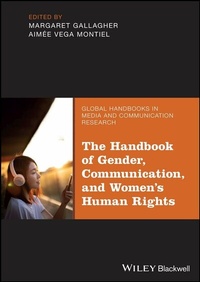
The Handbook of Gender, Communication, and Women's Human Rights
Description

The Handbook on Gender, Communication, and Women's Human Rights engages contemporary debates on women's rights, democracy, and neoliberalism through the lens of feminist communication scholarship. The first major collection of its kind published in the COVID-19 era, this unique volume frames a wide range of issues relevant to the gender and communication agenda within a human rights framework.
An international panel of feminist academics and activists examines how media, information, and communication systems contribute to enabling, ignoring, questioning, or denying women's human and communication rights. Divided into four parts, the Handbook covers governance and policy, systems and institutions, advocacy and activism, and content, rights, and freedoms. Throughout the text, the contributors demonstrate the need for strong feminist critiques of exclusionary power structures, highlight new opportunities and challenges in promoting change, illustrate both the risks and rewards associated with digital communication, and much more.
* Offers a state-of-the-art exploration of the intersection between gender, communication, and women's rights
* Addresses both core and emerging topics in feminist media scholarship and research
* Discusses the vital role of communication systems and processes in women's struggles to claim and exercise their rights
* Analyzes how the COVID-19 pandemic has exacerbated structures of inequality and intensified the spread of disinformation
* Explores feminist-based concepts and approaches that could enrich communication policy at all levels
Part of the Global Handbooks in Media and Communication Research series, TheHandbook of Gender, Communication, and Women's Human Rights is essential reading for advanced undergraduate and graduate students in media studies, communication studies, cultural studies, journalism, feminist studies, gender studies, global studies, and human rights programs at institutions around the world. It is also an invaluable resource for academics, researchers, policymakers, and civil society and human rights activists.
More details
Other editions
Additional editions

Persons
MARGARET GALLAGHER is an independent researcher who has published widely on gender, media, and communication rights. She started her career at the British Broadcasting Corporation (BBC) before moving to the Open University, where she was Deputy Head of the Audio-Visual Media Research Group. She has consulted for the United Nations, the European Commission, the Council of Europe, as well as international development agencies and broadcasting organizations. She serves on the editorial boards of International Communication Gazette, Feminist Media Studies, and Media Development.
AIMÉE VEGA MONTIEL is a researcher at the Center for Interdisciplinary Research in Sciences and Humanities at the National Autonomous University of Mexico (UNAM). She is Co-Chair of the UNESCO UNITWIN on Gender, Media, and ICTs, and Chair of the Global Alliance on Media and Gender (GAMAG). She is a past Vice-President of the International Association for Media and Communication Research (IAMCR) and has served as an expert for the Council of Europe Recommendation of Gender Equality in the Audiovisual Sector.
Content
Notes on Contributors vii
Acknowledgements xv
1 Introduction: Gender, Communication, and Women's Human Rights 1
Margaret Gallagher and Aimée Vega Montiel
Part I Governance and Policy 15
2 Gender Dimensions of Communication Governance: Perspectives, Principles, and Practices 17
Claudia Padovani
3 Communicating Gender in Global Development 35
Karin Gwinn Wilkins
4 Gendered Disinformation and Platform Accountability 53
Margaret Gallagher
5 From Media Reform to Data Justice: Situating Women's Rights as Human Rights 71
Leslie Regan Shade
Part II Systems and Institutions 89
6 Gender, Race, and Locality: Intersectionality in Media and Communication 91
Laura Guimarães Corrêa
7 Gender Dimensions of Communication Industries: A Political Economy Analysis 105
Carolyn M. Byerly
8 Power in AI: Inequality Within and Without the Algorithm 123
Kate Devlin
9 Challenges for Women Journalists in the Age of Covid, and Union and Media Repression: One Trade Unionist's Perspective 141
Mindy Ran
10 Women and the News: Reimagining Journalism 159
Maria João Silveirinha
11 Revisiting and Unpacking the #MeToo Moment 175
Ammu Joseph
Part III Content, Rights, and Freedoms 193
12 Promoting Gender Equality in Media Content: A Limitation or Extension of Freedom of Expression? 195
Maria Edström and Eva-Maria Svensson
13 Digital Culture, Online Misogyny, and Gender-based Violence 213
Debbie Ging
14 Media Do Not Represent Me: Young Women's Social Media Lives 229
Rosalind Gill and Whitney Francois-Cull
15 Gendering Surveillance from a South Asian Perspective 245
Shmyla Khan
16 Pornography in Feminist Theory 261
Rosa Cobo Bedía
17 Violence Against Women in and Through the Media and Digital Technologies 273
Aimée Vega Montiel
Part IV Strategies, Advocacy, and Activism 287
18 The Feminist Principles of the Internet: A Framework for Feminist Organizing and Research in a Digital Age 289
Janine Moolman and Christy Alves Nascimento
19 Lessons Learned from Communication Strategies Created by Indigenous Women 305
Karla Prudencio
20 Gender Equality in and Through the Media in Southern Africa 321
Tarisai Nyamweda
21 Digital Media and Feminist Activism in Latin America: Cyberfeminism 3.0 337
Graciela Natansohn
22 A Feminist Critique of Gender Mainstreaming in Journalism and Communication Education 347
Yanet Martínez Toledo, Lucía Gloria Vázquez Rodríguez, and María Soledad Vargas
23 Building the Evidence for Feminist Advocacy and Awareness-raising: The Global Media Monitoring Project 361
Sarah Macharia
24 Transnational Feminist Organizing and Advocacy for Gender Justice and Women's Rights 377
Dinah Musindarwezo, Felogene Anumo, and Sanyu Awori
Index 395
Notes on Contributors
Felogene Anumo is a pan-African feminist activist who is passionate about advancing gender, climate, social, and economic justice. She is currently the Regional Director for Africa at Thousand Currents, where she brings her experience and passion to strengthen the power of movements. Felogene has worked for feminist organizations such as the AWID and FEMNET. She is a book chapter contributor to Gender, Protests, and Political Change in Africa, Reflections from African, Afrodescendent and Black voices transforming philanthropy and co-author of Report on the Status of Ratification on the Rights of Women in Africa. Felogene's analysis has been published with the London School of Economics (LSE) Blog, Open Global Rights, openDemocracy 50:50 and the Business and Human Rights Journal (CUP), where she serves as a joint Blog Editor. Outside of work, Felogene enjoys spending quality time exploring the world alongside her 9-year-old daughter, providing her with a unique perspective on life.
Sanyu Awori is an African feminist working globally to advance visions, policies, and practice on economic justice. She currently works for the Association for Women's Rights in Development (AWID) a global, feminist, movement-support organization working to achieve gender justice and women's human rights worldwide, where she manages their work on Building Feminist Economies. She has spent more than the last decade working with labor, feminist, and human rights movements advocating for economic justice, gender justice, and corporate accountability. She has worked with the Business & Human Rights Resource Centre, IWRAW Asia Pacific, and the Commonwealth Human Rights Initiative. She has a Master of Laws in Human Rights Law and a Bachelor of Laws from the University of Nottingham. Her writing has appeared in the Business and Human Rights Journal, Human Rights Law Review, Open Global Rights, Open Democracy and more.
Carolyn M. Byerly is Professor Emerita, Howard University, USA. She received her MA and PhD from University of Washington and her BS from University of Colorado, USA. She is a feminist critical scholar whose work takes a political economy approach in the study of media policy, ownership, labor, and other issues. She has central concerns about both gender and race relations in media industries within the United States and internationally. She is the author of Intersectionality, Political Economy and the Media (Routledge, forthcoming), the co-author of Women and Media: A Critical Introduction (Blackwell) and Women and Media: International Perspectives (Blackwell), and the editor of The Palgrave Handbook of Women and Journalism (Palgrave Macmillan). She was the principal investigator and author for the 59-nation Global Report on the Status of Women, sponsored by International Women's Media Foundation, and is the author or co-author of more than 75 articles and book chapters.
Rosa Cobo Bedía is Full Professor of Sociology at the University of A Coruña (Spain). She is the president of the International Scholarly Network of Studies on Prostitution and Pornography. She is the head of the 10th edition of the "History of Feminist Theory" course at the University of A Coruña. She is the director of Atlánticas. International Journal of Feminist Studies. She has coordinated the project "Prostitution and Public Policies," funded by the Spanish Women's Institute. She has taught on feminist theory in Spain and throughout Latin America. Her latest book is Pornography. The Pleasure of Power (2020). Other publications include Prostitution at the Heart of Capitalism (2017) and Towards a New Sexual Politics (2011). She has received awards from several institutions in Spain for her activism in the field of women's human rights.
Laura Guimarães Corrêa is an Associate Professor at the Communications Department of the Federal University of Minas Gerais, Brazil. She holds a PhD in Communication from the same institution and is former director of the Advertising course at UFMG. She was a Visiting Fellow at London School of Economics and Political Science (2015-2016) and a Visiting Research Fellow at the Centre for Feminist Research at Goldsmiths, University of London, researching intersectional theory (2022-2023). She is a board member of Ciseco (International Association of Semiotics and Communication) and leader of Coragem (Research Group on Communication, Race and Gender of UFMG). She has authored articles and book chapters about her research in Portuguese and English. Among other publications, Laura edited the book Vozes Negras em Comunicação: mídia, racismos, resistências (2019), and is currently co-editing the book Black Voices in Communication II: paths, intersections and crossroads, to be published in English and in Portuguese in 2023.
Kate Devlin is Reader in Artificial Intelligence & Society in the Department of Digital Humanities, King's College London, UK. She is an interdisciplinary computer scientist investigating how people interact with and react to technologies, both past and future. Kate is the author of Turned On: Science, Sex and Robots (Bloomsbury, 2018), which examines the ethical and social implications of technology and intimacy. She is Creative and Outreach lead for the UK Research and Innovation (UKRI) Responsible Artificial Intelligence program - an international research and innovation ecosystem for responsible AI. She is a board member of the Open Rights Group, a UK-based organization that works to preserve digital rights and freedoms, and is a campaigner for gender equality to improve opportunities for women in tech.
Maria Edström holds a position as Senior Lecturer and Associate Professor at the Department of Journalism, Media, and Communication (JMG), University of Gothenburg (Sweden), teaching and researching in gender, media, and human rights. She has been involved in two major projects, Comparing gender and media equality across the Globe (2016-2020) and gendered ageism and the challenges of an ageing population through AgeCap, Centre for Ageing and Health (2016 and ongoing). She has been involved in several international gender and media projects, among others Global Media Monitoring Project as national coordinator and the EU-funded project AGEMI, Advancing Gender Equality in Media Industries. Before entering the research field, Maria worked 11 years as a journalist, mainly in print and radio.
Whitney Francois-Cull is a researcher and educator specializing in Sociolinguistics. She obtained her PhD in Applied Linguistics from the School of English, University of Nottingham and her MA from King's College London's Centre for Language, Discourse and Communication, UK. Her work critically investigates discursive representations of teenage pregnancy in policy, primarily in England, exploring the impact of these representations on teenagers who terminate their pregnancies. She utilizes Feminist Critical Discourse Analysis, Intersectionality, Biopolitics and frameworks for identity analyses to investigate identity construction and clinical discourses within teenage pregnancy and abortion experiences.
Margaret Gallagher is an Irish independent researcher and consultant, based in the United Kingdom, whose work spans the fields of gender, media, communication policy, and communication rights. She started her career at the British Broadcasting Corporation (BBC) in London, before moving to the Open University where she was Deputy Head of the Audiovisual Media Research Group. Her consultancy work has included assignments for the United Nations Statistics Division, UNESCO, the International Labour Office, the Council of Europe, the European Commission and the European Audiovisual Observatory. She has published many articles and book chapters, and several books including Unequal Opportunities: The Case of Women and the Media (UNESCO) and Gender Setting: New Agendas for Media Monitoring and Advocacy (Zed Books). She is a member of the editorial advisory boards of Gazette: The International Journal of Communication Studies (Sage), Feminist Media Studies (Routledge) and Media Development (WACC).
Rosalind Gill is Professor of Social and Cultural Analysis at City, University of London, UK. She has worked across gender and sexuality studies, media and communications, sociology, and psychology. She is author or editor of 15 books including Gender and the Media (Polity 2007), Aesthetic Labour (with Ana Elias and Christina Scharff, Palgrave 2017), Mediated Intimacy (with Meg-John Barker and Laura Harvey, Polity 2018) and Confidence Culture (with Shani Orgad, Duke 2022). Her latest book, on which the research here is based, is Perfect: Feeling Judged on Social Media, and is due out in autumn 2023 with Polity Press.
Debbie Ging is Associate Professor of Digital Media and Gender in the School of Communications at Dublin City University, Ireland. She teaches and researches on gender, sexuality, and digital media, with a focus on digital hate, online anti-feminist men's rights politics, the incel subculture, and radicalization of boys and men into male supremacist ideologies. Debbie's research also addresses youth experiences of gender-based and sexual abuse online and educational interventions to address this issue. She is co-editor of Gender Hate Online: Understanding the New Antifeminism (Routledge, 2019) and has published...
