

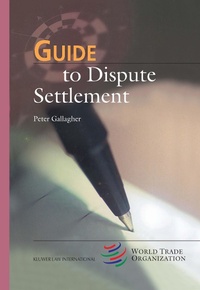
Guide to Dispute Settlement
Published on 9. January 2002
158 pages
978-90-411-5107-0 (ISBN)
Description

As the ultimate arbiter in today's global trade regime, the dispute settlement system of the World Trade Organization (WTO) is a body whose workings should be known to business people and their counsel everywhere. Here is a book--reviewed for accuracy by the WTO but written independently--that provides an uncomplicated but thorough explanation of the system, its purpose, its rules, and the role it plays in the management of the international economy.
Peter Gallagher, a former trade negotiator and a specialist in the Uruguay Round agreements, answers such questions as the following:
What sort of disputes does the WTO deal with? Can business or citizens use the WTO dispute system? Is it possible to get a temporary injunction to stop some action? How much does it cost a to bring a case? How far can you keep on appealing a decision?
As a handy guide to 'bringing a case' before the WTO, or responding to a case already in progress, this easy-to-use book is the ideal starting point for lawyers, business people, or government officials confronted with a disputable trade issue. It is sure to find a place in the working library of people everywhere concerned with international trade.
Peter Gallagher, a former trade negotiator and a specialist in the Uruguay Round agreements, answers such questions as the following:
What sort of disputes does the WTO deal with? Can business or citizens use the WTO dispute system? Is it possible to get a temporary injunction to stop some action? How much does it cost a to bring a case? How far can you keep on appealing a decision?
As a handy guide to 'bringing a case' before the WTO, or responding to a case already in progress, this easy-to-use book is the ideal starting point for lawyers, business people, or government officials confronted with a disputable trade issue. It is sure to find a place in the working library of people everywhere concerned with international trade.
More details
Other editions
Additional editions
Peter Gallagher
Guide to Dispute Settlement
Book
09/2002
1st Edition
Kluwer Law International
€53.50
Shipment within 10-20 days
Content
- Cover
- Half Title Page
- Title Page
- Copyright Page
- Foreword
- Contents
- Chapter One Start here
- A unique experiment
- The global goals of the WTO
- Business pressures can mean conflicts
- Keeping trade benefits in perspective
- The 'experiment'
- How this Guide is organized
- What is a dispute?
- How are disputes settled?
- How are rulings enforced?
- The dispute timetable
- The panel process
- The 'law' and democracy
- Frequently asked questions
- (i) What sort of disputes does the WTO deal with?
- (ii) Can you give me some examples?
- (iii) Are all the WTO rules covered by the dispute system?
- (iv) Can businesses or citizens use the WTO dispute system?
- (v) How long does it take to win a case and get a remedy through the WTO?
- (vi) Is it possible to get a temporary injunction to stop some action?
- (vii) Does the WTO hand out fines or other punishments?
- (viii) How much does it cost to bring a case?
- (ix) Are there judgments for costs against the parties?
- (x) Can several defendants be joined in a case?
- (xi) Do you need a lawyer to represent you?
- (xii) How do I research earlier cases?
- (xiii) Is there just one court at the WTO or are there several?
- (xiv) How far can you keep on appealing a decision?
- (xv) Can we get a Panel to give us an advisory opinion?
- (xvi) Who is responsible in my government for representing me?
- (xvii) Does the WTO provide legal assistance for developing countries?
- Chapter Two A closer look
- The grounds for complaint
- Mutually agreed solutions
- Dispute Resolution - not rulemaking
- The case-by-case approach
- The Panel Process
- (i) Who may serve on a Panel?
- (ii) What must Panels consider?
- (iii) Request for a Panel
- (iv) Terms of reference
- (v) Burden of proof
- (vi) Are there ethical standards for Panels?
- (vii) What processes does a Panel follow?
- (viii) Who may appear before a Panel?
- (ix) Expert assistance
- The Appeal Process
- (i) The need for appellate process
- (ii) What does the Appellate Body review?
- (iii) Basis of legal interpretations
- (iv) Review of 'objective assessment'
- (v) Review of Panel request
- (vi) What can the Appellate Body do?
- (vii) What processes does the Appellate Body follow?
- (viii) Who may appear before the Appellate Body?
- (ix) Consequences of 'judicial' processes
- The Dispute Settlement Body
- Implementing dispute decisions
- (i) Compensation
- (ii) Retaliation
- Role of the Secretariat
- Developing country provisions
- Chapter Three Review of the DSU
- Chapter Four Should you bring a complaint?
- You are a firm
- You are a government
- (i) Has there been a breach of obligation?
- (ii) Does there need to be a trade interest?
- (iii) Is there a 'non-violation' case to answer?
- (iv) Is there a process in the covered Agreement?
- (v) Do previous cases clarify WTO obligations?
- (vi) Are you ' vulnerable' as a plaintiff?
- (vii) How does intervention by other parties affect a dispute?
- (viii) Is it realistic to expect commercial benefit or relief?
- (ix) How long will it take?
- (x) How much will it cost?
- (xi) What are the alternatives to Dispute Settlement
- (xii) Is 'unilateral action' an option?
- (xiii) Should you consider conciliation or mediation?
- (xiv) Is independent legal advice a good idea?
- (xv) Who may represent a Member?
- Chapter Five Disputes by subject
- (i) DSU Procedures
- (ii) Safeguards
- (iii) SPS
- (iv) TRIMS
- (v) Non-violation complaints
- (vi) Intellectual Property
- (vii) Textiles and Clothing
- (viii) 'Environment'
- (ix) National treatment
- (x) Export subsidies
- (xi) Anti-dumping
- Annex I: DSB Annual Report (2000)
- Annex II: Understanding on rules and procedures governing the settlement of disputes
- Appendices
- Index
- Back Cover
