

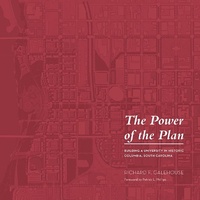
The Power of the Plan
Description

The history and future of the unique partnership between the City of Columbia and the University of South Carolina
State universities are more than just places of higher learning, more indeed than just campuses or buildings, and more than just students scurrying from class to class. They are a symbol of the future of the nation and a statement about the commitment the sponsoring state has made to its people. In turn each city or town that hosts, develops, and nurtures these institutions recognizes that it holds within the community one of the more precious jewels in a state's crown. So it is with the city of Columbia and the University of South Carolina.
Richard F. Galehouse has been involved in the university's master planning work for more than twenty-five years, making him more than qualified to take a lapidary look not only at the present and unfolding plans for the university, but also at the historic path that has brought it to its current luster. Encompassing its earliest days as Columbia College in 1801 (almost two decades before Thomas Jefferson's University of Virginia); the devastating effects of the Civil War; the "crisis years" between 1861 and 1915, when the institution was closed twice and reorganized five times; and some bungled urban planning in the 1950s and 60s, Galehouse's candid examination details the growth of the university and speaks hopefully about its present and its future.
The city of Columbia and the University of South Carolina are unique in how they were designed to grow together, yet cosmopolitan in how they grapple collectively with the challenges and difficulties of combining the city's needs with the university's to create a symbiotic but nevertheless holistic community. The plan for this meeting of minds and needs is the meat of this narrative. The original and iconic "Horseshoe grid" of the city is echoed in the "Innovista" master plan outlined here, which will create in the city a shining setting for the university, one of its own most highly prized treasures.
A foreword is provided by Patrick L. Phillips, global chief executive officer of the Urban Land Institute (2009-2018) and an instructor at the Harvard Graduate School of Design Executive Education Program and at the Carey Business School at Johns Hopkins University.
More details
Other editions
Additional editions

Person
Richard F. Galehouse received his architectural degree from the University of Notre Dame and his master's degree in city and regional planning from the Harvard Graduate School of Design. Now a principal emeritus of Sasaki Associates, a global design firm, he continues to consult on matters related to the University of South Carolina's master plan.
Content
- Cover
- The Power of the Plan
- Title
- Copyright
- Dedication
- CONTENTS
- FOREWORD
- INTRODUCTION
- Civic Outreach
- Architectural Design
- Vision
- Quality of Place
- The Builders
- SECTION I. A NEW CAPITAL CITY FOR SOUTH CAROLINA
- Chapter 1. The Planned City of Columbia 1786
- The Guignard Family
- Location of the New City of Columbia
- The Plan of the City of Columbia
- Origin of the "Grid"
- Development of the City of Columbia
- The Kelsey and Guild Plan
- The Post-World War II Period
- Chapter 2. The Legacy of the Congaree River
- The River
- The Mills
- Chapter 3. A New Public University-South Carolina College
- A College in the City
- The Master Plan for South Carolina College
- The Horseshoe
- Campus Precedents
- SECTION II. BEST LAID PLANS
- Chapter 4. The University of South Carolina in the Twentieth Century
- The Crisis Era
- Rapid Growth of the University
- Saving the Horseshoe
- Chapter 5. Conflict
- Neighborhood Conflict
- University of Chicago
- University of Pennsylvania
- University of Notre Dame
- University of South Carolina
- Conflict Resolution
- The University in Transition
- SECTION III. A VISION FOR THE VISTA
- Chapter 6. The Bicentennial Master Plan
- The Pawleys Island Retreat
- Building a University Campus
- Governing Boards of Trustees
- University of South Carolina Trustees
- Leadership for the Bicentennial Master Plan
- John Palms (1991-2002)
- C. Edward Floyd
- William Hubbard
- Mark W. Byuck Jr.
- Thomas Stepp
- Lyles Glenn
- Charles Jeffcoat
- The Need for Planning
- The Planning Process
- The Facilities Program
- Planning Challenges
- Planning Principles
- Design Principles
- Land Use
- Transportation
- A Vision for the Twenty-First Century
- Building the Plan
- Chapter 7. A Decade of Planning
- University Leadership in the Decade of Planning
- President Andrew Sorensen (2002-2008)
- Rick Kelly
- Mack Whittle
- Herbert Adams
- Dr. Dennis Pruitt
- Dr. Jerry Odom
- Eric Hyman
- Shirley Mills
- Thomas Quasney
- The New Baseball Park
- The Greek Village
- The Athletics Village
- Design Guidelines
- Chapter 8. Setting the Stage for Innovista
- University Research Parks
- The Georgia Tech Research Institute
- The Research Triangle
- The Princeton Forrestal Center
- University Park at the Massachusetts Institute of Technology
- Goals of University Research Parks
- The University as a Real Estate Developer
- SECTION IV. INNOVISTA: A NEW PARTNERSHIP
- Chapter 9. A Research Park for the University of South Carolina
- The Concept
- A Team of Partners
- Charles Thompson
- John Lumpkin
- Bill Boyd
- Lee Bussell
- The Planning Area
- The Planning Process
- The Innovista Master Plan
- Land Use
- Streets and Pedestrian Ways
- Parking
- Special Precincts
- The Greene Street Promenade
- Foundation Square
- The Sculpture Park
- The Congaree Regional Waterfront Park
- Market Feasibility and Economic Impact
- Critical Planning Issues
- The Waterfront Steering Team
- A Real Estate Development Partner
- Financing Innovista
- Public Unveiling
- Dr. Sorensen Goes to Washington
- Chapter 10. Realizing the Vision
- A New Beginning
- The Development Team
- Harris Pastides
- Miles Loadholt
- Ed Walton, Russ Meekins, Bill Kirkland
- Derrick Huggins
- Derek Gruner
- The Community Partners
- The City of Columbia and Richland County
- The Columbia Development Corporation
- The State of South Carolina
- The River Alliance
- The Army Corps of Engineers
- The Guignard Family
- Craig Davis Partners
- Proactive Marketing and Development
- SECTION V. A CAMPUS IN THE CITY
- Chapter 11. A Twenty-First-Century Campus
- Historic Mandate
- The "City" as Campus
- Place
- Quality of Place
- Place and Urban Universities
- Place-Making
- NOTES
- BIBLIOGRAPHY
- Primary Sources: Oral History by the Author, 2014 and 2015
- Sasaki Associates Inc. Documents
- Published Sources
- ACKNOWLEDGMENTS
- ABOUT THE AUTHOR
- INDEX
