

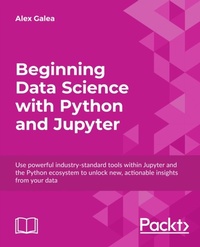
Beginning Data Science with Python and Jupyter
Use powerful industry-standard tools within Jupyter and the Python ecosystem to unlock new, actionable insights from your data
Published on 23. September 2024
194 pages
978-1-78953-465-8 (ISBN)
Description

Getting started with data science doesn t have to be an uphill battle. This step-by-step guide is ideal for beginners who know a little Python and are looking for a quick, fast-paced introduction.
Key Features
Get up and running with the Jupyter ecosystem and some example datasets
Learn about key machine learning concepts like SVM, KNN classifiers and Random Forests
Discover how you can use web scraping to gather and parse your own bespoke datasets
Book DescriptionGet to grips with the skills you need for entry-level data science in this hands-on Python and Jupyter course. You'll learn about some of the most commonly used libraries that are part of the Anaconda distribution, and then explore machine learning models with real datasets to give you the skills and exposure you need for the real world. We'll finish up by showing you how easy it can be to scrape and gather your own data from the open web, so that you can apply your new skills in an actionable context.What you will learn
Get up and running with the Jupyter ecosystem and some example datasets
Learn about key machine learning concepts like SVM, KNN classifiers, and Random Forests
Plan a machine learning classification strategy and train classification, models
Use validation curves and dimensionality reduction to tune and enhance your models
Discover how you can use web scraping to gather and parse your own bespoke datasets
Scrape tabular data from web pages and transform them into Pandas DataFrames
Create interactive, web-friendly visualizations to clearly communicate your findings
Who this book is forThis book is ideal for professionals with a variety of job descriptions across large range of industries, given the rising popularity and accessibility of data science. You'll need some prior experience with Python, with any prior work with libraries like Pandas, Matplotlib and Pandas providing you a useful head start.
Key Features
Get up and running with the Jupyter ecosystem and some example datasets
Learn about key machine learning concepts like SVM, KNN classifiers and Random Forests
Discover how you can use web scraping to gather and parse your own bespoke datasets
Book DescriptionGet to grips with the skills you need for entry-level data science in this hands-on Python and Jupyter course. You'll learn about some of the most commonly used libraries that are part of the Anaconda distribution, and then explore machine learning models with real datasets to give you the skills and exposure you need for the real world. We'll finish up by showing you how easy it can be to scrape and gather your own data from the open web, so that you can apply your new skills in an actionable context.What you will learn
Get up and running with the Jupyter ecosystem and some example datasets
Learn about key machine learning concepts like SVM, KNN classifiers, and Random Forests
Plan a machine learning classification strategy and train classification, models
Use validation curves and dimensionality reduction to tune and enhance your models
Discover how you can use web scraping to gather and parse your own bespoke datasets
Scrape tabular data from web pages and transform them into Pandas DataFrames
Create interactive, web-friendly visualizations to clearly communicate your findings
Who this book is forThis book is ideal for professionals with a variety of job descriptions across large range of industries, given the rising popularity and accessibility of data science. You'll need some prior experience with Python, with any prior work with libraries like Pandas, Matplotlib and Pandas providing you a useful head start.
More details
Edition
Digital original
Language
English
Place of publication
Birmingham
United Kingdom
Target group
Professional and scholarly
US School Grade: College Graduate Student
Edition type
Digital original
File size
13,56 MB
ISBN-13
978-1-78953-465-8 (9781789534658)
Copyright in bibliographic data and cover images is held by Nielsen Book Services Limited or by the publishers or by their respective licensors: all rights reserved.
Schweitzer Classification
Other editions
Additional editions
Alex Galea
Beginning Data Analysis with Python And Jupyter
Use powerful industry-standard tools to unlock new, actionable insight from your existing data
Book
05/2018
Packt Publishing
€22.40
Shipment within 3-4 weeks
Person
Galea Alex :
Alex Galea has been professionally practicing data analytics since graduating with a masters degree in physics from the University of Guelph, Canada. He developed a keen interest in Python while researching quantum gases as part of his graduate studies. Alex is currently doing web data analytics, where Python continues to play a key role in his work. He is a frequent blogger about data-centric projects that involve Python and Jupyter Notebooks.
Alex Galea has been professionally practicing data analytics since graduating with a masters degree in physics from the University of Guelph, Canada. He developed a keen interest in Python while researching quantum gases as part of his graduate studies. Alex is currently doing web data analytics, where Python continues to play a key role in his work. He is a frequent blogger about data-centric projects that involve Python and Jupyter Notebooks.
Content
Table of Contents
Jupyter Fundamentals
Data Cleaning and Advanced Machine Learning
Web Scraping and Interactive Visualizations
Jupyter Fundamentals
Data Cleaning and Advanced Machine Learning
Web Scraping and Interactive Visualizations
