

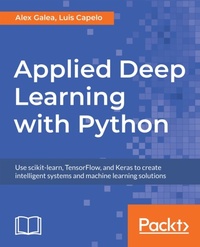
Applied Deep Learning with Python
Use scikit-learn, TensorFlow, and Keras to create intelligent systems and machine learning solutions
1st Edition
Published on 31. August 2018
334 pages
978-1-78980-699-1 (ISBN)
Description

A hands-on guide to deep learning that's filled with intuitive explanations and engaging practical examplesKey Features - Designed to iteratively develop the skills of Python users who don't have a data science background
- Covers the key foundational concepts you'll need to know when building deep learning systems
- Complete with step-by-step exercises and activities to help you build the skills you need for the real world
Book DescriptionTaking an approach that uses the latest developments in the Python ecosystem, you'll first be guided through the Jupyter ecosystem, key visualization libraries and powerful data sanitization techniques before you train your first predictive model. You'll then explore a variety of approaches to classification such as support vector networks, random decision forests and k-nearest neighbors to build on your knowledge before moving on to advanced topics. After covering classification, you'll go on to discover ethical web scraping and interactive visualizations, which will help you professionally gather and present your analysis. Next, you'll start building your keystone deep learning application, one that aims to predict the future price of Bitcoin based on historical public data. You'll then be guided through a trained neural network, which will help you explore common deep learning network architectures (convolutional, recurrent, and generative adversarial networks) and deep reinforcement learning. Later, you'll delve into model optimization and evaluation. You'll do all this while working on a production-ready web application that combines TensorFlow and Keras to produce meaningful user-friendly results. By the end of this book, you'll be equipped with the skills you need to tackle and develop your own real-world deep learning projects confidently and effectively. What you will learn - Discover how you can assemble and clean your very own datasets
- Develop a customized machine learning classification strategy
- Build, train and enhance your own models to solve unique problems
- Work with production-ready frameworks such as TensorFlow and Keras
- Understand how neural networks operate in clear and simple terms
- Deploy your predictions to the web
Who this book is forIf you're a Python programmer stepping into the world of data science, this is the ideal way to get started.
- Covers the key foundational concepts you'll need to know when building deep learning systems
- Complete with step-by-step exercises and activities to help you build the skills you need for the real world
Book DescriptionTaking an approach that uses the latest developments in the Python ecosystem, you'll first be guided through the Jupyter ecosystem, key visualization libraries and powerful data sanitization techniques before you train your first predictive model. You'll then explore a variety of approaches to classification such as support vector networks, random decision forests and k-nearest neighbors to build on your knowledge before moving on to advanced topics. After covering classification, you'll go on to discover ethical web scraping and interactive visualizations, which will help you professionally gather and present your analysis. Next, you'll start building your keystone deep learning application, one that aims to predict the future price of Bitcoin based on historical public data. You'll then be guided through a trained neural network, which will help you explore common deep learning network architectures (convolutional, recurrent, and generative adversarial networks) and deep reinforcement learning. Later, you'll delve into model optimization and evaluation. You'll do all this while working on a production-ready web application that combines TensorFlow and Keras to produce meaningful user-friendly results. By the end of this book, you'll be equipped with the skills you need to tackle and develop your own real-world deep learning projects confidently and effectively. What you will learn - Discover how you can assemble and clean your very own datasets
- Develop a customized machine learning classification strategy
- Build, train and enhance your own models to solve unique problems
- Work with production-ready frameworks such as TensorFlow and Keras
- Understand how neural networks operate in clear and simple terms
- Deploy your predictions to the web
Who this book is forIf you're a Python programmer stepping into the world of data science, this is the ideal way to get started.
More details
Other editions
Additional editions
Alex Galea | Luis Capelo
Applied Deep Learning with Python
Use scikit-learn, TensorFlow, and Keras to create intelligent systems and machine learning solutions
Book
08/2018
Packt Publishing
€56.30
Shipment within 3-4 weeks
Content
- Cover
- Title Page
- Copyright and Credits
- Packt Upsell
- Contributors
- Table of Contents
- Preface
- Chapter 1: Jupyter Fundamentals
- Basic Functionality and Features
- What is a Jupyter Notebook and Why is it Useful?
- Navigating the Platform
- Introducing Jupyter Notebooks
- Jupyter Features
- Exploring some of Jupyter's most useful features
- Converting a Jupyter Notebook to a Python Script
- Python Libraries
- Import the external libraries and set up the plotting environment
- Our First Analysis - The Boston Housing Dataset
- Loading the Data into Jupyter Using a Pandas DataFrame
- Load the Boston housing dataset
- Data Exploration
- Explore the Boston housing dataset
- Introduction to Predictive Analytics with Jupyter Notebooks
- Linear models with Seaborn and scikit-learn
- Activity: Building a Third-Order Polynomial Model
- Linear models with Seaborn and scikit-learn
- Using Categorical Features for Segmentation Analysis
- Create categorical fields from continuous variables and make segmented visualizations
- Summary
- Chapter 2: Data Cleaning and Advanced Machine Learning
- Preparing to Train a Predictive Model
- Determining a Plan for Predictive Analytics
- Preprocessing Data for Machine Learning
- Exploring data preprocessing tools and methods
- Activity: Preparing to Train a Predictive Model for the Employee-Retention Problem
- Training Classification Models
- Introduction to Classification Algorithms
- Training two-feature classification models with scikit-learn
- The plot_decision_regions Function
- Training k-nearest neighbors for our model
- Training a Random Forest
- Assessing Models with k-Fold Cross-Validation and Validation Curves
- Using k-fold cross-validation and validation curves in Python with scikit-learn
- Dimensionality Reduction Techniques
- Training a predictive model for the employee retention problem
- Summary
- Chapter 3: Web Scraping and Interactive Visualizations
- Scraping Web Page Data
- Introduction to HTTP Requests
- Making HTTP Requests in the Jupyter Notebook
- Handling HTTP requests with Python in a Jupyter Notebook
- Parsing HTML in the Jupyter Notebook
- Parsing HTML with Python in a Jupyter Notebook
- Activity: Web Scraping with Jupyter Notebooks
- Interactive Visualizations
- Building a DataFrame to Store and Organize Data
- Building and merging Pandas DataFrames
- Introduction to Bokeh
- Introduction to interactive visualizations with Bokeh
- Activity: Exploring Data with Interactive Visualizations
- Summary
- Chapter 4: Introduction to Neural Networks and Deep Learning
- What are Neural Networks?
- Successful Applications
- Why Do Neural Networks Work So Well?
- Representation Learning
- Function Approximation
- Limitations of Deep Learning
- Inherent Bias and Ethical Considerations
- Common Components and Operations of Neural Networks
- Configuring a Deep Learning Environment
- Software Components for Deep Learning
- Python 3
- TensorFlow
- Keras
- TensorBoard
- Jupyter Notebooks, Pandas, and NumPy
- Activity: Verifying Software Components
- Exploring a Trained Neural Network
- MNIST Dataset
- Training a Neural Network with TensorFlow
- Training a Neural Network
- Testing Network Performance with Unseen Data
- Activity: Exploring a Trained Neural Network
- Summary
- Chapter 5: Model Architecture
- Choosing the Right Model Architecture
- Common Architectures
- Convolutional Neural Networks
- Recurrent Neural Networks
- Generative Adversarial Networks
- Deep Reinforcement Learning
- Data Normalization
- Z-score
- Point-Relative Normalization
- Maximum and Minimum Normalization
- Structuring Your Problem
- Activity: Exploring the Bitcoin Dataset and Preparing Data for Model
- Using Keras as a TensorFlow Interface
- Model Components
- Activity: Creating a TensorFlow Model Using Keras
- From Data Preparation to Modeling
- Training a Neural Network
- Reshaping Time-Series Data
- Making Predictions
- Overfitting
- Activity: Assembling a Deep Learning System
- Summary
- Chapter 6: Model Evaluation and Optimization
- Model Evaluation
- Problem Categories
- Loss Functions, Accuracy, and Error Rates
- Different Loss Functions, Same Architecture
- Using TensorBoard
- Implementing Model Evaluation Metrics
- Evaluating the Bitcoin Model
- Overfitting
- Model Predictions
- Interpreting Predictions
- Activity:Creating an Active Training Environment
- Hyperparameter Optimization
- Layers and Nodes - Adding More Layers
- Adding More Nodes
- Layers and Nodes - Implementation
- Epochs
- Epochs - Implementation
- Activation Functions
- Linear (Identity)
- Hyperbolic Tangent (Tanh)
- Rectifid Linear Unit
- Activation Functions - Implementation
- Regularization Strategies
- L2 Regularization
- Dropout
- Regularization Strategies - Implementation
- Optimization Results
- Activity:Optimizing a Deep Learning Model
- Summary
- Chapter 7: Productization
- Handling New Data
- Separating Data and Model
- Data Component
- Model Component
- Dealing with New Data
- Re-Training an Old Model
- Training a New Model
- Activity: Dealing with New Data
- Deploying a Model as a Web Application
- Application Architecture and Technologies
- Deploying and Using Cryptonic
- Activity: Deploying a Deep Learning Application
- Summary
- Other Books You May Enjoy
- Index
