

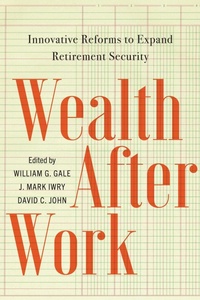
Wealth After Work
Innovative Reforms to Expand Retirement Security
1st Edition
Published on 27. July 2021
404 pages
978-0-8157-3935-7 (ISBN)
Description

Pensions and retirement saving plans have helped millions of households build financial security. But tens of millions of people have been left behind, without access to these wealth accumulation vehicles. For many others, the plans they have do not ensure financial security in retirement.
The problems that underlie these failures can be addressed. This book proposes concrete, practical ways to make dependable retirement income accessible for all Americans¿not just those with means.
Individual accounts have eclipsed traditional pensions as the primary vehicle for retirement saving in the United States¿a shift that underlies many sources of retirement insecurity. The 401(k) plan and similar accounts have increased financial security for many people but have done nothing for millions more. Many of those who do have such plans are burdened with the need to make numerous saving, investment, and withdrawal decisions that stress their financial acumen. Financial advice that is unbiased, unconflicted, and affordable is often difficult to find. Managing wealth in retirement¿especially the need to convert retirement savings into steady income¿poses significant challenges that current financial instruments and practices do not adequately address. Economic downturns like the Great Recession and the COVID-19 pandemic increase financial insecurity and make addressing these issues more urgent.
Written by noted experts in the field, Wealth After Work offers practical solutions that address these concerns. The proposals show how policymakers can help all Americans gain access to retirement savings accounts, obtain better information about their savings choices, and better manage their wealth in retirement. By proposing solutions that build on, rather than replace the existing system, the book provides a nuanced, practical guide to reform that would benefit all Americans.
The problems that underlie these failures can be addressed. This book proposes concrete, practical ways to make dependable retirement income accessible for all Americans¿not just those with means.
Individual accounts have eclipsed traditional pensions as the primary vehicle for retirement saving in the United States¿a shift that underlies many sources of retirement insecurity. The 401(k) plan and similar accounts have increased financial security for many people but have done nothing for millions more. Many of those who do have such plans are burdened with the need to make numerous saving, investment, and withdrawal decisions that stress their financial acumen. Financial advice that is unbiased, unconflicted, and affordable is often difficult to find. Managing wealth in retirement¿especially the need to convert retirement savings into steady income¿poses significant challenges that current financial instruments and practices do not adequately address. Economic downturns like the Great Recession and the COVID-19 pandemic increase financial insecurity and make addressing these issues more urgent.
Written by noted experts in the field, Wealth After Work offers practical solutions that address these concerns. The proposals show how policymakers can help all Americans gain access to retirement savings accounts, obtain better information about their savings choices, and better manage their wealth in retirement. By proposing solutions that build on, rather than replace the existing system, the book provides a nuanced, practical guide to reform that would benefit all Americans.
More details
Edition
1. Auflage
Language
English
Place of publication
New York
United States
Publishing group
Bloomsbury Publishing Plc
Illustrations
30 tables
ISBN-13
978-0-8157-3935-7 (9780815739357)
DOI
10.5771/9780815739357
Copyright in bibliographic data and cover images is held by Nielsen Book Services Limited or by the publishers or by their respective licensors: all rights reserved.
Schweitzer Classification
Other editions
Additional editions
William G. Gale | J. Mark Iwry | David C. John
Wealth After Work
Innovative Reforms to Expand Retirement Security
Book
07/2021
Brookings Institution
€52.90
Shipment within 10-20 days
Persons
William Gale is the Arjay and Frances Miller Chair in Federal Economic Policy at the Brookings Institution, where he directs the Retirement Security Project and codirects the Urban-Brookings Tax Policy Center. He authored Fiscal Therapy: Curing America's Addiction to Debt and Investing in the Future (Oxford, 2019) and has co-edited several books.J. Mark Iwry is a nonresident senior fellow at the Brookings Institution and Visiting Scholar at the Wharton School. He formerly served as Senior Advisor to the Secretary of the Treasury for national retirement and health policy and was previously a partner in the law firm of Covington & Burling.David C. John is a nonresident senior fellow at the Brookings Institution and a Senior Policy Advisor at the AARP Public Policy Institute. Prior to joining AARP, he was a Senior Fellow at the Heritage Foundation and held senior roles in four congressional offices.
Content
Contents:
Preface
Introduction, William G. Gale, Claire Haldeman, David C. John, and J. Mark Iwry
1. How Will Retirement Saving Change by 2050? Prospects for the Millennial Generation, William G. Gale, Hilary Gelfond, and Jason J. Fichtner
2. Changing Wealth Accumulation Patterns: Evidence and Determinants, William G. Gale and Benjamin H. Harris
3. How Does Gender Equality Affect Women in Retirement?, Grace Enda and William G. Gale
4. A Retirement Dashboard for the United States, David C. John, Grace Enda, William G. Gale, and J. Mark Iwry
5. Retirement Plans for Contingent Workers: Issues and Options, William G. Gale, Sarah Holmes Berk, and David C. John
6. Supplemental Transition Accounts for Retirement: A Proposal to Increase Retirement Income Security and Reform Social Security, Gary Koenig, Jason J. Fichtner, and William G. Gale
7. State-Sponsored Retirement Saving Plans: New Approaches to Boost Retirement Plan Coverage, William G. Gale and David C. John
8. Structuring State Retirement Saving Plans: A Guide to Policy Design and Management Issues, David C. John and William G. Gale
9. Public Pensions in Flux: How the Federal Government's Experience Can Inform State Responses, William G. Gale, Sarah Holmes Berk, and David C. John
10. You Get What You Pay For: Guaranteed Returns in Retirement Saving Accounts, William G. Gale, David C. John, and Bryan Kim
11. From Saving to Spending: A Proposal to Convert Retirement Account Balances into Automatic and Flexible Income, David C. John, William G. Gale, J. Mark Iwry, and Aaron Krupkin
12. When Income Is the Outcome: Reducing Regulatory Obstacles to Annuities in 401(k) Plans, J. Mark Iwry, William G. Gale, David C. John, and Victoria Johnson
13. Retirement Tontines: Using a Classical Finance Mechanism as an Alternative Source of Retirement Income, J. Mark Iwry, Claire Haldeman, William G. Gale, and David C. John
Contributors
Chapter Credits
Index
Preface
Introduction, William G. Gale, Claire Haldeman, David C. John, and J. Mark Iwry
1. How Will Retirement Saving Change by 2050? Prospects for the Millennial Generation, William G. Gale, Hilary Gelfond, and Jason J. Fichtner
2. Changing Wealth Accumulation Patterns: Evidence and Determinants, William G. Gale and Benjamin H. Harris
3. How Does Gender Equality Affect Women in Retirement?, Grace Enda and William G. Gale
4. A Retirement Dashboard for the United States, David C. John, Grace Enda, William G. Gale, and J. Mark Iwry
5. Retirement Plans for Contingent Workers: Issues and Options, William G. Gale, Sarah Holmes Berk, and David C. John
6. Supplemental Transition Accounts for Retirement: A Proposal to Increase Retirement Income Security and Reform Social Security, Gary Koenig, Jason J. Fichtner, and William G. Gale
7. State-Sponsored Retirement Saving Plans: New Approaches to Boost Retirement Plan Coverage, William G. Gale and David C. John
8. Structuring State Retirement Saving Plans: A Guide to Policy Design and Management Issues, David C. John and William G. Gale
9. Public Pensions in Flux: How the Federal Government's Experience Can Inform State Responses, William G. Gale, Sarah Holmes Berk, and David C. John
10. You Get What You Pay For: Guaranteed Returns in Retirement Saving Accounts, William G. Gale, David C. John, and Bryan Kim
11. From Saving to Spending: A Proposal to Convert Retirement Account Balances into Automatic and Flexible Income, David C. John, William G. Gale, J. Mark Iwry, and Aaron Krupkin
12. When Income Is the Outcome: Reducing Regulatory Obstacles to Annuities in 401(k) Plans, J. Mark Iwry, William G. Gale, David C. John, and Victoria Johnson
13. Retirement Tontines: Using a Classical Finance Mechanism as an Alternative Source of Retirement Income, J. Mark Iwry, Claire Haldeman, William G. Gale, and David C. John
Contributors
Chapter Credits
Index
