

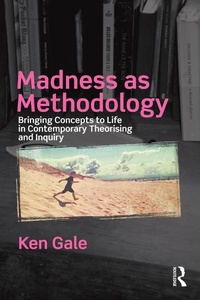
Madness as Methodology
Bringing Concepts to Life in Contemporary Theorising and Inquiry
1st Edition
Published on 23. March 2018
208 pages
978-1-351-65928-4 (ISBN)
Description

Madness as Methodology begins with the following quotation from Deleuze and Guattari, 'Madness need not be all breakdown. It may also be breakthrough.' This quotation firmly expresses the book's intention to provide readers with radical and innovative approaches to methodology and research in the arts, humanities and education practices. It conceptualises madness, not as a condition of an individual or particular being, but rather as a process that does things differently in terms of creativity and world making.
Through a posthuman theorising as practice, the book emphasises forms of becoming and differentiation that sees all bodies, human and nonhuman, as acting in constant, fluid, relational play. The book offers a means of breaking through and challenging the constraints and limitations of Positivist approaches to established research practice. Therefore, experimentation, concept making as event and a going off the rails are offered as necessary means of inquiry into worlds that are considered to be always not yet known.
Rather than using a linear chapter structure, the book is constructed around Deleuze and Guattari's use of an assemblage of plateaus, providing the reader with a freedom of movement via multiple entry and exit points to the text. These plateaus are processually interconnected providing a focal emphasis upon topics apposite to this madness as methodology. Therefore, as well as offering a challenge to the constraining rigours of conventional research practices, these plateaus engage with topics to do with posthuman thinking, relationality, affect theory, collaboration, subjectivity, friendship, performance and the use of writing as a method of inquiry.
Through a posthuman theorising as practice, the book emphasises forms of becoming and differentiation that sees all bodies, human and nonhuman, as acting in constant, fluid, relational play. The book offers a means of breaking through and challenging the constraints and limitations of Positivist approaches to established research practice. Therefore, experimentation, concept making as event and a going off the rails are offered as necessary means of inquiry into worlds that are considered to be always not yet known.
Rather than using a linear chapter structure, the book is constructed around Deleuze and Guattari's use of an assemblage of plateaus, providing the reader with a freedom of movement via multiple entry and exit points to the text. These plateaus are processually interconnected providing a focal emphasis upon topics apposite to this madness as methodology. Therefore, as well as offering a challenge to the constraining rigours of conventional research practices, these plateaus engage with topics to do with posthuman thinking, relationality, affect theory, collaboration, subjectivity, friendship, performance and the use of writing as a method of inquiry.
Reviews / Votes
Treat yourself. Enter Gale's writing, his becoming, where assertion gives way to the possible. See how the nail rejects the hammer, the thread zigzags away from the seam, the mirror celebrates its shards. Gale's work is an assemblage of colorful fabrics and ribbons, always flowing, some wildly, some modestly, all caught in an always swirling wind. Embrace the pleasures of becoming with Gale, of moving with him and into your own terrain. His joyful methodological madness invites a performative immediacy of the moment, of movement. At the end, you may feel as I do: What pleasure surrendering to the space Gale opens!Ronald J. Pelias, University of Louisiana, USA
Advocating madness as methodology is a tricky business: get it wrong, and you risk seeming either 'just' mad, or not really mad enough. Ken Gale gets it right. The book wears its erudition, its range, and its deep thoughtfulness lightly. It exemplifies exactly what it advocates - unruly resources for creative, ethical and experimental research encounters.
Maggie MacLure, Manchester Metropolitan University, UK
Madness in this book does not rest in a binary opposition to sanity; in the emergent, playful experimentation and poetry of this text, the thrust is not so much toward breakdown, but breakthrough. Gale confronts chaos, not as something to be conquered, but as a means to enhancing thought by removing it from the relentless repetitions of representation, classification and identification. In breaking loose from those old forms of humanist inquiry, the book opens out as a sparkling, embodied, sensory and unpredictable set of experiments, bringing to life the entanglements of language, of human and non-human bodies, and of desire.
Bronwyn Davies, Emeritus Professor Western Sydney University, Australia
Madness as concept, madness as breakthrough, madness as movement, sensation, madness as life-giving, madness as in-formation, madness as the more-than. Madness as the force of a non-methodology that moves to the rhythm of a methodogenesis, a movement always processual, the movement of thought itself. This is the proposition: to compose, to write, to live in the midst of what refuses to know itself in advance. Not only toward new ways of writing, new forms of composition, but toward new forms of teaching, of learning, of living.
Erin Manning, Research Chair, Relational Art and Philosophy, Concordia University
More details
Edition
1. Auflage
Language
English
Place of publication
London
United Kingdom
Publishing group
Taylor & Francis Ltd
Target group
College/higher education
File size
0,96 MB
ISBN-13
978-1-351-65928-4 (9781351659284)
Copyright in bibliographic data and cover images is held by Nielsen Book Services Limited or by the publishers or by their respective licensors: all rights reserved.
Schweitzer Classification
Other editions
Additional editions
Book
03/2018
1st Edition
Routledge
€207.40
Shipment within 10-20 days
Book
03/2018
1st Edition
Routledge
€64.70
Shipment within 10-20 days
Person
Ken Gale works in the Institute of Education in the Faculty of Arts and Humanities at Plymouth University. His main philosophical and academic interests are to do with bringing the use of posthuman, process based forms of concept making as event to creative, experimental practices of pedagogy and research in education.
Content
(Not a) Foreword
Acknowledgements
Introduction? On Arrival from Elsewhere
Some Stories of Emergence: Routines, Surprises And Epiphanies
Bringing Madness to Life
Conceptualising Madness as Process?
Conceptualising Madness as Affect?
Madness as A Collaborative Practice
Friendship, Madness and The Posthuman
Writing Minor Literature: Working with Flows, Intensities and The Welcome of The Unknown
Madness as Methodology as Performance
Considering (Non) Data as Event: Employing Interference as Methodology
What Can This Madness as Methodology Do?
References
Index
Acknowledgements
Introduction? On Arrival from Elsewhere
Some Stories of Emergence: Routines, Surprises And Epiphanies
Bringing Madness to Life
Conceptualising Madness as Process?
Conceptualising Madness as Affect?
Madness as A Collaborative Practice
Friendship, Madness and The Posthuman
Writing Minor Literature: Working with Flows, Intensities and The Welcome of The Unknown
Madness as Methodology as Performance
Considering (Non) Data as Event: Employing Interference as Methodology
What Can This Madness as Methodology Do?
References
Index
