

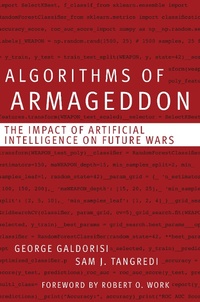
Algorithms of Armageddon
Description

It is unclear if U.S. policy makers and military leaders fully realize that we have already been thrust into an artificial intelligence (AI) race with authoritarian powers. Today, the United States' peer adversaries-China and Russia-have made clear their intentions to make major investments in AI and insert this technology into their military systems, sensors and weapons. Their goal is to gain an asymmetric advantage over the U.S. military. The implications for our national security are many and complex. Algorithms of Armageddon examines this most pressing security issue in a clear, insightful delivery by two experts. Authors George Galdorisi and Sam J. Tangredi are national security professionals who deal with AI on a day-to-day basis in their work in both the technical and policy arenas.
Opening chapters explain the fundamentals of what constitutes big data, machine learning, and artificial intelligence. They investigate the convergence of AI with other technologies and how these systems will interact with humans. Critical to the issue is the manner by which AI is being developed and utilized by Russia and China. The central chapters of the work address the weaponizing of AI through interaction with other technologies, man-machine teaming, and autonomous weapons systems. The authors cover in depth debates surrounding the AI "genie out of the bottle" controversy, AI arms races, and the resulting impact on policy and the laws of war. Given that global powers are leading large-scale development of AI, it is likely that use of this technology will be global in extent. Will AI-enabled military weapons systems lead to full-scale global war? Can such a conflict be avoided? The later chapters of the work explore these questions, point to the possibility of humans failing to control military AI applications, and conclude that the dangers for the United States are real.
Neither a protest against AI, nor a speculative work on how AI could replace humans, Algorithms of Armageddon provides a time-critical understanding of why AI is being implemented through state weaponization, the realities for the global power balance, and more importantly, U.S. national security. Galdorisi and Tangredi propose a national dialogue that focuses on the need for U.S. military to have access to the latest AI-enabled technology in order to provide security and prosperity to the American people.
More details
Other editions
Additional editions
Persons
Captain Sam J. Tangredi, U.S. Navy (Ret.) is the Leidos Chair of Future Warfare Studies and Professor of National, Naval and Maritime Strategy at the U.S. Naval War College. A surface warfare officer and warship captain deployed worldwide, Dr. Tangredi also served multiple tours of duty in the Pentagon as a leader of strategic planning teams. He has published six books and over 200 articles on defense strategy and has won 15 professional literature awards. His book Anti-Access Warfare, considered a definitive work, was recently republished in paperback by Naval Institute Press as well as translated into Chinese by the People's Liberation Army. He splits his time between Newport, RI and Coronado, CA.
Content
- Intro
- Title Page
- Copyright
- Contents
- Foreword
- Introduction. "The Ruler of the World"
- 1. What Is AI, and Why Is It Important?
- 2. How Did We Get Here? Human Minds and Converging Technologies
- 3. What Is at Stake? China, Russia, and the Race for AI
- 4. Weaponizing AI: Why AI Is Important for Military Weapons
- 5. Robots at War: The Untested Theory of Human-Machine Teaming
- 6. Decision-Making: Can AI Do It Better and Faster?
- 7. Is the Genie Out of the Bottle? Is Weaponizing AI Inevitable?
- 8. The Laws of War: Will AI-Enabled Weapons Change Them?
- 9. World War III: How Will It Start?
- 10. Will World War III Ever End? If So, How?
- 11. Toward a National Dialogue on Military AI
- Conclusion
- Notes
- Index
- About the Authors
