

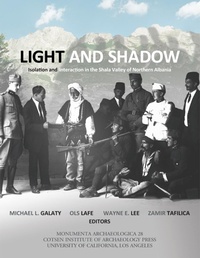
Light and Shadow
Isolation and Interaction in the Shala Valley of Northern Albania
Published on 31. December 2013
304 pages
978-1-938770-91-3 (ISBN)
Description

Employing survey archaeology, excavation, ethnographic study, and multinational archival work, the Shala Valley Project uncovered the many powerful, creative ways whereby the men and women of Shala shaped their world: through dynamic, world-systemic relationships with the powers that surrounded but never fully conquered them. The Shala Valley Project presents the highlanders, the malesore, in the full complexity of their lives, while also unveiling a new, deeper history for the region--a history that reaches back to an unexpected fortified Iron Age site. Light and Shadow tells many stories. Archaeologists, historians, and students of tribes, of empires, of imperial-indigenous relations, of blood feud, of kinship, of the built landscape, of world-systems theory and sustainability science, and more, will find much here to digest. The people of Shala, to which Light and Shadow is dedicated, may serve as an example in our modern age, one in which persistent, tribal peoples still fight for their survival, and seek to preserve some degree of independence from capitalist economies bent on their incorporation.
More details
Series
Language
English
Place of publication
Los Angeles
United States
File size
14,18 MB
ISBN-13
978-1-938770-91-3 (9781938770913)
Copyright in bibliographic data and cover images is held by Nielsen Book Services Limited or by the publishers or by their respective licensors: all rights reserved.
Schweitzer Classification
Other editions
Additional editions

Michael L. Galaty | Ols Lafe | Wayne E. Lee
Light and Shadow
Isolation and Interaction in the Shala Valley of Northern Albania
Book
04/2013
Cotsen Institute of Archaeology at UCLA
€68.50
Article not available at the moment
Content
- Cover
- Half Title
- Recent Monumenta Archaeologica
- Title
- Copyright
- Frontispiece
- Dedication
- Table of Contents
- Foreword
- Preface
- Acknowledgments
- List of Figures
- List of Tables
- About the Editors
- About the Contributors
- Chapter 1: Introduction
- Why Northern Albania?
- Literature Review: Shala
- Factors Affecting Incorporation and Persistence in Shala
- World-Systems/Frontier Effects
- Dynamics Landscapes
- Conclusion
- Note
- Chapter 2: Project History and Methodology
- Project History
- Project Goals and Methods
- Indicators
- Environmental Inputs
- Population and House Size/Elaboration
- Settlement Pattern and Seasonality
- Landscape Investment
- Trade
- Exogamy
- Travelers
- Rebellions
- Incorporative Pressure
- Conclusion
- Notes
- Chapter 3: The Environmental Context
- Geography
- Geology
- Climate
- Resources
- Cultural Responses to Northern Albania's Environment
- Subsistence and Economy
- Demography, Marriage, and Feud
- Conclusion
- Notes
- Chapter 4: Archival Historical Research
- Introduction and Historical Overview
- Ancient and Medieval History
- The Ottoman Regime
- An Independent Albania
- Founding Legends of Shala
- Other Tribes in Shala
- The Church Administration in Shala
- Conclusion
- Venetian and Ottoman Sources on the Northern Albanian Frontier, 1400-1750
- Skanderbeg
- The Attractions of the Region: Soldiers and Minerals
- The Beginnings: From 1385 to 1463
- The Ottoman-Venetian Frontier
- The War of 1463-1479
- The War of 1499-1503
- The War of 1537-1540
- The War of 1570-1573
- The Seventeenth Century
- The War of Candia, 1644-1669
- Sancaks, Cadasters, and Dioceses
- Propaganda on the Frontier
- Conclusion
- Travelers, Routes, and Trade
- Conclusion
- Demography
- The Sources
- Population, 1485-2007
- Other Demographic Issues: Household Structure, Male-Female Ratios, Military Labor
- Conclusion
- Notes
- Chapter 5: Spatial and Temporal Patterns in Kinship Relations
- Descent
- Marriage
- Feuding
- The Basics of the Northern Albanian Feud
- Implications
- Reconciliation: Past and Present
- Notes
- Chapter 6: Economy and Settlement
- Types of Economic Activity: Arable Farming
- Pastoralism and Transhumance
- Exploitation of Wild Resources
- The Agricultural Calendar
- Craft Activities
- Tourism
- Unites of Economic Activity: Households, Neighborhoods, and Villages
- Households
- Neighborhoods
- Villages
- Concluding Comments
- Economic Isolation versus Interaction
- Reconstructing Economic Activity in the Past
- Notes
- Chapter 7: Modern Settlement Patterns and the Built Landscape
- The "Splitting of Brothers
- Neighborhood Creation and Expansion in the Past Century-Theth and Gimaj
- Upper Gjelaj
- Gjeçaj
- Gimaj
- Additional Evidence for Neighborhood Dating
- Photographic
- Living Space
- Shteg Complexity
- Terraces
- Architecture
- Conclusion
- Notes
- Chapter 8: The Sacred Landscape of Shala
- Symbolism and Sacred Landscapes
- The Stone and the House
- The Benedictines and Other Medieval Orders
- The Symbols
- 1. The Sun Dial
- 2. The Sun Symbol
- 3. The Moon Symbol
- 4. The Astral Symbol
- 5. The Square
- 5a. The Holy Center
- 5b. The Threefold Encirclement
- 6. The Cave
- 7. The Triangle and the Rhombus
- 8. The Tree of Life
- 9. Anthropomorphic Symbols
- 10. The Cross
- 11. Geometric Symbols
- 11a. Parallel Lines
- 11b. The Zigzag Line
- 11c. The Net Symbol
- 12. The Secret Sign
- 13. The Snake
- Conclusion
- Note
- Chapter 9: Regional Archaeological Survey and Excavation Results
- Results of the Intensive Archaeological Survey
- Introduction: Goals and Methods
- IAS Site Catalog
- IAS Site 001: Middle Paleolithic
- IAS Site 002: Okol Rockshelters
- IAS Site 003: Upper Gjelaj
- IAS Site 004: Lower Gjelaj
- IAS Site 005: Stone Circle Near Gerlë (Grunasi)
- IAS Site 006: Grunas
- IAS Site 007: Dakaj
- IAS Site 008: Gimaj
- IAS Site 009: Okol
- IAS Site 010: Qafë e Thorës
- Results of the Extensive Archaeological Survey
- Introduction: Goals and Methods
- EAS Site Catalog: Region of Shosh
- EAS Site 001: Kodër i Shën Gjergjit, Ara e Peronit
- EAS Sites 002 and 004: Ndrejaj
- EAS Site 003: Qafa e Pyllës
- EAS Site 005: Leparu
- EAS Site 006: Pepsumaj
- EAS Site 007: Moll-kuqe/Dardhë
- EAS Site 010: Cilkuk
- EAS Site Catalog: Region of Pult
- The Village of Kir
- EAS 011
- EAS Sites 008 and 009: Lower and Upper Pog
- Comparative Settlement Patterns
- Conclusion
- Notes
- Chapter 10: Grunas
- Discovery
- Survey and Mapping
- Excavation Results
- Unit 2008-001
- Unit 2008-002
- Unit 2008-004
- Unit 2008-003
- Artifact and Ecofact Analyses
- Lithics
- Flint Chemistry
- Pottery
- Pottery Chemistry
- Residue Analysis
- Fauna
- Archaeobotany
- Wood
- Soil Chemistry
- Conclusion
- Notes
- Chapter 11: Conclusion
- Factors Affecting Resilience and Change in Shala
- Theoretical Reprise
- World-Systems Theory
- Landscape Theory
- Micro-history
- Resilience Theory
- Shala in Comparative Context
- Shala vs. Montenegro
- Shala vs. Lowland Albania
- Shala vs. the Inupiaq Eskimos
- Shala vs. the Andes
- Modern vs. Prehistoric Shala
- Final Thoughts
- Note
- Glossary of Key Albanian Terms
- References
- Monumenta Archaeologica
- Index
