

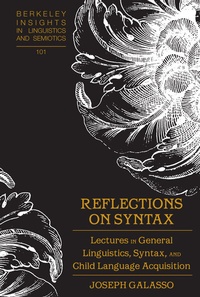
Reflections on Syntax
Description

The lectures in this book are immensely Chomskyan in spirit, recursive-syntactic in nature, and tethered to a framework which takes as the null hypothesis the notion that language is an innate, pre-determined biological system-a system which by definition is multi-complex, human-specific, and analogous to a philosophy highly commensurate of Descartes' great proverbial adage which announces the calling for a 'ghost-in-the-machine'. The book begins with a gradual assessment of the kinds of complex constructs students of syntax need to work-up. Leading to the classic 'Four-Sentences'-each of which bears as a kind of post-mark its own decade of Chomskyan analysis-we trace the origins of generative grammar from the fields of child language acquisition (of the 1960s), to psycholinguistics (of the 1970s), to where we stand today within the Minimalist Program. Various spin-off proposals have been spawned by envisioned analyses which treat syntactic movement as the quintessential human processing-a processing which would give rise to human language. Such spin-offs include 'Proto-language' and a new treatment of the so-called morpho-syntactic 'Dual Mechanism Model'.
Reviews / Votes
"This book provides a fascinating and highly individual perspective on language. It deals with a wide range of topics including the philosophy of language, its biological basis and evolution, as well as language acquisition, language disorders, language processing and language universals."-Andrew Radford, Emeritus Professor of Linguistics, University of Essex, United KingdomMore details
Other editions
Additional editions
Person
Content
List of Figures and Tables - Preface - Overview - Introduction - Opening Philosophical Questions: Language and Brain Analogies - Preliminary Overview - The 'Four Sentences' - Reflections on Syntax - Reasons for Syntactic Movement/'Four Sentences' Revisited - The Myth of 'Function Defines Form' as the Null-Biological Adaptive Process and the Counter Linguistics-Based Response. (The 'Accumulative Lecture') - Poverty of Stimulus - Concluding Remarks. The Dual Mechanism: Studies on Language - A Note on 'Proto-language': A Merge-Based Theory of Language Acquisition-Case, Agreement and Word Order Revisited - Concluding Remarks: Lack of Recursion Found in Protolanguage - A Note on the Dual Mechanism Model: Language Acquisition vs. Learning and the Bell-Shape Curve - Overview of Chomsky - Works Cited - List of Terms (informal definitions) - Full References and Web Links - Index.
