

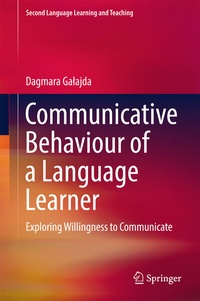
Communicative Behaviour of a Language Learner
Description

This book investigates and analyzes the way in which factors such as communication apprehension, self-perceived communicative competence and group dynamics influence the communicative behavior of a foreign-language learner. It also focuses on interpersonal communication, group communication and public speaking. Using selected models it characterizes and analyzes all types of communication with reference to communication in the language classroom, with a particular emphasis on the foreign-language context. The author also presents some conclusions and implications for both language teachers and language learners, as well as offering suggestions for further research in the field of classroom communication. The results of the study serve as a point of reference for teachers interested in the construct of willingness to communicate and other communication variables related to the issue of communication in a foreign language. The work also raises teachers' awareness of individual learnerdifferences in the context of communication in the foreign-language classroom.
More details
Other editions
Additional editions
Person
Dagmara Galajda received her Ph.D. degree in Linguistics from the University of Silesia, where she now works as an assistant professor. Apart from communication studies, her research interests focus on the teachers' action zone in facilitating group dynamics, affect in language learning, individual learner differences in SLA/FLL and reflective teaching. Recent publications include "Anxiety and perceived communication competence as predictors of willingness to communicate in ESL/FL classroom" in D. Gabrys-Barker, J. Bielska (eds) (2013), The Affective Dimension in Second Language Acquisition; Clevedon ; and "Multilingual Matters, Communication Apprehension and Self-perceived Communication Competence as Variables Underlying Willingness to Communicate" in K. Piatkowska, E. Koscialkowska-Okonska (eds) (2013) Correspondences and Contrasts in Foreign Language Pedagogy and Translation Studies , Berlin: Springer-Verlag. She has co-edited three volumes (two in 2016 and one in 2017) in the series Second Language Learning and Teaching published by Springer-Verlag.
Content
Communication in L1 and FL: Selected Variables.- Communicative Competence.- Factors Influencing FL Interpersonal Communication.- Willingness to Communicate (WTC) of a Foreign Language Learner - Empirical Study.- Implications for Foreign Language Teachers and Learners.
