

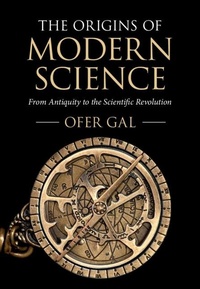
The Origins of Modern Science
From Antiquity to the Scientific Revolution
Published on 31. March 2021
978-1-108-24714-6 (ISBN)
Description

The Origins of Modern Science is the first synthetic account of the history of science from antiquity through the Scientific Revolution in many decades. Providing readers of all backgrounds and students of all disciplines with the tools to study science like a historian, Ofer Gal covers everything from Pythagorean mathematics to Newton's Principia, through Islamic medicine, medieval architecture, global commerce and magic. Richly illustrated throughout, scientific reasoning and practices are introduced in accessible and engaging ways with an emphasis on the complex relationships between institutions, beliefs and political structures and practices. Readers gain valuable new insights into the role that science plays both in history and in the world today, placing the crucial challenges to science and technology of our time within their historical and cultural context.
Reviews / Votes
'Ofer Gal is a superb guide to the history of science. Students will appreciate his clarity, well-chosen illustrations and strong thematic exposition. Instructors will delight in his erudition, synthetic power and fresh historical vision. All can read this book with pleasure and profit. It is the gold standard in texts on science from antiquity to Newton.' John W. Servos, Amherst College 'Densely packed throughout with provocative analyses and a wealth of powerful concepts, The Origins of Modern Science is a history on a grand scale that is destined to become a standard work. Gal's narrative exemplifies a rare balance between history and historiography, sophistication and accessibility, text and context, while consistently emphasizing the human component at the heart of this millennia-long saga.' Victor Boantza, University of Minnesota 'In The Origins of Modern Science: From Antiquity to the Scientific Revolution, Dr. Ofer Gal has presented the history of science through scientific ideas, concurrent practices and principles of knowledge. The book presents a trove of information on science as 'particular, local and historical,' a remarkable source and perspective certain to inspire the interests of readers as well as those of instructors in their history of science classes.' Caterina Agostini, Rutgers University (formerly North Carolina State) 'A fascinating book detailing the rise of modern science in a broader perspective as a human intellectual achievement, one that was contingent on the fallible thoughts and actions of real people, rather than the inevitable triumph of disembodied ideas. Beginning with antiquity, the book does not shy away from difficult questions of the relation of religion and magic to early modern science, and produces a rich account of the development of science through the high Middle Ages to the publication of Newton's Principia. Of particular interest is the original integration of the various ways in which knowledge was thought to be made during these periods. This book deserves to be widely read, not only by historians of science but by a much broader audience interested in the generation of knowledge as a human phenomenon.' Andrew Gregory, University College London 'In this very wide-ranging and superbly illustrated account, Ofer Gal offers an original and instructive survey of the development of the sciences from classical and medieval periods to early modernity. In well-organized histories of medicine and mechanics, astronomy and experiment, this work cleverly shows in persuasive detail the intricate relations between the sciences and their history. Designed to provide a usable textbook for students with background in history and in the sciences, the work explains clearly the relationship between theoretical knowledge and practical know-how, and between the complex and fascinating emergence of modern sciences and the long development of different techniques and understandings of nature.' Simon Schaffer, University of Cambridge 'This book is an excellent overview of the early history of science and covers the ideas and personalities of the time in a highly readable format. Particularly useful are the references, primary sources, and suggestions for further reading. It deserves to be well thumbed by all with an interest in the history of science and medicine.' Arpan K. Banerjee, Hektoen International JournalMore details
Language
English
Place of publication
Cambridge
United Kingdom
Target group
College/higher education
Professional and scholarly
Illustrations
Worked examples or Exercises
File size
16,08 MB
ISBN-13
978-1-108-24714-6 (9781108247146)
Copyright in bibliographic data and cover images is held by Nielsen Book Services Limited or by the publishers or by their respective licensors: all rights reserved.
Schweitzer Classification
Other editions
Additional editions
Book
02/2021
Cambridge University Press
€126.30
Shipment within 15-20 days
Person
Content
1. Cathedrals; 2. Greek Thought; 3. The Birth of Astronomy; 4. Medieval Learning; 5. The Seeds of Revolution; 6. Magic; 7. The Moving Earth; 8. Medicine and the Body; 9. The New Science; 10. The Road to the Principia.
