

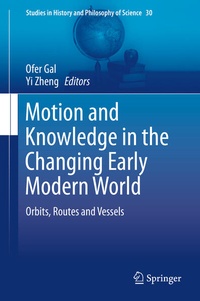
Motion and Knowledge in the Changing Early Modern World
Description

This volume comprises studies of the early modern drama of motion and transformation of knowledge. It is unique in taking its global nature as fundamental and contains studies of the theme of motion and knowledge in China, Europe and the Pacific from the 16th to the 18th century.
People living around the turn of the 17 th century were experiencing motion in ways beyond the grasp of anyone less than a century earlier. Goods and people were crossing lands and oceans to distances never envisioned and in scales hardly imaginable by their recent predecessors. The earth itself has been set in motion and the heavens were populated by a whole new array of moving objects: comets, moons, sun spots. Even the motion of terrestrial objects-so close at hand and seemingly obvious-was being thoroughly reshaped. In the two centuries to follow, this incessant, world-changing motion would transform the creation, interpretation and dissemination of knowledge and the life and experiences of the people producing it: savants, artisans, pilots, collectors.
More details
Other editions
Additional editions
Content
Note on Contributors.- Global Motion and the Production of Knowledge; Ofer Gal and Yi Zheng.- Part I. The Savant in Motion and at Home.- Two Bohemian Journeys: Real, Imaginary and Idealized Voyages at the Turn of the 17 th Century; Ofer Gal.- Xu Xiake's Travel Notes : Motion, Records and Genre Change; Yi Zheng.- Those who stayed: English Chorography and the Elizabethan Society of Antiquaries; Claire Kennedy.- Part II. Dialogues and Skeptics-Traversing Geography and Cultures.- 'How very little he can learn': exotic visitors and the transmission of cultural knowledge in 18 th Century London; Vanessa Smith.- Diplomatic Journeys and Medical Brush Talks: Eighteenth-Century Dialogues between Korean and Japanese Medicine; Daniel Trambaiolo.- The Circulation of Sericulture Knowledge through Temple Networks and Cognitive Poetics in 18 th Century Zhejiang; Philip S. Cho.- Part III. Motion as Free Thinking and Social Circulation.- Travel as a basis for atheism: Free-Thinking as Deterritorialization in the Early Radical enlightenment; Charles T. Wolfe.- Late Traditional Chinese Civilization in Motion, 1400-1900; Benjamin A. Elman.- Index.
